The complete archived text is retained here, including details that may extend beyond the inquiry blueprint.
Read the full archived lesson text
•
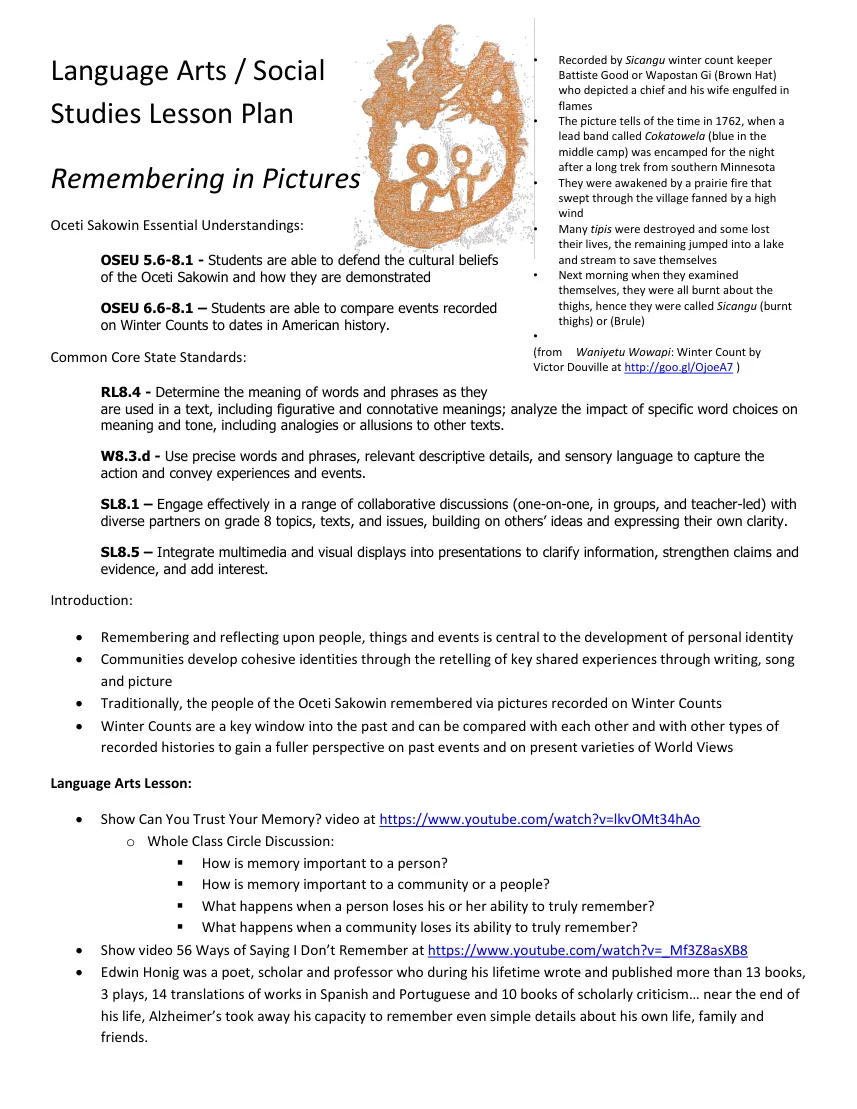
Recorded by Sicangu winter count keeper
Battiste Good or Wapostan Gi (Brown Hat)
who depicted a chief and his wife engulfed in
flames
•
The picture tells of the time in 1762, when a
lead band called Cokatowela (blue in the
middle camp) was encamped for the night
after a long trek from southern Minnesota
•
They were awakened by a prairie fire that
swept through the village fanned by a high
wind
•
Many tipis were destroyed and some lost
their lives, the remaining jumped into a lake
and stream to save themselves
•
Next morning when they examined
themselves, they were all burnt about the
thighs, hence they were called Sicangu (burnt
thighs) or (Brule)
•
(from
Waniyetu Wowapi: Winter Count by
Victor Douville at http://goo.gl/OjoeA7 )
Language Arts / Social
Studies Lesson Plan
Remembering in Pictures
Oceti Sakowin Essential Understandings:
OSEU 5.6-8.1 - Students are able to defend the cultural beliefs
of the Oceti Sakowin and how they are demonstrated
OSEU 6.6-8.1 – Students are able to compare events recorded
on Winter Counts to dates in American history.
Common Core State Standards:
RL8.4 - Determine the meaning of words and phrases as they
are used in a text, including figurative and connotative meanings; analyze the impact of specific word choices on
meaning and tone, including analogies or allusions to other texts.
W8.3.d - Use precise words and phrases, relevant descriptive details, and sensory language to capture the
action and convey experiences and events.
SL8.1 – Engage effectively in a range of collaborative discussions (one-on-one, in groups, and teacher-led) with
diverse partners on grade 8 topics, texts, and issues, building on others’ ideas and expressing their own clarity.
SL8.5 – Integrate multimedia and visual displays into presentations to clarify information, strengthen claims and
evidence, and add interest.
Introduction:
•
Remembering and reflecting upon people, things and events is central to the development of personal identity
•
Communities develop cohesive identities through the retelling of key shared experiences through writing, song
and picture
•
Traditionally, the people of the Oceti Sakowin remembered via pictures recorded on Winter Counts
•
Winter Counts are a key window into the past and can be compared with each other and with other types of
recorded histories to gain a fuller perspective on past events and on present varieties of World Views
Language Arts Lesson:
•
Show Can You Trust Your Memory? video at https://www.youtube.com/watch?v=lkvOMt34hAo
o Whole Class Circle Discussion:
How is memory important to a person?
How is memory important to a community or a people?
What happens when a person loses his or her ability to truly remember?
What happens when a community loses its ability to truly remember?
•
Show video 56 Ways of Saying I Don’t Remember at https://www.youtube.com/watch?v=_Mf3Z8asXB8
•
Edwin Honig was a poet, scholar and professor who during his lifetime wrote and published more than 13 books,
3 plays, 14 translations of works in Spanish and Portuguese and 10 books of scholarly criticism… near the end of
his life, Alzheimer’s took away his capacity to remember even simple details about his own life, family and
friends.
o Whole Class Circle Discussion:
Do you know anyone who has lost his or her ability to remember?
How does this impact those around them?
•
I Remember… poem activity
o Word lists
o Poem lines
Social Studies Lesson:
•
View Dr. Craig Howe video on Winter Counts at http://www.lc-
triballegacy.org/video.php?vid=957&query=Winter%20Counts
o Whole Class Circle Discussion:
What’s the difference between “history” you’ve experienced and history you’ve only read
about?
What kinds of events became a part of the Winter Counts?
Why do you think the Lewis & Clark Expedition is so important in American History but doesn’t
amount to even a “blip” in time for the Lakota people?
•
Visit Smithsonian Winter Count site at http://wintercounts.si.edu/index.html View 1800-1803 Counts.
o Whole Class Circle Discussion:
What do you notice looking across different Winter Counts in the same year?
What things seem to have been very memorable in these years?
Why do you think they were?
•
Distribute Lone Dog Winter Count Handouts (found at http://history.sd.gov/FurTrade.pdf )
o Whole Class Circle Discussion
Which pictographs do you find especially interesting? Why?
What was happening at this time? What important changes were the Lakota people
experiencing?
Do you know what was going on on the rest of the North American continent?
•
Students complete their own Winter Count pictograph on one of the important people, things or events on their
“I Remember…” poem, and are invited to share with class the Picture, title and additional details. Preface
activity by reading The Keeper handout.
I Remember…
List five people who are important to you:
1
2
3
4
5
List five objects that are important to you:
A
B
C
D
E
List five important events that happened to you
ONE
TWO
THREE
FOUR
FIVE
I Remember…
I remember...(1)
he or she…
I remember...(A)
it…
I remember...(ONE)
when…
I remember...(2)
he or she…
I remember...(B)
it…
I remember...(TWO)
when…
I remember...(3)
he or she…
I remember...(C)
it…
I remember...(THREE)
when…
I remember...(4)
he or she…
I remember...(D)
it…
I remember...(FOUR)
when…
I remember...(5)
he or she…
I remember...(E)
it…
I remember...(FIVE)
when…
The Keeper
Each tiyospaye had a designated winter count historian or keeper. As the
community historian, this member of the tribe—always a man—was responsible
for maintaining the winter count and remembering its stories. Before recording
the past year on the count, the keeper consulted with a council of elders to choose
an appropriate event by which to remember the year. The even chosen was not
considered the most important event of the past year, only the most memorable.
The keeper was also responsible for retelling the tiyospaye’s history at various
times throughout the year. During ceremonies or other social gatherings, he would
bring out the count and use it as a visual reference to name the years. In this way,
the members of the band knew their history and could use particular years to
recall events in their own lives, such as the year of someone’s birth. It was
important that the keeper, in consulting with the community elder’s, chose events
that were easily remembered by the entire tribe.
When the keeper could no longer fulfill his role as historian, the duty was passed
on to another male member of the tiyospaye—usually a son or nephew—whose
first obligation was to copy his predecessor’s winter count. With the arrival of the
Euro-American people which brought devastating change for the western tribes
keepers began to add written captions to their pictograph images. By the end of
the 19th century, some winter counts were only written texts. Eventually
pictographs were replaced by written years-names as the device to record
community history.
Sources:
Carkeek-Cheney, Roberta; Sioux Winter Count: A 131-Year Calendar of Events, Naturegraph Publishers, Inc.,
Happy Camp, CA, 1998.
Horse Capture, Geoge, P., Vitart, Anne, Waldberg, Michel, West, Richard W., Jr.; Robes of Splendor: Native North
American Painted Buffalo Hides, The New Press, New York, NY, 1993.
http://aktalakota.stjo.org/site/News2?page=NewsArticle&id=8994
I Will Remember…
Title:
Fur Trade: Bridging Two Worlds
South Dakota State Historical Society Education Kit
48
Background Information:
Europeans divided time into days, weeks, months and years. The Sioux marked time by counting
nights, moons, winters, and generations. Designing a symbol for each winter and putting the symbols
down in chronological order on hide, paper, or cloth created a winter count. The figures and symbols
on a winter count depict a memorable event for each year. They serve as a kind of diary for a tribe.
The symbols on a winter count are meaningless unless someone knows the history and stories the
symbols represent. It was the count keeper’s job to tell the winter count stories. Wintercounts aided
the memory of the tribal historian by providing a symbol for an event during a particular year. The
memory of that event then triggered other memories.
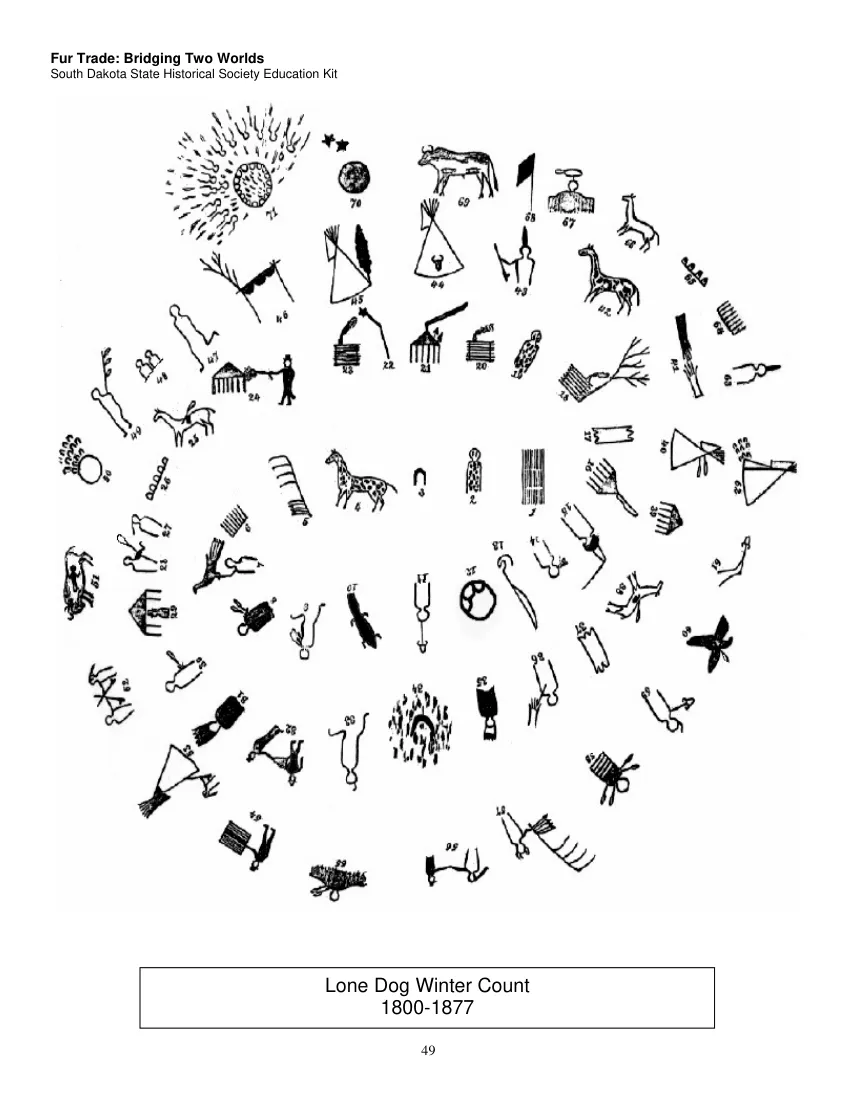
Lone Dog’s winter count covers the years 1800-1871. Its symbols are organized in a spiral,
starting at the center and working counter-clockwise. Lone Dog probably consulted with his tribe’s
elders for their advice before choosing each symbol.
Activity Steps:
1. Display the overhead of Lone Dog’s Winter Count on the projector or show the poster of the winter
count to the participants and explain what a winter count is. Ask if they see any symbols that might
deal with fur traders. (Some examples would be numbers 2, 3, 18, 20, 21, 23, 29, 32, 56, and 69. )
The explanations for the symbols can be found on the Wintercount Key. Why would the building of a
trading post be the most important event of the year?
2. Give each participant a piece of paper and explain that they will be creating their own winter count.
Each participant will need to think of a symbol that best represents each year of their life, or whatever
years they choose to depict – doing a symbol for each year in school, for example. Participants draw
their counts on the paper. Encourage them to be thoughtful and creative.
3. Once completed, the participants can share their counts with the rest of the group, sharing the
stories that each of their symbols represents.
Fur Trade: Bridging Two Worlds
South Dakota State Historical Society Education Kit
49
Lone Dog Winter Count
1800-1877
Fur Trade: Bridging Two Worlds
South Dakota State Historical Society Education Kit
50
WINTERCOUNT KEY
1.
1800-1801
Thirty Dakotas were killed by Crow Indians. In this chart, black lines always
signify the death of Dakotas killed by their enemies.
2.
1801-1802
A human being with many marks was always the sign of an epidemic or some
disease such as small pox or measles. The interpretation is, “many died of small pox.”
3.
1802-1803
A Dakota stole horses with shoes on. This means they would have had to stolen
them directly from the Europeans or from some other Indians who had before obtained them
from the Europeans as the Indians never shod their horses.
4.
1803-1804
They stole “curly horses” or horses with curly hides, from the Crows.
5.
1804-1805
The Dakota had a calumet dance and then off on a war expedition.
6.
1805-1806
The Crows killed eight Dakotas.
7.
1806-1807
A Dakota kills an Arikara (Ree) just as he was about to capture an eagle.
8.
1807-1808
Red-Coat, a chief, was killed.
9.
1808-1809
The Dakota who had killed the Ree shown in this record for 1806-1807 was killed
himself by the Rees.
10.
1809-1810
A chief, Little Beaver, set fire to a trading store and was killed.
11.
1810-1811
This picture has to do with Black Stone, the medicine man. The symbol is a white
buffalo skull over his head.
12.
1811-1812
The circle is a dirt lodge, while the interior circles represent heads. Interpreted, it
shows that 27 Arikaras or Mandans were killed in a dirt lodge by the Dakotas.
13.
1812-1813
The device is a lasso. Wild horses were first run down and caught by the
Dakotas.
14.
1813-1814
Whooping cough killed many.
15.
1814-1815
A Dakota kills an Arapaho in his lodge. The symbol represents a tomahawk
stuck in the man’s skull.
16.
1815-1816
The Sans Arcs make a dirt lodge at Peoria Bottom, near Pierre.
17.
1816-1817
“Buffalo were plenty.” The symbol crudely represents a side of buffalo.
18.
1817-1818
A trading post of dry timber was built at Ft. Pierre by Joseph La Frombois.
Fur Trade: Bridging Two Worlds
South Dakota State Historical Society Education Kit
51
19.
1818-1819
The measles broke out and many died. (Note that the small pox epidemic
represented in 1801-1802 showed larger marks on a human body.)
20.
1819-1820
Another trading post was built. This time by La Conte also at Ft. Pierre.
21.
1820-1821
The trader, La Conte, gave Two Arrow a war dress for his bravery.
22.
1821-1822
This symbol represents a very brilliant meteor falling to earth.
23.
1822-1823
Another trading house was built at the mouth of the Bad River.
24.
1823-1824
The event portrayed is the attack of the US forces, accompanied by the Dakotas,
upon the Arikara villages.
25.
1824-1825
Swan, chief of the Two-Kettle tribe, had all of his horses killed.
26.
1825-1826
Many Indians drowned in a horrible flood on the Missouri River. The symbol
suggests heads appearing above a line of water.
27.
1826-1827
Indians died a strange death after eating a rotting buffalo carcass while on the
warpath.
28.
1827-1828
Dead Arm, a Dakota, was stabbed by a Mandan and lost lots of blood.
29.
1828-1829
A white man named Chadron built a dirt lodge.
30.
1829-1830
A Yanktonai Dakota was killed by Bad-Arrow, or “Blackfoot” Lakota.
31.
1830-1831
Twenty-three were killed in a bloody battle with the Crows.
32.
1831-1832
One European named Le Beau, killed another named Kermel.
33.
1832-1833
Lone Horn broke his leg on a buffalo hunt.
34.
1833-1834
The great meteor shower observed all over the US on the night of Nov. 12 of that
year.
35.
1834-1835
The chief Medicine Hide was killed.
36.
1835-1836
Lame Deer shot a Crow Indian with an arrow, drew it out, and show him again
with the same arrow.
37.
1836-1837
Plenty of buffalo again.
38.
1837-1838
One hundred elk were killed on a big hunt.
39.
1838-1839
A dirt lodge was built for Iron Horn.
Fur Trade: Bridging Two Worlds
South Dakota State Historical Society Education Kit
52
40.
1839-1840
The Dakotas killed an entire village of Snake or Shoshoni Indians.
41.
1840-1841
The Dakotas made peace with the Cheyenne.
42.
1841-1842
Feather-in-the-Ear stole 30 spotted ponies.
43.
1842-1843
One Feather raised a large war party against the Crows.
44.
1843-1844
The Sans Arcs made medicine to bring the buffalo.
45.
1844-1845
The Mineconjous built a pine fort.
46.
1845-1846
Plenty of buffalo meat, which is represented as hung upon poles and trees to dry.
47.
1836-1847
Broken Leg died.
48.
1847-1848
Two Man was killed.
49.
1848-1849
Humpback was killed.
50.
1849-1850
The Crows stole a large drove of horses (it is said 800) from the Brules.
51.
1850-1851
An old woman was found in the belly of a killed buffalo cow.
52.
1851-1852
Peace with the Crows.
53.
1852-1853
The Nez Perce came to Lone Horn’s lodge at midnight.
54.
1853-1854
Striped blankets brought by Europeans to the Indians.
55.
1854-1855
Brave Bear was killed.
56.
1855-1856
General Harney, with a hat, makes a treaty with the Dakotas. This was at Ft.
Pierre in the spring of 1856.
57.
1856-1857
A man with four horns holds out the same kind of ornamented pipestem shown in
the character for 1804-1805, it being his badge of office.
58.
1857-1858
The Dakotas killed a Crow woman. She is pierced by four arrows, and the peace
made with the Crows in 1851-52 seems to have been short lived.
59.
1858-1859
Lone Horn made buffalo “medicine,” doubtless on account of the scarcity of that
animal.
60.
1859-1860
Big Crow, a Dakota chief, was killed by the Crows.
61.
1860-1861
The elk makes medicine.
Fur Trade: Bridging Two Worlds
South Dakota State Historical Society Education Kit
53
62.
1861-1862
Buffalo were so plentiful that their tracks came close to the tipis.
63.
1862-1863
Red Feather, a Minneconjou, was killed.
64.
1863-1864
Eight Dakotas were killed by the Crows.
65.
1864-1865
Four Crows were killed by the Dakotas.
66.
1865-1866
Many horses died for want of grass.
67.
1866-1867
Swan, father of “White Swan,” died.
68.
1867-1868
The flag indicates the treaty negotiations at Ft. Laramie that year.
69.
1868-1869
Texas cattle were brought into the country.
70.
1869-1870
There was an eclipse of the sun in August 1869.
71.
1870-1871
The circle is a Crow fort, nearly surrounded, and the weapons used were guns
for it is bullets that are flying. All but one of the Crows was killed in fact, and 14 Dakotas.
Source provenance: Full_Winter_Count_Lessons.pdf · WoLakota Project archive. Reformatted for this collection.