The complete archived text is retained here, including details that may extend beyond the inquiry blueprint.
Read the full archived lesson text
8th Grade Earth Science Lesson Plan
“Our Relatives…the Stars”
8th Grade Earth Science Standards
8.E.2.1: Students are able to compare celestial bodies within the solar system using
composition, size, and orbital motion.
Indicator 2: Analyze essential principles and ideas about the composition and structure
of the universe.
Common Core
Speaking and Listening:
SL.9.1 Initiate and participate effectively in a range of collaborative discussions (one-on-one, in
groups, and teacher-led) with diverse partners on grades 9–10 topics, texts, and issues, building
on others’ ideas and expressing their own clearly and persuasively.
OSEU 3:
The origin, thought and philosophy of the Oceti Sakowin continues in the contemporary
lifestyles of Tribal members. Tribal cultures, traditions and languages are incorporated and are
observed by many Tribal members both on and off the reservations.
OSEU 3.2.3-5 and 9-12: Students are able to describe the relationship between the sacred sites,
star knowledge and creation stories. Students are able to use the star knowledge to identify the
sacred sites within the Black Hills.
Lesson:
link to the Prezi: http://prezi.com/sajf1qyxrcgg/?utm_campaign=share&utm_medium=copy
•
Watch “We are Dead Stars” video http://youtu.be/UUo-Q8hhvB0
o Questions for circle discussion
How does it make you feel to think about your body and everything about you being
made of “stardust”?
Have you ever lain down under a starry night sky to watch the stars? What goes
through your mind if you ever do that?
In what ways do the stars “rain down energy” for free on us? Do you ever pause to
be thankful for all the “free stuff” you get just for being a human being living right
now and here? How might being thankful like that change the way people live?
View clip from “Lakota Star Knowledge” https://www.youtube.com/watch?v=VyK1Oqoqcg8
o Questions for circle discussion
Why do you think “the year the stars fell” (Nov 12-13, 1833—the Leonid Meteor
Showers) would be so important on almost every Winter Count?
In what ways are the stars and their movements “ordered” or predictable?
What do you already know about the Lakota belief that the stars are relatives?
What sorts of things might you think in 1833 as a Lakota person watching the “stars”
fall?
•
View Duane Hollow Horn Bear story, “Star Boy and the Seven Sisters”
http://youtu.be/uBOervlM4ag
o Questions for circle discussion
Can you name all the various relatives who assist the people in this story?
What lessons about the stars do you learn from this story?
What lessons about being away from home do you learn from this story?
•
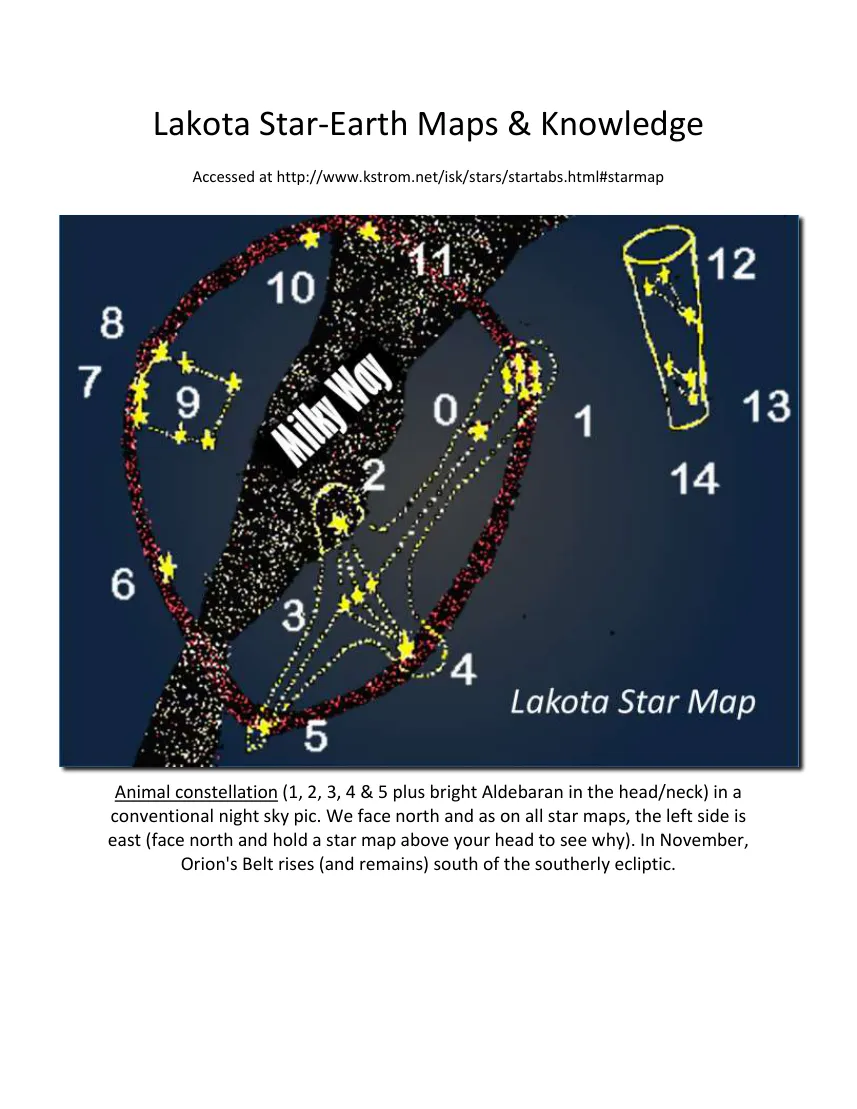
Explore the Lakota Star Map labeled in the Prezi
What is your understanding of “"What is in the stars is on earth and what is on earth
is in the stars" & “As above, so below”?
Why do you think people of almost EVERY culture have stories and characters
associated with the stars?
•
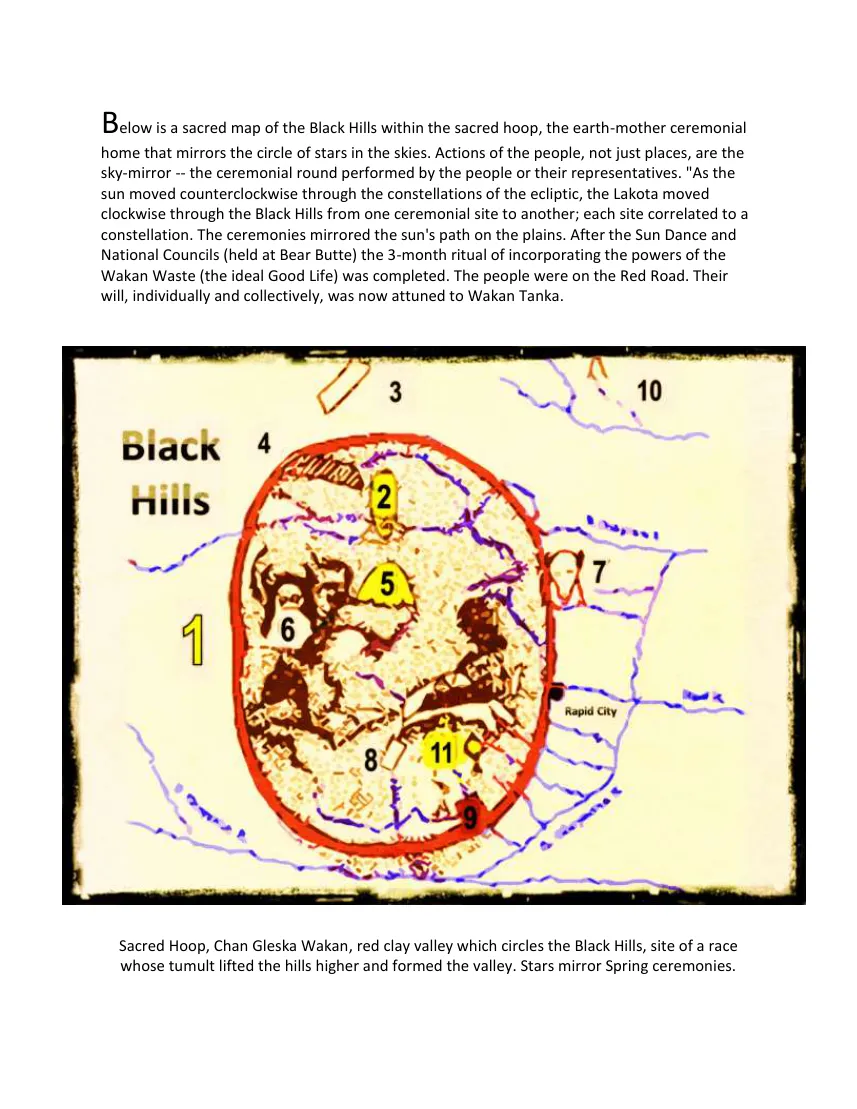
Explore the Sacred Places Map labeled in the Prezi
How many of these sacred places have you visited?
What other sacred places are there in this region? Do you know of others?
How did the orderliness of the stars help the Lakota people order their ceremonies?
How might the “falling of the stars” impact Lakota ceremonial life?
•
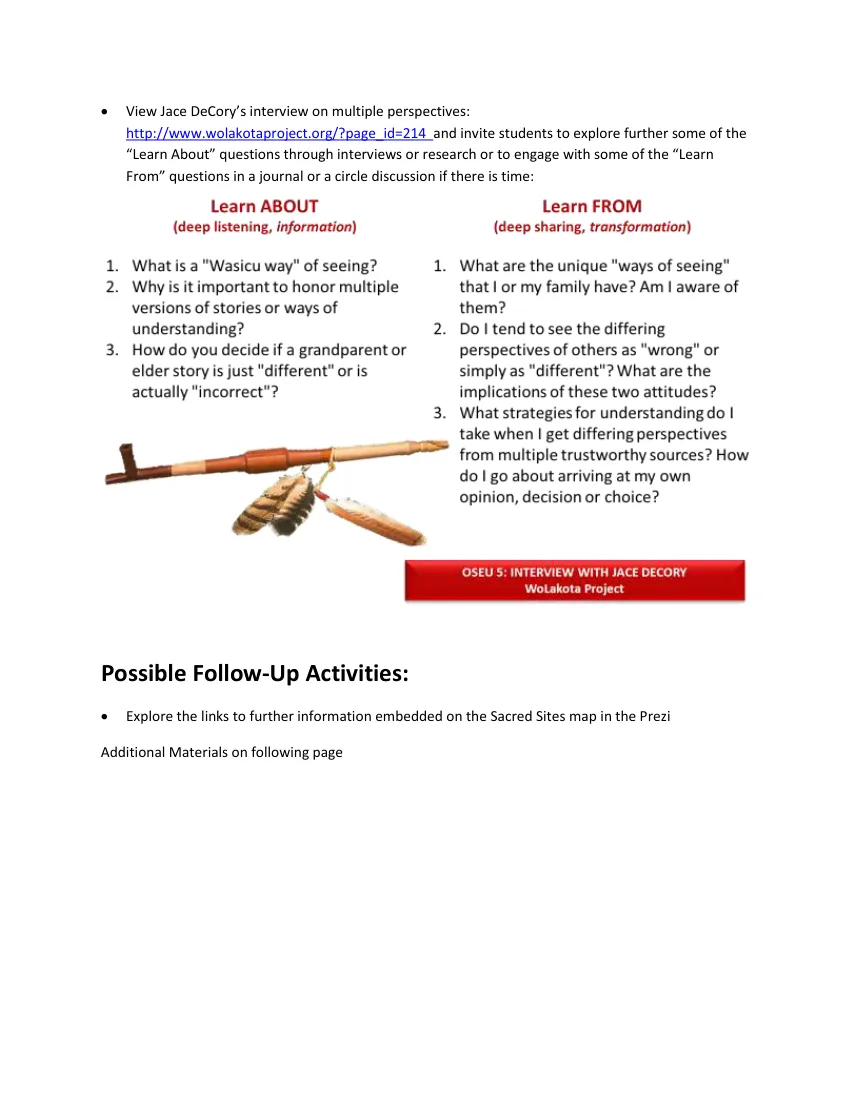
View Jace DeCory’s interview on multiple perspectives:
http://www.wolakotaproject.org/?page_id=214 and invite students to explore further some of the
“Learn About” questions through interviews or research or to engage with some of the “Learn
From” questions in a journal or a circle discussion if there is time:
Possible Follow-Up Activities:
•
Explore the links to further information embedded on the Sacred Sites map in the Prezi
Additional Materials on following page
Lakota Star-Earth Maps & Knowledge
Accessed at http://www.kstrom.net/isk/stars/startabs.html#starmap
Animal constellation (1, 2, 3, 4 & 5 plus bright Aldebaran in the head/neck) in a
conventional night sky pic. We face north and as on all star maps, the left side is
east (face north and hold a star map above your head to see why). In November,
Orion's Belt rises (and remains) south of the southerly ecliptic.
Numbers on the Star Map refer to stars and constellations. The red track -- Ki Inyanka Ochanku,
the Sacred Hoop -- is traced by certain bright stars: the Pleiades (7 sisters), Rigel, Sirius, Castor-
Pollux, Auriga B, Capella.
No.
Name
Astron. name
Represents
0
----
Aldebaran
First magnitude star lying in the bright
Hyades cluster (Taurus) on backbone line
to Pleiades (Animal's head)
1
Tayamnipa
Pleiades
Head of constellation "Animal" (perhaps
Buffalo)--Harney Peak. Also known as
Wincincala Sakowin (7 little girls)
2
Tayamnitucuhu
Betelgeuse
With Rigel, Animal's ribs
3
Tayamnicankahu
Orion's Belt
Animal's backbone
4
Tayamnitucuhu
Rigel
Animal's other rib, Hoop marker
5
Tayamnisinte
Sirius
Animal's tail, Hoop marker; Animal's
name means "born of 3 relatives"
6
----
Procyon
A Hoop marker
7
Matotipila marker
Castor ("Twins")
Constellation is Bear's Tipi, aka Devil's
Tower
8
Matotipila marker
Pollux ("Twins")
Mato Tipila and Hoop marker
9
Mato Tipila
constellation
8 of the 12 stars in
Gemini
Constellation is Bear Tipi, now Grey
Buffalo Horn (aka Devil's Tower), place of
solstice Sun Dance
10
----
Beta Aurigae
Hoop marker
11
----
Capella
Hoop north marker
12
Part of Chanshasha
Ipusye
Triangulum
Part of Dried Willow constellation, Spring
Equinox, Pipe ceremony
13
Part of Chanshasha
Ipusye
Aries
Dried Willow, People are in the winter
camps, Pipe Ceremony begins round of
spring ceremonies
14
Chanshasha Ipusye
----
Standing for Pipe (red willow used in
smoking); spring renewal ceremonies in
Black Hills
--Sun and Star Constellations and Time--explains how sun is "in" a constellation, and how the
age of these ceremonies can be known from that.
"What is in the stars is on earth and what is on earth is in the stars." This idea unites the
ceremonial map in the circle of stars, not only with sites in the Black Hills, but with a round of
ceremonial actions at sacred sites there, ending with a Sun Dance at the Bear's Lodge (Devil's
Tower) June 21 (summer solstice). "As above, so below" that is, what occurs in the stars is
mirrored on earth is a very old idea now forgotten by Western culture. It is expressed in
Alchemy and the even older idea that humankind and our events are a microcosmic mirror of
the macrocosm. The Lakota elders believed this, and some of that knowledge did survive.
Below is a sacred map of the Black Hills within the sacred hoop, the earth-mother ceremonial
home that mirrors the circle of stars in the skies. Actions of the people, not just places, are the
sky-mirror -- the ceremonial round performed by the people or their representatives. "As the
sun moved counterclockwise through the constellations of the ecliptic, the Lakota moved
clockwise through the Black Hills from one ceremonial site to another; each site correlated to a
constellation. The ceremonies mirrored the sun's path on the plains. After the Sun Dance and
National Councils (held at Bear Butte) the 3-month ritual of incorporating the powers of the
Wakan Waste (the ideal Good Life) was completed. The people were on the Red Road. Their
will, individually and collectively, was now attuned to Wakan Tanka.
Sacred Hoop, Chan Gleska Wakan, red clay valley which circles the Black Hills, site of a race
whose tumult lifted the hills higher and formed the valley. Stars mirror Spring ceremonies.
Numbers on the Black Hills Map refer to sacred sites. The red track -- Ki Inyanka Ocanku, the
Sacred Hoop -- was created by a race run by 2-legged and 4-legged.
1
Ki Iyanka
Ochanku
Race Track Valley
Race Track or Sacred Hoop bounding
ceremonial area, mirrored in stars.
2
Mata Tipi Paha
Bear's Tipi, also Grey
Buffalo Horn (Devil's
Tower)
Site of June 21 Sun Dance that concludes
Spring Sacred Ceremonial round.
3
Paha Zipela
Slim Buttes
----
4
Paha Sapa
Black Butte
---- .
5
Pe Sla
Old Baldy
Center of Black Hills, Welcome back all
life in peace (Okislataya Wowahwata --
Peace at a Bare Spot, 2nd stage of spring
ceremonies
6
Hinhan Kaga
Paha
Ghost (Owl) Butte
Spirits of dead start path on Milky Way.
7
Mato paha
Bear Butte
Sacred underground emergence origin;
desecrated by park site
8
Mnikata
Hot springs
For sacred purifications, now desecrated
by tourist operations.
9
Pte tali yapa
Buffalo Gap
Sacred entrance/exit to Hoop
10
Wakinyan Paha
Thunder Butte
Welcoming back thunders (Wakinyan)
ceremony, when sun is in Pleiades, Yate
Iwakicipi ceremony
11
----
Harney Peak
When the sun is in Pleiades, the sacred
round starts from Harney Peak, or any of
several buttes.
MAP CORRELATIONS: If you jumped back & forth between Star and Hills maps and were puzzled, you're being too
literal, looking for a mirror that's like a 1-to-1 matched diagram. Both the stars in the circle and the Black Hills
contain time in their mirrors of each other, but not in the same way. People and their ceremonies are a part of the
time-of-the-hills. The relative motions of the sun (and moon and certain planets) are time-in-the-stars.
When the sun is "in" certain constellations, it is time for certain ceremonies to begin. Old Baldy, a bare place in the
Hills marks the center of the ceremonial geography -- but there is no star or constellation to mark the starry circle's
center in the sky, the correspondence is 2 different kinds of empty places. (Although in the 11th century, when the
light from the Crab Nebula Supernova reached earth so the star was even visible in daytime, it occupied this empty
center.)
There's a red clay valley round the Black Hills (not so neat a circle as the elders drew above) but the Red Race Track
in the star map is only indicated by certain bright stars, and is imagined. Constellations for any culture (all have
them) aren't outlined by stars like so many connect-the-dots pix, they are imaginative projections on scatters of
bright lights. The Lakota sky/earth mirroring is spiritual, metaphorical, symbolic, artistic -- not a literal mapping of 2
diagrams onto each other.
CREDITS: http://www.kstrom.net/isk/stars/startabs.html#starmap
Source provenance: 8th-Grade-Our-Relatives-the-Stars-Lesson.pdf · WoLakota Project archive. Reformatted for this collection.