Grade inferred from the archived academic standard codes; check suitability for your students.
Archived standards are preserved as originally published and may differ from current standards.
Compelling question
Why is it important to understand that differing perspectives from trustworthy sources may be
different but not wrong?
Standards & practices
OSEU 5.1 Identify elements of Oceti Sakowin culture within oral tradition, written accounts, and
primary source information, and compare them to written accounts by mainstream historians.
HISTORY 4.H.5.1 Infer the intended audience and purpose of a historical source from information
within the source itself
Staging the question
Is it “wrong” or is it just “different?”
Supporting inquiries
Supporting question 1
How is it possible to have two different perspectives of
the same thing?
Formative performance task
Each set of student partners is given the same picture.
Students sit back to back. One student describes the
picture to his or her partner while the partner sketches
what is being described. Then they compare the sketch to
the picture and note parts that were “understood”
differently, resulting in different “perspectives.” Sketches
across the classroom can be quickly compared, noting
differences also. Partners reverse roles with new pictures
and repeat the entire procedure.
Differing perspectives could also be illustrated using the
old “Gossip” game.
Featured sources
Not specified in the archived lesson.
Supporting question 2
How does Jace DeCory say the people of the Oceti
Sakowin viewed stories that were told a bit differently by
trusted elders?
Formative performance task
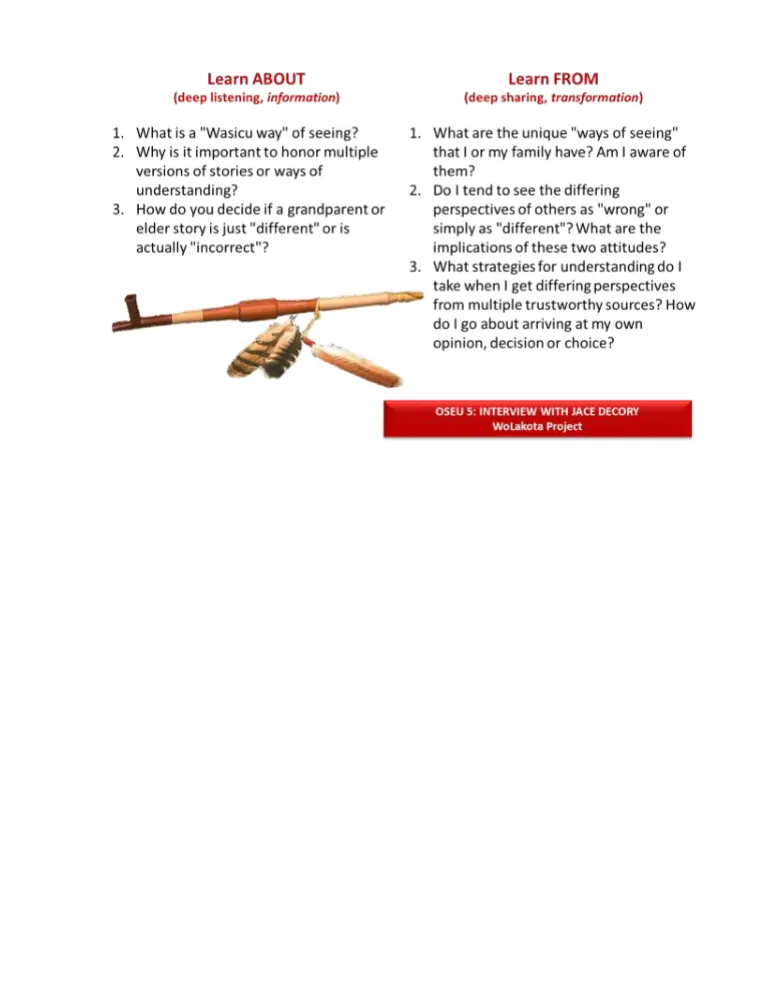
Watch the video and discuss the supporting question
(above). Then discuss Learn ABOUT question 3 (provided
below).
Structure student role play to compare what can happen
in the following two scenarios in a discussion: (1)
Someone has the attitude that anyone who disagrees is
WRONG; (2) Someone has the attitude that those who
disagree just think DIFFERENTLY.
Each student writes on an EXIT TICKET (designed by the teacher) what he or she
learned from the role play and/or other class activities. The goal is to see if students
realize the importance of respecting differing perspectives that come from trustworthy
sources.
The complete archived text is retained here, including details that may extend beyond the inquiry blueprint.
Read the full archived lesson text
Inquiry Design Model (IDM) Blueprint™
“Different Perspectives” | OSEU 5: Oral Tradition & Story
Compelling
Question
Why is it important to understand that differing perspectives from trustworthy sources may be
different but not wrong?
Standards and
Practices
OSEU 5.1 Identify elements of Oceti Sakowin culture within oral tradition, written accounts, and
primary source information, and compare them to written accounts by mainstream historians.
HISTORY 4.H.5.1 Infer the intended audience and purpose of a historical source from information
within the source itself
Staging the
Question
Is it “wrong” or is it just “different?”
Supporting Question 1
Supporting Question 2
How is it possible to have two different perspectives of
the same thing?
How does Jace DeCory say the people of the Oceti
Sakowin viewed stories that were told a bit differently by
trusted elders?
Formative Performance Task
Formative Performance Task
Each set of student partners is given the same picture.
Students sit back to back. One student describes the
picture to his or her partner while the partner sketches
what is being described. Then they compare the sketch to
the picture and note parts that were “understood”
differently, resulting in different “perspectives.” Sketches
across the classroom can be quickly compared, noting
differences also. Partners reverse roles with new pictures
and repeat the entire procedure.
Differing perspectives could also be illustrated using the
old “Gossip” game.
Watch the video and discuss the supporting question
(above). Then discuss Learn ABOUT question 3 (provided
below).
Structure student role play to compare what can happen
in the following two scenarios in a discussion: (1)
Someone has the attitude that anyone who disagrees is
WRONG; (2) Someone has the attitude that those who
disagree just think DIFFERENTLY.
Featured Sources
Featured Sources
http://www.wolakotaproject.org/oseu-five/oseu-five-
interview-with-jace-decory/
Summative
Performance
Task
Argument
Each student writes on an EXIT TICKET (designed by the teacher) what he or she
learned from the role play and/or other class activities. The goal is to see if students
realize the importance of respecting differing perspectives that come from trustworthy
sources.
Extension
Taking Informed
Action
Original page 3 · illustrations and source materials