Grade inferred from the archived academic standard codes; check suitability for your students.
Archived standards are preserved as originally published and may differ from current standards.
Compelling question
How did the circle of kinship that is important to the people of the Oceti Sakowin affect their early
economy, and how does that economy differ from Western capitalism?
Standards & practices
OSEU 4.2 – Describe the traditional behavior patterns, codes of respect and values promoted
within the Oceti Sakowin tiospaye.
4.SL.1 Engage effectively in a range of collaborative discussions.
Economics 4.E.1.1 Discuss what factors (both positive and negative) influence individual choices.
Staging the question
Do you like to TRADE things? Can TRADING be the entire way families get what they need to live?
Supporting inquiries
Supporting question 1
How do circle relationships differ from
hierarchal relationships?
Formative performance task
Watch the Joseph Marshall elder interview
(link below) and discuss the circle of
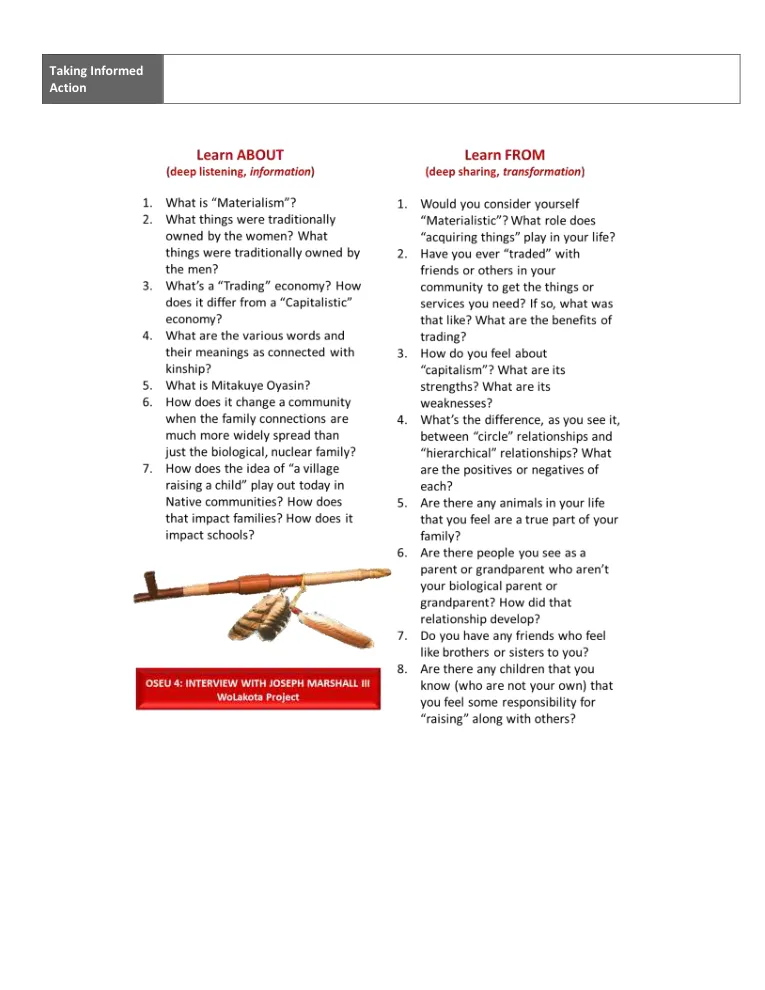
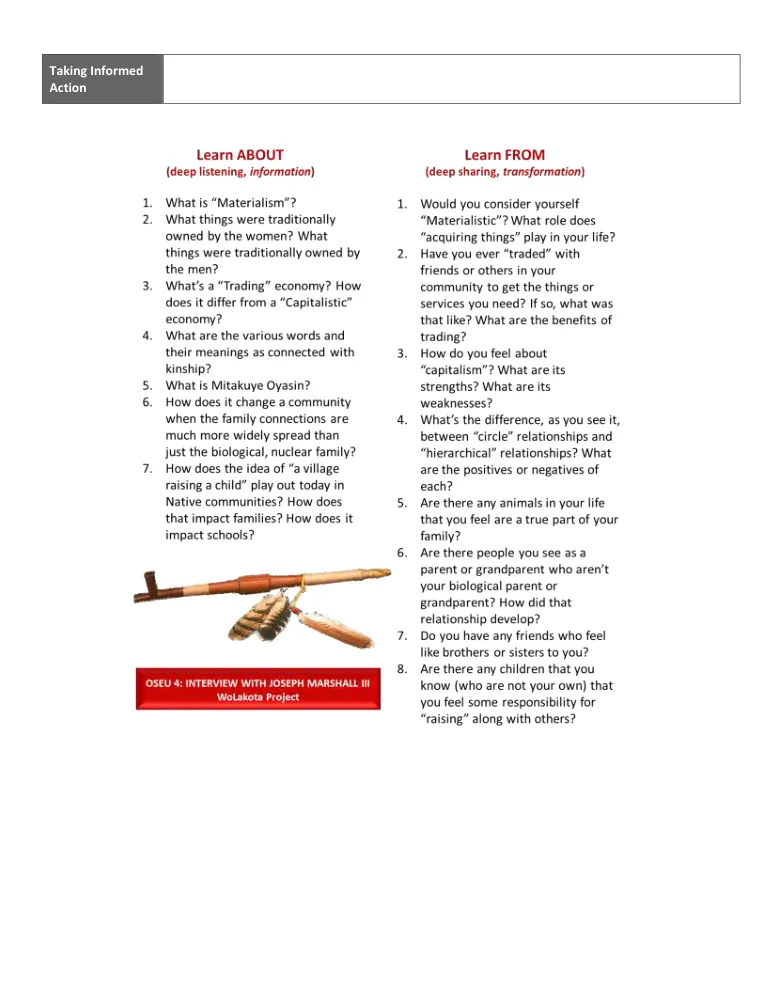
kinship using “Learn FROM” question 4
(provided below). Use a Venn diagram
(overlapping circles) to compare and
contrast the implications of circle
relationships and the implications of
hierarchal relationships.
What is materialism, and how does
Joseph Marshall say that differs
from a trading economy?
Formative performance task
Discuss the concept of
“materialism” using “Learn ABOUT”
question 1 and “Learn FROM”
question 1.
Discuss how the “circle of kinship”
led to a trading economy. Discuss
the meaning of “trading economy”
using “Learn FROM” question 2
(provided below). If desired, the
teacher could create a trading
experience.
Featured sources
Refer back to Joseph Marshall
video.
Supporting question 3
What are the pros and cons of a
trading economy and the pros and
cons of a capitalistic economy?
Formative performance task
Create PRO/CON charts to explore
pros and cons of TRADING
ECONOMY and pros and cons of
CAPITALISTIC ECONOMY.
Featured sources
Refer back to Joseph Marshall
video.
Summative performance task · Argument
Students share with partners what they learned about how the circle of kinship led
to a trading economy and refer to the class pros and cons charts to express their
personal feelings about trading and capitalism. This reflection with partners will
strengthen learning. The teacher walks around to do informal assessment based
on listening to the reflections.
Extension
Not specified in the archived lesson.
Taking informed action
Inquiry Design Model (IDM) Blueprint™
“We Are All Relatives-Lesson 2 of 2 -Economy” | OSEU 4: Kinship & Harmony
The complete archived text is retained here, including details that may extend beyond the inquiry blueprint.
Read the full archived lesson text
Inquiry Design Model (IDM) Blueprint™
“We Are All Relatives-Lesson 2 of 2 -Economy” | OSEU 4: Kinship & Harmony
Compelling
Question
How did the circle of kinship that is important to the people of the Oceti Sakowin affect their early
economy, and how does that economy differ from Western capitalism?
Standards and
Practices
OSEU 4.2 – Describe the traditional behavior patterns, codes of respect and values promoted
within the Oceti Sakowin tiospaye.
4.SL.1 Engage effectively in a range of collaborative discussions.
Economics 4.E.1.1 Discuss what factors (both positive and negative) influence individual choices.
Staging the
Question
Do you like to TRADE things? Can TRADING be the entire way families get what they need to live?
Supporting Question 1
Supporting Question 2
Supporting Question 3
How do circle relationships differ from
hierarchal relationships?
What is materialism, and how does
Joseph Marshall say that differs
from a trading economy?
What are the pros and cons of a
trading economy and the pros and
cons of a capitalistic economy?
Formative Performance Task
Formative Performance Task
Formative Performance Task
Watch the Joseph Marshall elder interview
(link below) and discuss the circle of
kinship using “Learn FROM” question 4
(provided below). Use a Venn diagram
(overlapping circles) to compare and
contrast the implications of circle
relationships and the implications of
hierarchal relationships.
Discuss the concept of
“materialism” using “Learn ABOUT”
question 1 and “Learn FROM”
question 1.
Discuss how the “circle of kinship”
led to a trading economy. Discuss
the meaning of “trading economy”
using “Learn FROM” question 2
(provided below). If desired, the
teacher could create a trading
experience.
Create PRO/CON charts to explore
pros and cons of TRADING
ECONOMY and pros and cons of
CAPITALISTIC ECONOMY.
Featured Sources
Featured Sources
Featured Sources
http://www.wolakotaproject.org/oseu-
four-interview-with-joseph-marshall-iii/
Refer back to Joseph Marshall
video.
Refer back to Joseph Marshall
video.
Summative
Performance Task
Argument
Students share with partners what they learned about how the circle of kinship led
to a trading economy and refer to the class pros and cons charts to express their
personal feelings about trading and capitalism. This reflection with partners will
strengthen learning. The teacher walks around to do informal assessment based
on listening to the reflections.
Extension
Taking Informed
Action
Original page 2 · illustrations and source materialsOriginal page 3 · illustrations and source materialsOriginal page 5 · illustrations and source materialsOriginal page 6 · illustrations and source materials