The complete archived text is retained here, including details that may extend beyond the inquiry blueprint.
Read the full archived lesson text
Fine Arts – 5 Es Lesson
Lesson: Wakinyan Thunder-being, The Flying One
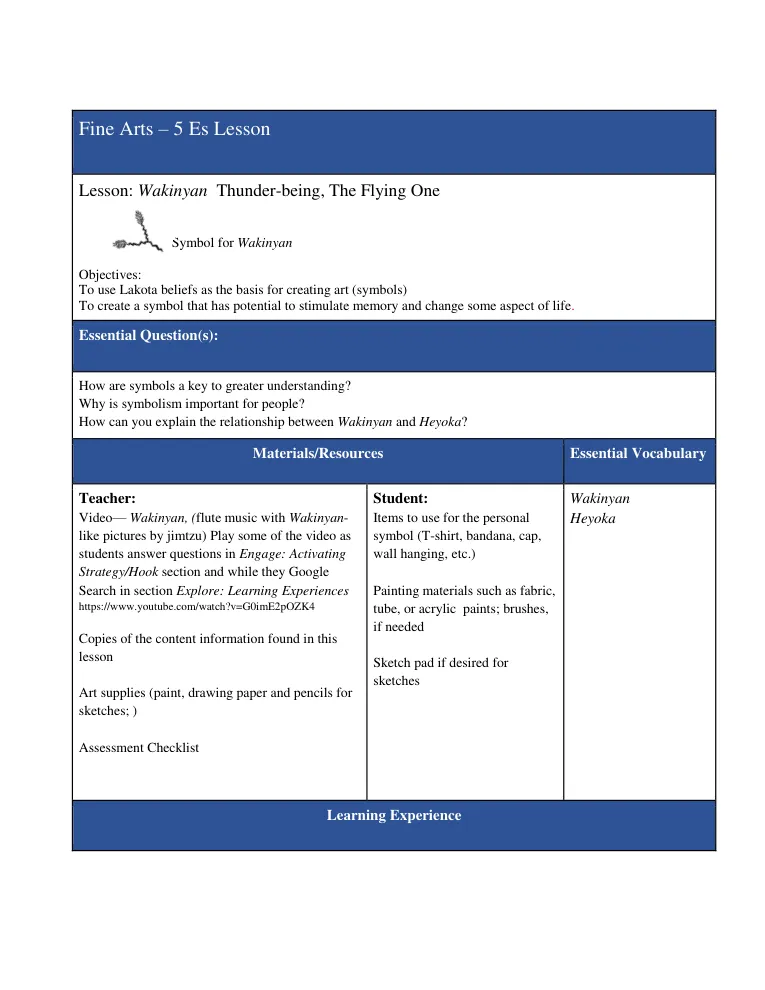
Symbol for Wakinyan
Objectives:
To use Lakota beliefs as the basis for creating art (symbols)
To create a symbol that has potential to stimulate memory and change some aspect of life.
Essential Question(s):
How are symbols a key to greater understanding?
Why is symbolism important for people?
How can you explain the relationship between Wakinyan and Heyoka?
Materials/Resources
Essential Vocabulary
Teacher:
Video— Wakinyan, (flute music with Wakinyan-
like pictures by jimtzu) Play some of the video as
students answer questions in Engage: Activating
Strategy/Hook section and while they Google
Search in section Explore: Learning Experiences
https://www.youtube.com/watch?v=G0imE2pOZK4
Copies of the content information found in this
lesson
Art supplies (paint, drawing paper and pencils for
sketches; )
Assessment Checklist
Student:
Items to use for the personal
symbol (T-shirt, bandana, cap,
wall hanging, etc.)
Painting materials such as fabric,
tube, or acrylic paints; brushes,
if needed
Sketch pad if desired for
sketches
Wakinyan
Heyoka
Learning Experience
Standards and Practice:
OSEU 2: Identity and Resiliency
There is a variety among individuals
within the Oceti Sakowin Oyate as
indentity is developed, defined and
redefined by entities, by organization,
and by people. A continuum of tribal
identity, unique to each individual,
ranges from assimilated to traditional
lifestyle. There is no “generic
American Indian.”
Anchor Standard 2: K-12. Cr. 2: Organize and develop artistic ideas and work.
HSa.VA.Cr.2.3
Anchor Standard 3: K-12. Cr. 3: Refine and complete artistic work.
HSa..VA.Cr3.2
Anchor Standard 6: K-12. Pr.6: Interpret meaning from presentation of artistic
work.
HSa.VA.Pr.6.1
Anchor Standard 7: K-12. Re.7: Perceive and analyze artistic work.
HSa.VA.Re.7.2
Anchor Standard 8: K-12. Re.8: Interpret intent and meaning in artistic work
HSpVA.Re.8.1
Anchor Standard 10: K-12. Cn.10: Synthesize and relate knowledge and personal
experiences to make art
HSa.VA.Cn.10.1
Anchor Standard 11: K-12. Cn.11:Relate artistic ideas and works
HSp.VA.Cn.11.1
Cultural Integration
Wakinyan Symbol
Why do cultures have symbols?
What symbols exist in my culture?
Why study Lakota symbols? What symbols are prevalent in society today?
I Can Statement(s):
I can see why Wakinyan is special
I can know how to connect Lakota beliefs with aesthetics
I can see that Wakinyan is more than just a bird or eagle
I can identify the Lakota X form in artwork
I can describe deep meaning of connected shapes that look like an hourglass
Engage: Activating
Strategy/Hook:
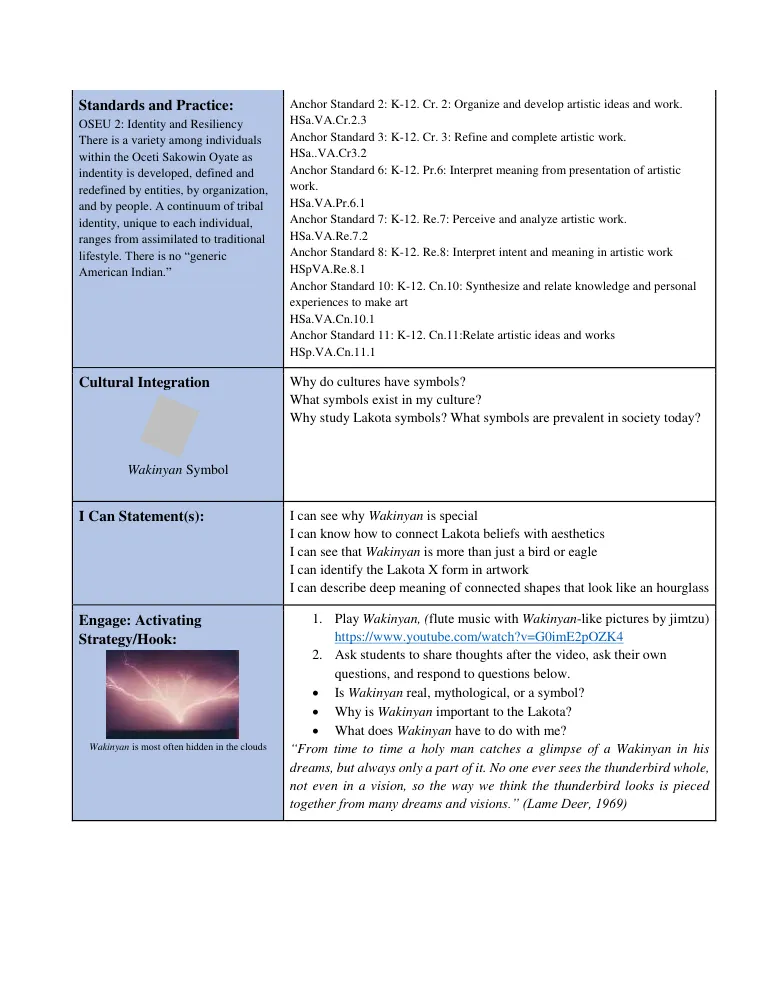
Wakinyan is most often hidden in the clouds
1. Play Wakinyan, (flute music with Wakinyan-like pictures by jimtzu)
https://www.youtube.com/watch?v=G0imE2pOZK4
2. Ask students to share thoughts after the video, ask their own
questions, and respond to questions below.
•
Is Wakinyan real, mythological, or a symbol?
•
Why is Wakinyan important to the Lakota?
•
What does Wakinyan have to do with me?
“From time to time a holy man catches a glimpse of a Wakinyan in his
dreams, but always only a part of it. No one ever sees the thunderbird whole,
not even in a vision, so the way we think the thunderbird looks is pieced
together from many dreams and visions.” (Lame Deer, 1969)
Explore: Learning
Experiences
“Thunder-being symbol is the red
zig-zag, lightning-bolt design,
which some people mistakenly think
represents a stairway”
Thunderbirds stand for rain, and
fire, and the truth …they like to
help the people. (Lame Deer, 1969).
Big Idea: How do symbols deliver messages from a story or event?
1. Google Search: Thunderbird Petroglyphs, preferably in SD and
MN, first home of D/Lakota Oyate.
2. Copy and Paste a few of your favorite images on a Word doc.
3. Pair and Share to discuss the question: Why are these my favorites?
4. Choose one that reflects your characteristics and “copy” it OR
create a personal symbol, such as an animal helper or an object that
represents your own unique qualities? Group Share.
5. Where will you place your symbol? Will it be on a household item:
a cup, lamp shade, wall hanging, etc.? Will it be on an item of
clothing: T-shirt, bandana, jacket, cap, cell phone, purse or wallet,
etc.? Pair-Share your thinking.
6. How will you paint it? Will you use a pattern or paint it free-hand?
What colors will you use? Group Share.
7. More ideas: Melvin Ferguson https://www.melvinwareagle.com/
Explain: Learning Experience
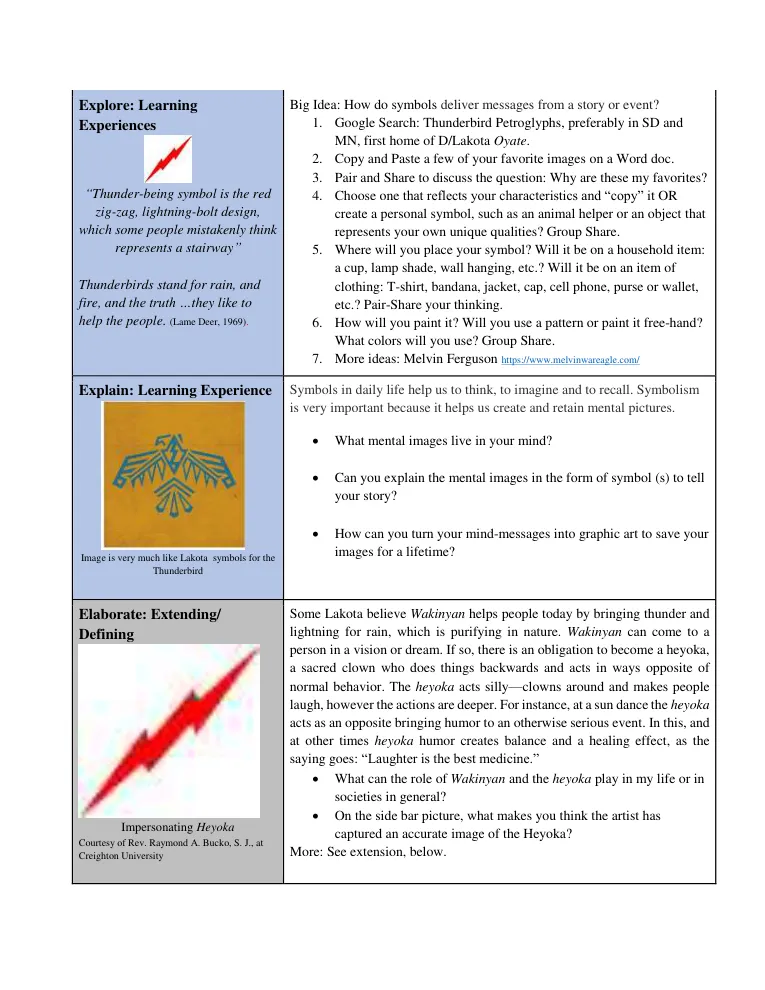
Image is very much like Lakota symbols for the
Thunderbird
Symbols in daily life help us to think, to imagine and to recall. Symbolism
is very important because it helps us create and retain mental pictures.
•
What mental images live in your mind?
•
Can you explain the mental images in the form of symbol (s) to tell
your story?
•
How can you turn your mind-messages into graphic art to save your
images for a lifetime?
Elaborate: Extending/
Defining
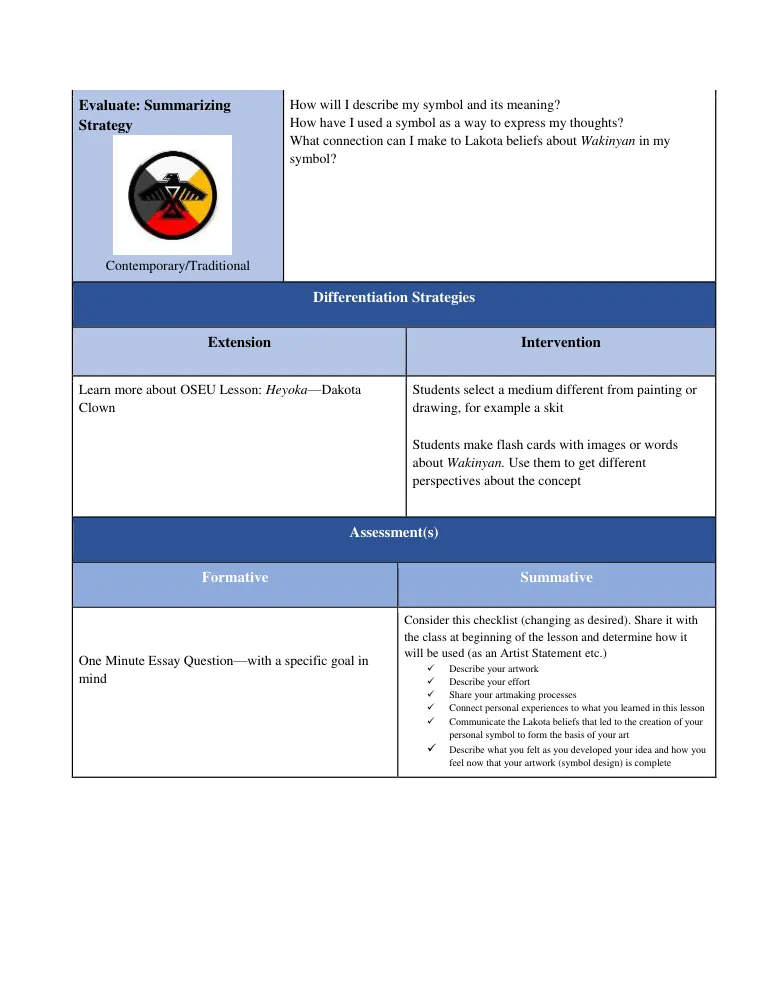
Impersonating Heyoka
Courtesy of Rev. Raymond A. Bucko, S. J., at
Creighton University
Some Lakota believe Wakinyan helps people today by bringing thunder and
lightning for rain, which is purifying in nature. Wakinyan can come to a
person in a vision or dream. If so, there is an obligation to become a heyoka,
a sacred clown who does things backwards and acts in ways opposite of
normal behavior. The heyoka acts silly—clowns around and makes people
laugh, however the actions are deeper. For instance, at a sun dance the heyoka
acts as an opposite bringing humor to an otherwise serious event. In this, and
at other times heyoka humor creates balance and a healing effect, as the
saying goes: “Laughter is the best medicine.”
•
What can the role of Wakinyan and the heyoka play in my life or in
societies in general?
•
On the side bar picture, what makes you think the artist has
captured an accurate image of the Heyoka?
More: See extension, below.
Evaluate: Summarizing
Strategy
Contemporary/Traditional
How will I describe my symbol and its meaning?
How have I used a symbol as a way to express my thoughts?
What connection can I make to Lakota beliefs about Wakinyan in my
symbol?
Differentiation Strategies
Extension
Intervention
Learn more about OSEU Lesson: Heyoka—Dakota
Clown
Students select a medium different from painting or
drawing, for example a skit
Students make flash cards with images or words
about Wakinyan. Use them to get different
perspectives about the concept
Assessment(s)
Formative
Summative
One Minute Essay Question—with a specific goal in
mind
That De
Consider this checklist (changing as desired). Share it with
the class at beginning of the lesson and determine how it
will be used (as an Artist Statement etc.)
Describe your artwork
Describe your effort
Share your artmaking processes
Connect personal experiences to what you learned in this lesson
Communicate the Lakota beliefs that led to the creation of your
personal symbol to form the basis of your art
Describe what you felt as you developed your idea and how you
feel now that your artwork (symbol design) is complete
Teacher Reflection: (Next steps?)
Source provenance: OSEU Lesson Plans Old ALL Combined.pdf · WoLakota Project archive. Reformatted for this collection.