The complete archived text is retained here, including details that may extend beyond the inquiry blueprint.
Read the full archived lesson text
Fine Arts 5 E’s Lesson Plan
Lesson: Wahcazi: “Following the Sun” A Multicultural Art Lesson
Student Learning Objectives:
To identify the elements of art in sunflower paintings
To describe Lakota cultural context in a work of art
To create art, reflect upon what they have made, and identity the meaning it holds for them
Essential Question(s):
What value can art hold for me?
How can I use the elements of art to create something of beauty?
How can learning more about Lakota culture help me in my own life?
Materials/Resources
Essential
Vocabulary
Teacher: (Open Hyperlinks)
1. Pgs. 48-49 Standing Bear/sunflowers
https://books.google.com/books?id=fZ_O8Opgm2kC&pg
=PA49&dq=Sunflower+Luther+standing+Bear&hl=en&
sa=X&ved=0ahUKEwjLy9feltraAhUGiIMKHXsnBo4Q
6AEISTAF#v=onepage&q=Sunflower%20Luther%20sta
nding%20Bear&f=false
3. Lakota/Sunflower
http://www.lakotacountrytimes.com/news/2014-
6/Voices/The_Sunflower_Medallion.html
4. How to draw sunflowers(advanced)
https://www.google.com/search?safe=active&source=hp
&ei=xc7hWpSUDKrUjwThyZDIAg&q=how+to+draw+s
unflowers&oq=ho&gs_l=psy-
ab.1.0.35i39k1l2j0i67k1l4j0i20i264k1j0i131k1j0i67k1l2.
1468.1685.0.4530.4.3.0.0.0.0.197.367.0j2.3.0....0...1c.1.6
4.psy-ab..1.3.619.6...254.87N35qM2Jd8
5.Time Lapse
https://www.youtube.com/watch?v=g8mr0R3ibPU
Student:
•
Oil-based Colored Pencils
•
Artagain paper by Strathmore or
other pads of paper for colored
pencil or printmaking paper
1. 7 Elements Of Art (Digital Art Tutorial)
https://www.youtube.com/watch?v=BwNQkh
Kg2Ig
2. Images for drawing sunflowers
https://www.google.com/search?q=how+to+m
ake+a+field+of+sunflowers+mural&safe=acti
ve&tbm=isch&tbo=u&source=univ&sa=X&v
ed=0ahUKEwiBwIr0hNjaAhVs5IMKHc8uD7
QQsAQIRQ&biw=1242&bih=615
3. Sunflower Quotes (optional)
https://www.pinterest.com/pin/337699672041
980756/?lp=true
4. How to draw sunflowers
https://easydrawingguides.com/how-to-draw-
a-sunflower/
http://www.yedraw.com/how-to-draw-
sunflower.html#.WuHQSYjwa00
Form
Space (+, -)
Hue
Intensity
Still life
Texture
Learning Experience
Standards and Practice:
OSEU 3: Culture and Language
The origin, thought and philosophy of the
Oceti Sakowin continues in the
contemporary lifestyles of tribal members.
Tribal cultures, traditions and languages
are incorporated and observed by many
tribal members both on and off the
reservations.
SD Visual Arts Standards
6-8.VA.Cr.2.1 Demonstrate willingness to experiment, innovate, and take risks to pursue ideas, forms,
and meanings that emerge in the process of art-making or designing.
6-8.VA.Pr.5.1 Individually or collaboratively, prepare and present works of art, analyze exhibit space, the
needs of the viewer, and the layout of the exhibit
6-8.VA.Re.7.1 Identify and explain how an individual's aesthetic choices are influenced by culture,
environment, and how their artwork is perceived by others
6-8.VA.Cn.10.1 Individually or collaboratively create art to reflect current interests, concerns, events,
community, or group identity.
Cultural Integration:
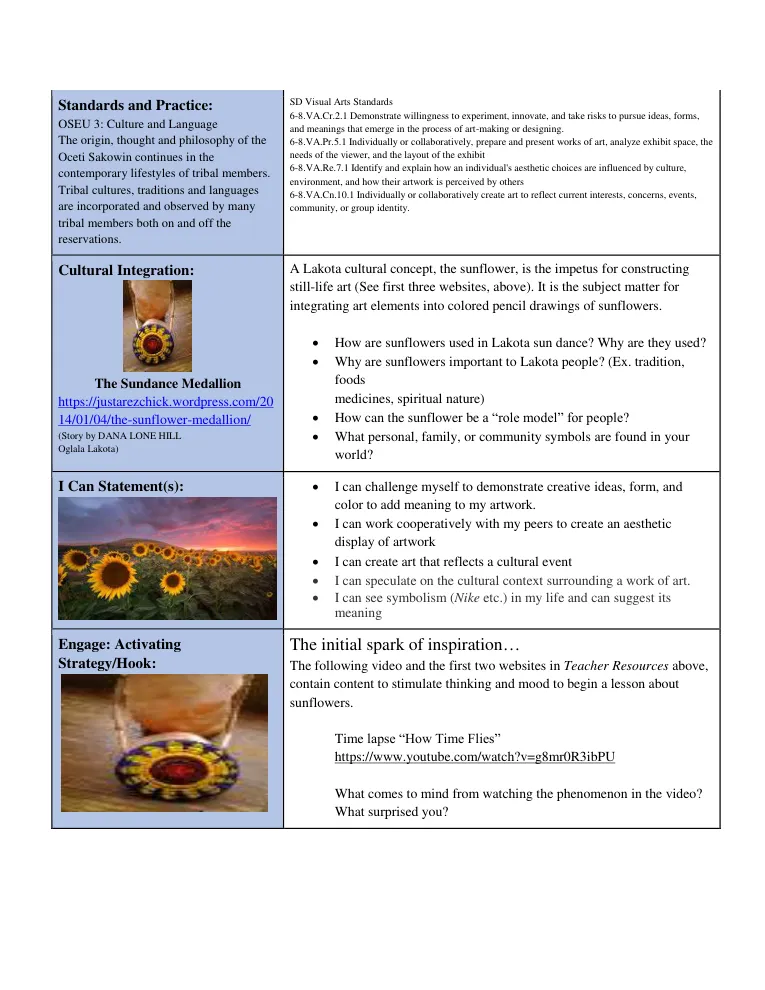
The Sundance Medallion
https://justarezchick.wordpress.com/20
14/01/04/the-sunflower-medallion/
(Story by DANA LONE HILL
Oglala Lakota)
A Lakota cultural concept, the sunflower, is the impetus for constructing
still-life art (See first three websites, above). It is the subject matter for
integrating art elements into colored pencil drawings of sunflowers.
•
How are sunflowers used in Lakota sun dance? Why are they used?
•
Why are sunflowers important to Lakota people? (Ex. tradition,
foods
medicines, spiritual nature)
•
How can the sunflower be a “role model” for people?
•
What personal, family, or community symbols are found in your
world?
I Can Statement(s):
•
I can challenge myself to demonstrate creative ideas, form, and
color to add meaning to my artwork.
•
I can work cooperatively with my peers to create an aesthetic
display of artwork
•
I can create art that reflects a cultural event
•
I can speculate on the cultural context surrounding a work of art.
•
I can see symbolism (Nike etc.) in my life and can suggest its
meaning
Engage: Activating
Strategy/Hook:
The initial spark of inspiration…
The following video and the first two websites in Teacher Resources above,
contain content to stimulate thinking and mood to begin a lesson about
sunflowers.
Time lapse “How Time Flies”
https://www.youtube.com/watch?v=g8mr0R3ibPU
What comes to mind from watching the phenomenon in the video?
What surprised you?
Explore: Learning Experiences
The investigation of ideas:
1. Students view 7 Elements of Art.
https://www.youtube.com/watch?v=BwNQkhKg2Ig
2. Then, they look at sunflower images.
3. https://www.google.com/search?q=how+to+make+a+field+of+sunflowers
+mural&safe=active&tbm=isch&tbo=u&source=univ&sa=X&ved=0ahUK
EwiBwIr0hNjaAhVs5IMKHc8uD7QQsAQIRQ&biw=1242&bih=615
4. Students discuss elements of art observed in the sunflower images.
5. They “play” with the materials and art techniques, working in pairs
while listening to lyrics/song: Following the Sun. https://genius.com/
https://www.youtube.com/watch?v=MxLTzIIBRzY
6. Next, they draft different types of lines (thin, thick, smooth, broken,
etc.), colors (warm, cool, primary, secondary, bright, subdued, etc.),
and other art elements seen in sunflower paintings. Question:
What’s love got to do with sunflowers? Think: What feelings arise
from the song lyrics and what feelings do the sunflower images
produce?
7. Students draw multiple sketches using any or all of the seven art
elements to further encourage thinking and exploration. Focus this
activity on the “big idea,” which is Lakota culture and art
appreciation.
8. Students respond to conceptual questions, such as: What ideas came
to mind during your “play” experiences? What images and
possibilities emerged? Which of them will work the best in the next
step—to produce your work of art? What is the relationship between
the Lakota concept about sunflowers and yours? How will you
depict it your drawing?
Explain: Learning Experiences
The production of the work of art:
Each student will create an original colored pencil sunflower drawing.
Student will formulate questions for teacher/peers and be prepared to answer
their own questions. Examples: How could I improve the depth of my
drawing? What do you think about the colors in my drawing? What could I
add?
How could I combine the elements of art with the Lakota concept of
sunflowers (example): https://www.pinterest.com/pin/70579919134682319/
Elaborate: Extending & Defining
The reflection about the work of art:
Students will present their drawings to a group of their peers identifying
elements of art in their work to reinforce the concepts.
Think and discuss: How could conscious awareness of the art elements
enhance the beauty of objects and enrich the joy of nature?
What can you conclude about this experience that that can help you find
meaning in your life?
How does what you know about the Lakota relationship with sunflowers
help you appreciate art and culture?
How did the lesson of the sunflower help you to discover the significance
and value of Lakota culture and art?
Evaluate: Summarizing Strategy
•
Response cards to teacher and student-posed questions
•
Think-Pair-Share to compare thoughts before a final sharing with
the class at the end of the lesson
These along with similar activities, including formative and summative
assessments will demonstrate the degree of student fulfillment of lesson
objectives.
Differentiation Strategies
Extension
Intervention
Producing a sunflower wall mural:
Students may replicate their individual sunflower drawings
to create the mural or position their individual drawings to
reflect a field of sunflowers
Elements of Art Introduction
https://www.youtube.com/watch?v=FY-qWoEx_hY
How to Make Better Art with 7 Elements of Art
https://www.youtube.com/watch?v=X6H_vNWp5JA
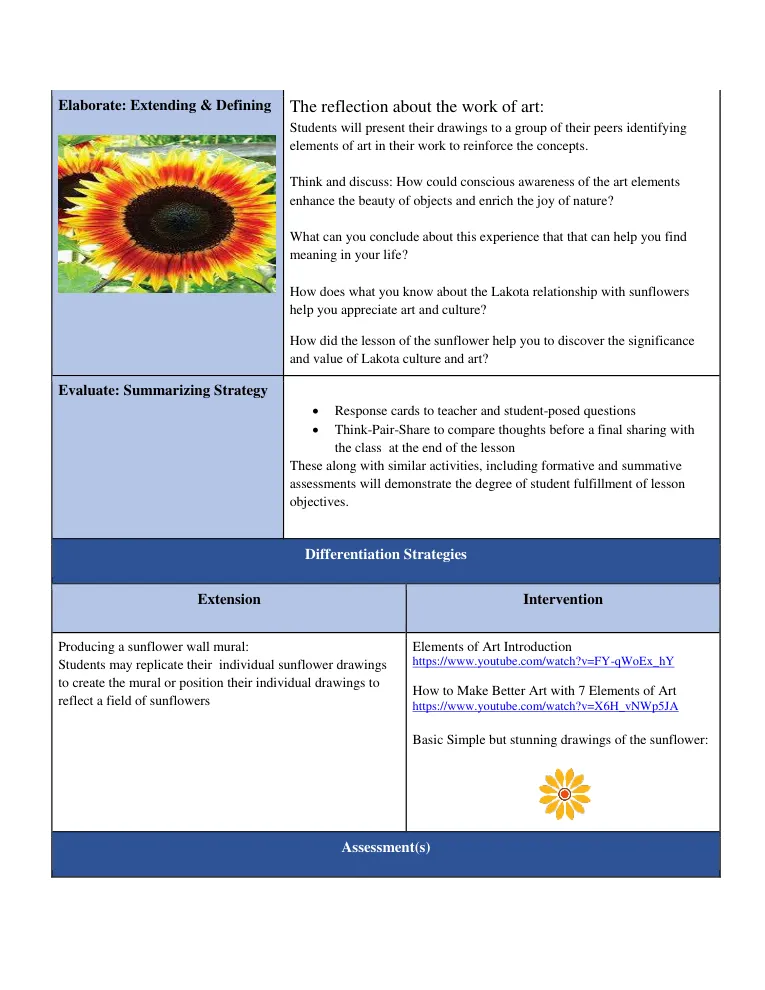
Basic Simple but stunning drawings of the sunflower:
Assessment(s)
Formative
Summative
•
Observation and anecdotal notes
•
Exit/Enter Slips
•
Strategic Questioning
Rubric to measure success: Students can verbally point out and
name one example of each of the elements of art in a single work of art.
Students who can name one example of all elements of art have excellent
understanding. Students who can find examples of 3–4 of the elements have
sufficient understanding. Students who can only find 1 or 2 examples need
more practice.
•
Teacher Reflection: (Next steps?)
Source provenance: OSEU Lesson Plans Old ALL Combined.pdf · WoLakota Project archive. Reformatted for this collection.