The complete archived text is retained here, including details that may extend beyond the inquiry blueprint.
Read the full archived lesson text
5 E’s Lesson Plan Template
Lesson: Iyaowapi (Rock Writing)
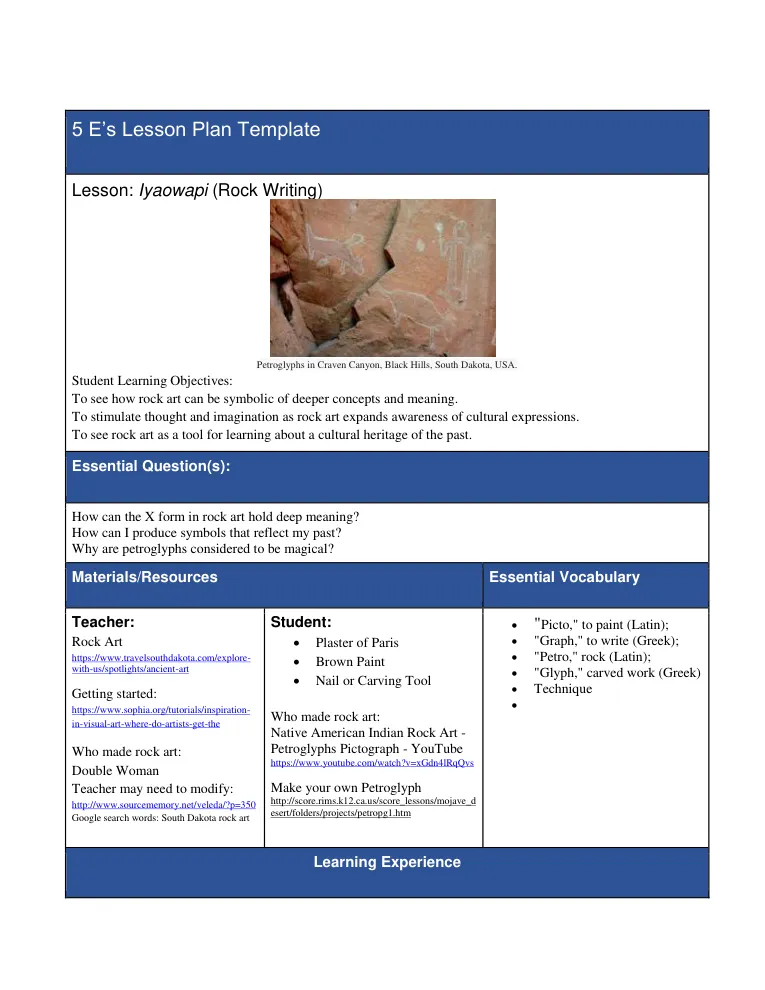
Petroglyphs in Craven Canyon, Black Hills, South Dakota, USA.
Student Learning Objectives:
To see how rock art can be symbolic of deeper concepts and meaning.
To stimulate thought and imagination as rock art expands awareness of cultural expressions.
To see rock art as a tool for learning about a cultural heritage of the past.
Essential Question(s):
How can the X form in rock art hold deep meaning?
How can I produce symbols that reflect my past?
Why are petroglyphs considered to be magical?
Materials/Resources
Essential Vocabulary
Teacher:
Rock Art
https://www.travelsouthdakota.com/explore-
with-us/spotlights/ancient-art
Getting started:
https://www.sophia.org/tutorials/inspiration-
in-visual-art-where-do-artists-get-the
Who made rock art:
Double Woman
Teacher may need to modify:
http://www.sourcememory.net/veleda/?p=350
Google search words: South Dakota rock art
Student:
•
Plaster of Paris
•
Brown Paint
•
Nail or Carving Tool
Who made rock art:
Native American Indian Rock Art -
Petroglyphs Pictograph - YouTube
https://www.youtube.com/watch?v=xGdn4lRqQvs
Make your own Petroglyph
http://score.rims.k12.ca.us/score_lessons/mojave_d
esert/folders/projects/petropg1.htm
• "Picto," to paint (Latin);
•
"Graph," to write (Greek);
•
"Petro," rock (Latin);
•
"Glyph," carved work (Greek)
•
Technique
•
Learning Experience
Standards and Practice:
OSEU 3: Culture and Language
Standards and Practice: South Dakota Visual Arts Standards:
Visual Arts Standards
Creating
Anchor Standard 2: K-12.Cr.2: Organize and develop artistic ideas and work
6-8. VA.Cr.2.1
Responding
Anchor Standard 7: K-12. Re.7: Perceive and analyze artistic work
6-8.VA.RE.7.1
Connecting
Anchor Standard 10: K-12.Cn.10:Synthesize and relate knowledge and
personal experiences to make art
Cultural Integration:
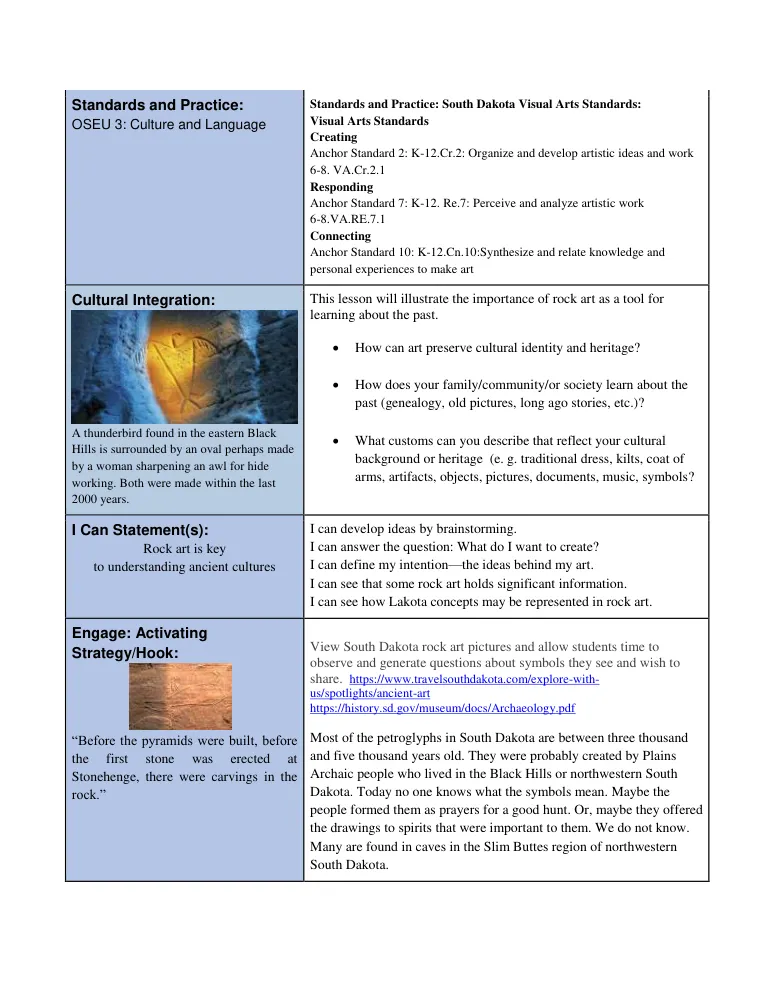
A thunderbird found in the eastern Black
Hills is surrounded by an oval perhaps made
by a woman sharpening an awl for hide
working. Both were made within the last
2000 years.
This lesson will illustrate the importance of rock art as a tool for
learning about the past.
•
How can art preserve cultural identity and heritage?
•
How does your family/community/or society learn about the
past (genealogy, old pictures, long ago stories, etc.)?
•
What customs can you describe that reflect your cultural
background or heritage (e. g. traditional dress, kilts, coat of
arms, artifacts, objects, pictures, documents, music, symbols?
I Can Statement(s):
Rock art is key
to understanding ancient cultures
I can develop ideas by brainstorming.
I can answer the question: What do I want to create?
I can define my intention—the ideas behind my art.
I can see that some rock art holds significant information.
I can see how Lakota concepts may be represented in rock art.
Engage: Activating
Strategy/Hook:
“Before the pyramids were built, before
the
first
stone
was
erected
at
Stonehenge, there were carvings in the
rock.”
View South Dakota rock art pictures and allow students time to
observe and generate questions about symbols they see and wish to
share. https://www.travelsouthdakota.com/explore-with-
us/spotlights/ancient-art
https://history.sd.gov/museum/docs/Archaeology.pdf
Most of the petroglyphs in South Dakota are between three thousand
and five thousand years old. They were probably created by Plains
Archaic people who lived in the Black Hills or northwestern South
Dakota. Today no one knows what the symbols mean. Maybe the
people formed them as prayers for a good hunt. Or, maybe they offered
the drawings to spirits that were important to them. We do not know.
Many are found in caves in the Slim Buttes region of northwestern
South Dakota.
Explore: Learning Experience:
Tauni yuke sni itokamna INYAN ki yuke, na
Nagi tawa ki WAKAN TANKA
(Before any other Inyan was. And his spirit
was Wakan Tanka.)
from Lakota creation story. Inyan means “rock” and
Wakan Tanka means “The Great Mystery.”
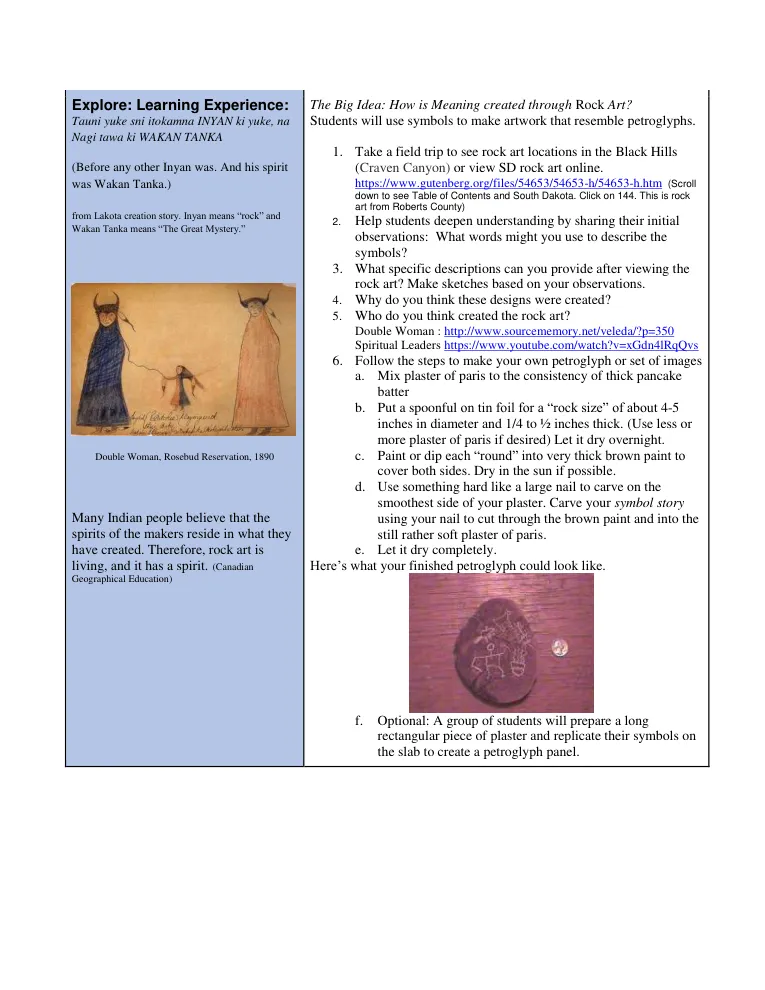
Double Woman, Rosebud Reservation, 1890
Many Indian people believe that the
spirits of the makers reside in what they
have created. Therefore, rock art is
living, and it has a spirit. (Canadian
Geographical Education)
The Big Idea: How is Meaning created through Rock Art?
Students will use symbols to make artwork that resemble petroglyphs.
1. Take a field trip to see rock art locations in the Black Hills
(Craven Canyon) or view SD rock art online.
https://www.gutenberg.org/files/54653/54653-h/54653-h.htm (Scroll
down to see Table of Contents and South Dakota. Click on 144. This is rock
art from Roberts County)
2.
Help students deepen understanding by sharing their initial
observations: What words might you use to describe the
symbols?
3. What specific descriptions can you provide after viewing the
rock art? Make sketches based on your observations.
4. Why do you think these designs were created?
5. Who do you think created the rock art?
Double Woman : http://www.sourcememory.net/veleda/?p=350
Spiritual Leaders https://www.youtube.com/watch?v=xGdn4lRqQvs
6. Follow the steps to make your own petroglyph or set of images
a. Mix plaster of paris to the consistency of thick pancake
batter
b. Put a spoonful on tin foil for a “rock size” of about 4-5
inches in diameter and 1/4 to ½ inches thick. (Use less or
more plaster of paris if desired) Let it dry overnight.
c. Paint or dip each “round” into very thick brown paint to
cover both sides. Dry in the sun if possible.
d. Use something hard like a large nail to carve on the
smoothest side of your plaster. Carve your symbol story
using your nail to cut through the brown paint and into the
still rather soft plaster of paris.
e. Let it dry completely.
Here’s what your finished petroglyph could look like.
f. Optional: A group of students will prepare a long
rectangular piece of plaster and replicate their symbols on
the slab to create a petroglyph panel.
Explain: Learning Experiences
“The Tunkan, the Dakotas say, is the
[stone spirit] that dwells in stones or
rocks, and is the oldest deity. If asked
why it is considered the oldest, they will
tell you because it is the hardest.”
Mr. J. W. Lynd, Pg. 168, MN Historical Collections,
Part 1.
Use SD petroglyph photograph on pg. 47
https://history.sd.gov/museum/docs/Archaeology.pdf
•
What ideas are reflected in your sketches from section
Explore: Learning Experience, No. 3 above?
•
How does your symbol (or symbols) help observers get your
message? What clues do you provide for your observers to get
the idea?
•
What title would you give your rock art? What comments
would you like to hear from your peers when they observe
your art?
•
What different ideas do you have about your rock art now?
Elaborate: Extending &
Defining
Petroglyphs Bring Lakota Origins To Life
http://listen.sdpb.org/post/petroglyph
s-bring-lakota-origins-life
Why do some people refer to this art form as petroglyphs and others
call it rock art?
Concept of Definition/Word Map—Teacher will introduce
vocabulary related to rock art. Students will make a “mini poster’ that
demonstrates: 1) what the term is (definition), 2) what it’s like
(properties, qualities), 3) and give examples of the word. Then,
students will hang the word posters on a “clothes line” in the room.
For examples of the process:
http://www.readingquest.org/strat/cdmap.html 5-3-1
Student think: How can I gain and retain my own cultural ideas and
what teachings are significant enough to preserve for the future?
Evaluate: Summarizing
Strategy
Quick Talk Activity— Establish a specified time frame (1-2 min.,
perhaps using a timer to signal when time is up). Then, tell students to
engage in “quick talk” to summarize their thinking/learning at various
intervals in the lesson. (Could also use: Student A talks for __ time,
Student B talks for __ time.)
Differentiation Strategies
Extension
Intervention
Language Development
How to Make a Petroglyph
https://www.youtube.com/watch?v=NDT
2IQcLZ8k
Ben Woodruff demonstrates how to
make “real” rock art
Student may look at rock art
from different countries to see
rock art symbols for more ideas,
inspiration, and sharing with the
class
https://www.gutenberg.org/files/54
653/54653-h/54653-h.htm
Assessment(s)
Formative
Summative
3-2-1
Three points to remember, two things you liked,
one question you still have.
Grade Themselves— an in-progress grade, then explain
why their work is earning that grade. Give explicit
standards and relevant vocab to use in their explanation.
Teacher and Student-made Rubric with attention to any
of the following for Process and Product such as:
execution, craftsmanship, technique (no major damage
due to improper technique) detail adds to realism; idea,
creativity, substance, clarity, looks like the sketch, etc.
Tea
Teacher Reflection: (Next steps?)
What improvements can I make to the lesson, activity, content, concept, or understanding?
Source provenance: OSEU Lesson Plans Old ALL Combined.pdf · WoLakota Project archive. Reformatted for this collection.