The complete archived text is retained here, including details that may extend beyond the inquiry blueprint.
Read the full archived lesson text
5 E’s Lesson Plan Template
Lesson: Wizipan—Parfleche
“Keeping the Tradition Alive.”
Objectives:
To describe Lakota parfleche designs found on everyday objects.
To use Lakota symbols to illustrate their importance in the cultural heritage of a people
Essential Question(s):
How can a thing of beauty, a parfleche, hold knowledge of the past?
How long can an art survive?
How can a parfleche teach me about my own past, present, and future?
Materials/Resources
Essential
Vocabulary
Teacher:
Parfleche Images (focus observations on Lakota or
“Sioux”)
https://www.pinterest.co.uk/pin/288793394835650609/?lp=true
This How-To uses felt instead of rawhide (not
recommended) but has a good diagram for
measuring, folding, etc.
http://history.nd.gov/activities/parfleche.pdf
Parfleche information from The Cartographic
Heritage of the Lakota Sioux, Number 48, Spring
2004. Julie A. Rice-Rollins. See pages 39-41.
http://www.cartographicperspectives.org/index.php/journal/article/
viewFile/cp48-rice-rollins/514
Student:
•
Rawhide
•
Parfleche Painting
Cookies
http://www.beadmatch.com/paint_
cookies.php
•
Brushes
•
Ice Pick or Nail
•
Leather Strips
•
“Hide Glue”
Mini American Indian parfleche
made from dog chew (fun
project) www.instructables.com
•
Parfleche
•
X Form
•
Motif
•
Iconography
•
Pigment
•
Cookies
Learning Experience
Standards and Practice:
OSEU 2: Identity and Resiliency
South Dakota Visual Arts Standards
Creating
Anchor Standard 1: K-12. Cr. 1 Generate and conceptualize artistic ideas and work.
HSp.VA.Cr.1.2
Anchor Standard 3: K-12. Cr. 3 Refine ad complete artistic work.
HSp.VA.Cr.3.2
Responding
Anchor Standard 7: K-12. Re. 7: Perceive and analyze artistic work.
HSp.VA.Re.7.2
Connecting
Anchor Standard 1: K-12. Cn. 11: Relate artistic ideas and works
HSp.VA.Cn.11.1
Cultural Integration:
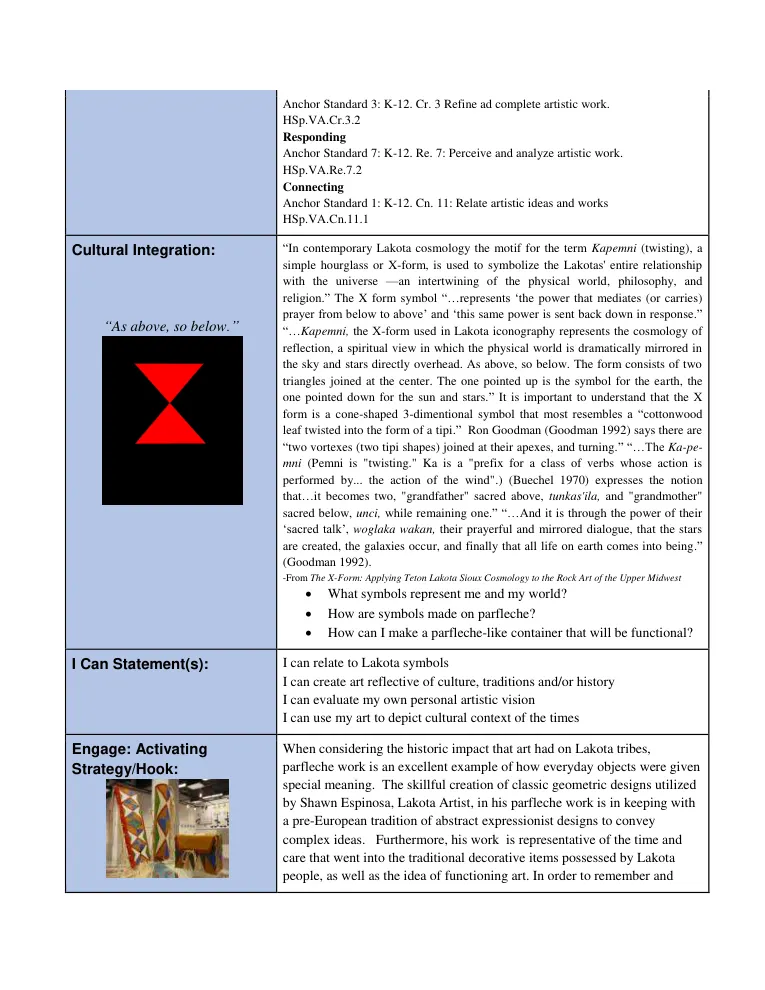
“As above, so below.”
“In contemporary Lakota cosmology the motif for the term Kapemni (twisting), a
simple hourglass or X-form, is used to symbolize the Lakotas' entire relationship
with the universe —an intertwining of the physical world, philosophy, and
religion.” The X form symbol “…represents ‘the power that mediates (or carries)
prayer from below to above’ and ‘this same power is sent back down in response.”
“…Kapemni, the X-form used in Lakota iconography represents the cosmology of
reflection, a spiritual view in which the physical world is dramatically mirrored in
the sky and stars directly overhead. As above, so below. The form consists of two
triangles joined at the center. The one pointed up is the symbol for the earth, the
one pointed down for the sun and stars.” It is important to understand that the X
form is a cone-shaped 3-dimentional symbol that most resembles a “cottonwood
leaf twisted into the form of a tipi.” Ron Goodman (Goodman 1992) says there are
“two vortexes (two tipi shapes) joined at their apexes, and turning.” “…The Ka-pe-
mni (Pemni is "twisting." Ka is a "prefix for a class of verbs whose action is
performed by... the action of the wind".) (Buechel 1970) expresses the notion
that…it becomes two, "grandfather" sacred above, tunkas'ila, and "grandmother"
sacred below, unci, while remaining one.” “…And it is through the power of their
‘sacred talk’, woglaka wakan, their prayerful and mirrored dialogue, that the stars
are created, the galaxies occur, and finally that all life on earth comes into being.”
(Goodman 1992).
-From The X-Form: Applying Teton Lakota Sioux Cosmology to the Rock Art of the Upper Midwest
•
What symbols represent me and my world?
•
How are symbols made on parfleche?
•
How can I make a parfleche-like container that will be functional?
I Can Statement(s):
I can relate to Lakota symbols
I can create art reflective of culture, traditions and/or history
I can evaluate my own personal artistic vision
I can use my art to depict cultural context of the times
Engage: Activating
Strategy/Hook:
When considering the historic impact that art had on Lakota tribes,
parfleche work is an excellent example of how everyday objects were given
special meaning. The skillful creation of classic geometric designs utilized
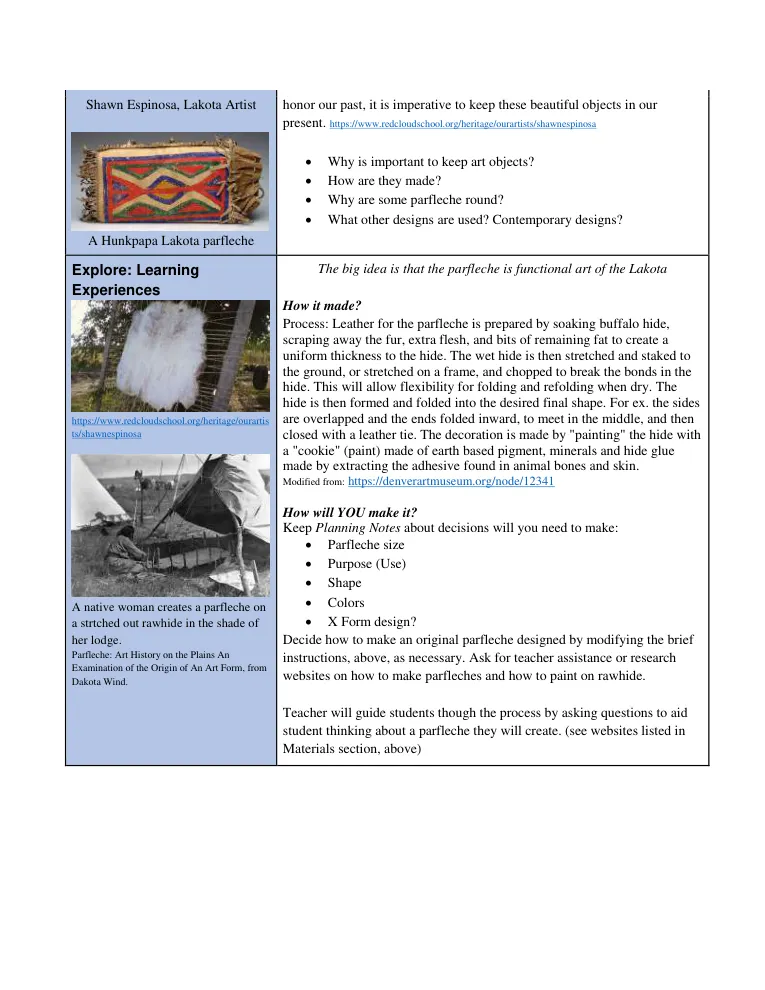
by Shawn Espinosa, Lakota Artist, in his parfleche work is in keeping with
a pre-European tradition of abstract expressionist designs to convey
complex ideas. Furthermore, his work is representative of the time and
care that went into the traditional decorative items possessed by Lakota
people, as well as the idea of functioning art. In order to remember and
Shawn Espinosa, Lakota Artist
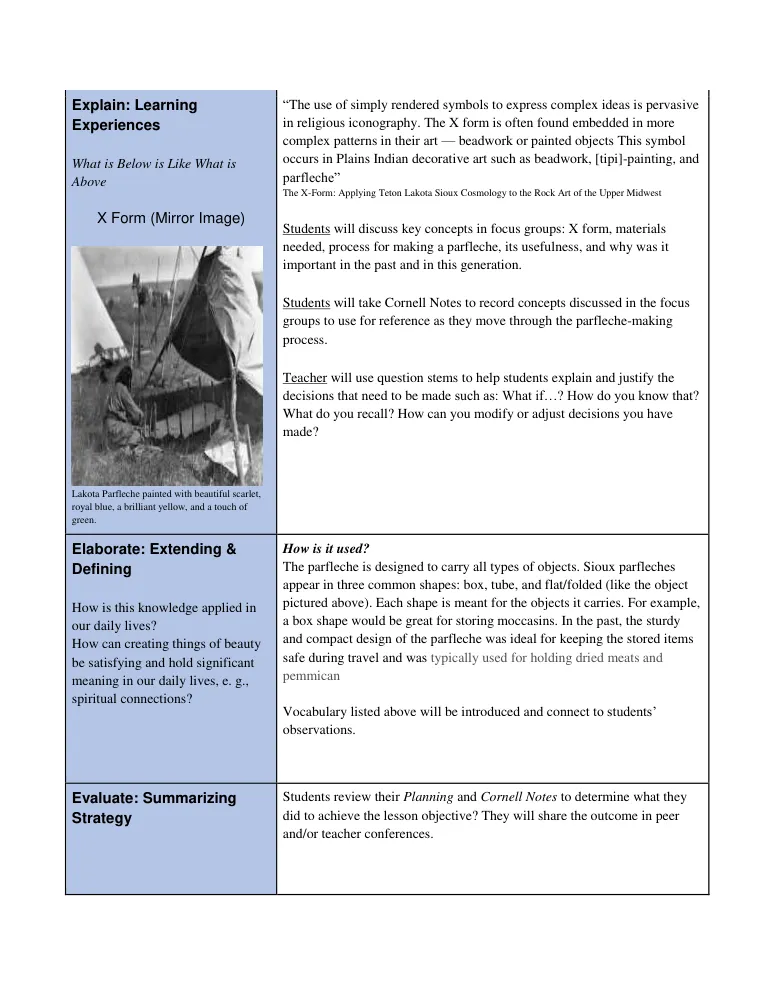
A Hunkpapa Lakota parfleche
honor our past, it is imperative to keep these beautiful objects in our
present. https://www.redcloudschool.org/heritage/ourartists/shawnespinosa
•
Why is important to keep art objects?
•
How are they made?
•
Why are some parfleche round?
•
What other designs are used? Contemporary designs?
Explore: Learning
Experiences
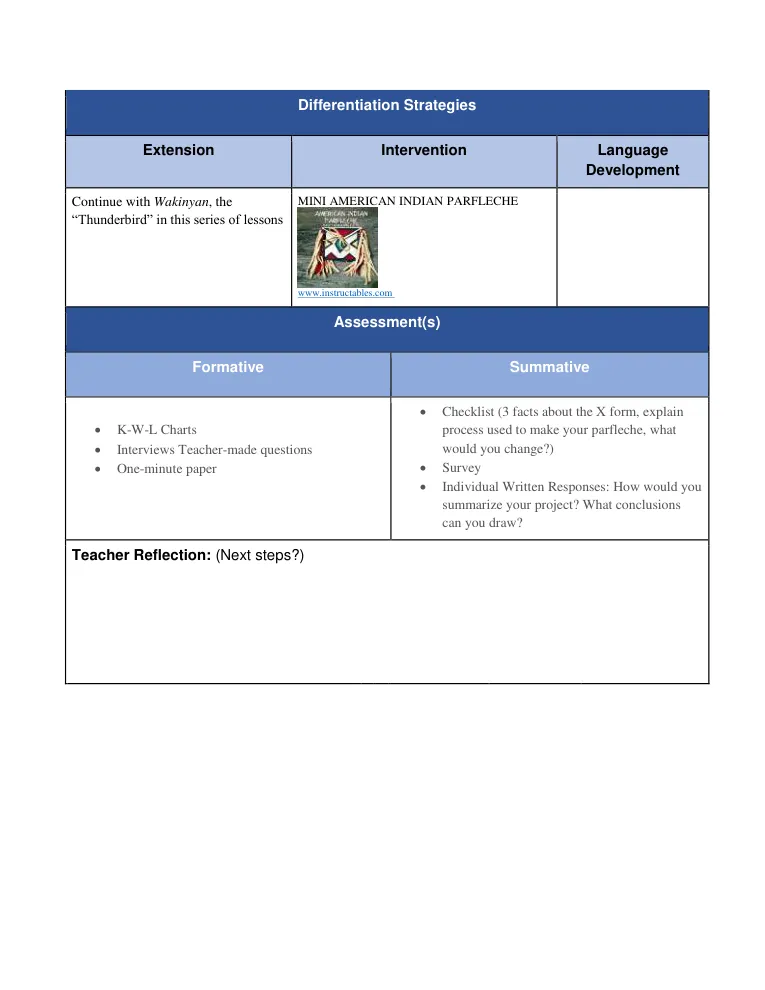
https://www.redcloudschool.org/heritage/ourartis
ts/shawnespinosa
A native woman creates a parfleche on
a strtched out rawhide in the shade of
her lodge.
Parfleche: Art History on the Plains An
Examination of the Origin of An Art Form, from
Dakota Wind.
The big idea is that the parfleche is functional art of the Lakota
How it made?
Process: Leather for the parfleche is prepared by soaking buffalo hide,
scraping away the fur, extra flesh, and bits of remaining fat to create a
uniform thickness to the hide. The wet hide is then stretched and staked to
the ground, or stretched on a frame, and chopped to break the bonds in the
hide. This will allow flexibility for folding and refolding when dry. The
hide is then formed and folded into the desired final shape. For ex. the sides
are overlapped and the ends folded inward, to meet in the middle, and then
closed with a leather tie. The decoration is made by "painting" the hide with
a "cookie" (paint) made of earth based pigment, minerals and hide glue
made by extracting the adhesive found in animal bones and skin.
Modified from: https://denverartmuseum.org/node/12341
How will YOU make it?
Keep Planning Notes about decisions will you need to make:
•
Parfleche size
•
Purpose (Use)
•
Shape
•
Colors
•
X Form design?
Decide how to make an original parfleche designed by modifying the brief
instructions, above, as necessary. Ask for teacher assistance or research
websites on how to make parfleches and how to paint on rawhide.
Teacher will guide students though the process by asking questions to aid
student thinking about a parfleche they will create. (see websites listed in
Materials section, above)
Explain: Learning
Experiences
What is Below is Like What is
Above
X Form (Mirror Image)
Lakota Parfleche painted with beautiful scarlet,
royal blue, a brilliant yellow, and a touch of
green.
“The use of simply rendered symbols to express complex ideas is pervasive
in religious iconography. The X form is often found embedded in more
complex patterns in their art — beadwork or painted objects This symbol
occurs in Plains Indian decorative art such as beadwork, [tipi]-painting, and
parfleche”
The X-Form: Applying Teton Lakota Sioux Cosmology to the Rock Art of the Upper Midwest
Students will discuss key concepts in focus groups: X form, materials
needed, process for making a parfleche, its usefulness, and why was it
important in the past and in this generation.
Students will take Cornell Notes to record concepts discussed in the focus
groups to use for reference as they move through the parfleche-making
process.
Teacher will use question stems to help students explain and justify the
decisions that need to be made such as: What if…? How do you know that?
What do you recall? How can you modify or adjust decisions you have
made?
Elaborate: Extending &
Defining
How is this knowledge applied in
our daily lives?
How can creating things of beauty
be satisfying and hold significant
meaning in our daily lives, e. g.,
spiritual connections?
How is it used?
The parfleche is designed to carry all types of objects. Sioux parfleches
appear in three common shapes: box, tube, and flat/folded (like the object
pictured above). Each shape is meant for the objects it carries. For example,
a box shape would be great for storing moccasins. In the past, the sturdy
and compact design of the parfleche was ideal for keeping the stored items
safe during travel and was typically used for holding dried meats and
pemmican
Vocabulary listed above will be introduced and connect to students’
observations.
Evaluate: Summarizing
Strategy
Students review their Planning and Cornell Notes to determine what they
did to achieve the lesson objective? They will share the outcome in peer
and/or teacher conferences.
Differentiation Strategies
Extension
Intervention
Language
Development
Continue with Wakinyan, the
“Thunderbird” in this series of lessons
MINI AMERICAN INDIAN PARFLECHE
www.instructables.com
Assessment(s)
Formative
Summative
•
K-W-L Charts
•
Interviews Teacher-made questions
•
One-minute paper
(
•
Checklist (3 facts about the X form, explain
process used to make your parfleche, what
would you change?)
•
Survey
•
Individual Written Responses: How would you
summarize your project? What conclusions
can you draw?
Teacher Reflection: (Next steps?)
Source provenance: OSEU Lesson Plans Old ALL Combined.pdf · WoLakota Project archive. Reformatted for this collection.