The complete archived text is retained here, including details that may extend beyond the inquiry blueprint.
Read the full archived lesson text
5 E’s Lesson Plan Template
Lesson: Oscar Howe (Mazuha Hokshina)
Personal Expression
Student Learning Objectives:
To create art, reflect on it, and identity its meaning
To create tempera paintings depicting self-awareness and self-expression inspired by personal experiences and a
study of Oscar Howe (Mazuha Hokshina) —his life and artistic styles.
Essential Question(s):
How can culture influence the formation of art?
How can art tell a story?
How does art reflect and record history?
Materials/Resources
Essential Vocabulary
Teacher:
•
Leftover of mat board (ask in
framing shops) or rectangular pieces
of cardboard (recycled corrugated
cardboard)
•
Sturdy flat brushes
•
Liquid tempera paint
•
Small containers for paint
Websites: Search: Oscar Howe White
Buffalo Dancer for paintings
•
Oscar Howe biography.
http://aktalakota.stjo.org/site/News2?page=News
Article&id=8858
•
Paintings, not all work is Howe’s.
https://www.pinterest.com/ellenbounds92/art-
work-of-oscar-howe/?lp=true
Student:
•
In-the-moment sketching.
https://cdn.dick-
blick.com/lessonplans/arp-art-and-
intuitioni/arp-art-and-intuitioni-art-
intuition.pdf
•
Beginners/observing
pictures:
http://svam.org/education/09b.pdf
lines and color;
http://svam.org/education/16a.pdf
•
Elements and Principles of Art
Style
Casein
Tempera
Cubric
Abstract
Traditional
Indian-
oriented
Learning Experience
Standards and Practice:
OSEU 2: Identity and Resiliency
South Dakota Visual Arts Standards:
Visual Arts Standards
Creating
Anchor Standard 1: K-12. Cr.1: Generate and conceptualize artistic ideas and
works. HSa. VA.Cr.1.1
Anchor Standard 2: K-12. Cr.2: Organize and develop artistic ideas and work.
HSp. VA.Cr.2.1
Anchor Standard 3: K-12. Cr.3: Refine and complete artistic work.
HSp.Cr. VA.Cr.3.1; HSa. VA.Cr. 3.1; HSa.VA.Cr.3.2
Visual Arts Standards—Presenting
Anchor Standard 6: K-12. Pr.6: Interpret meaning from the presentation of artistic
work HSp.VA.Pr.6.1
Visual Arts Standards—Responding
Anchor Standard 6: K-12. Pr.6: Interpret meaning from the presentation of artistic
work
Visual Arts Standards—Connecting
Anchor Standard 10: K-12. Cn.10: Synthesize and relate knowledge and personal
experience to make art. HSa. VA.Cn.10.1
Cultural Integration:
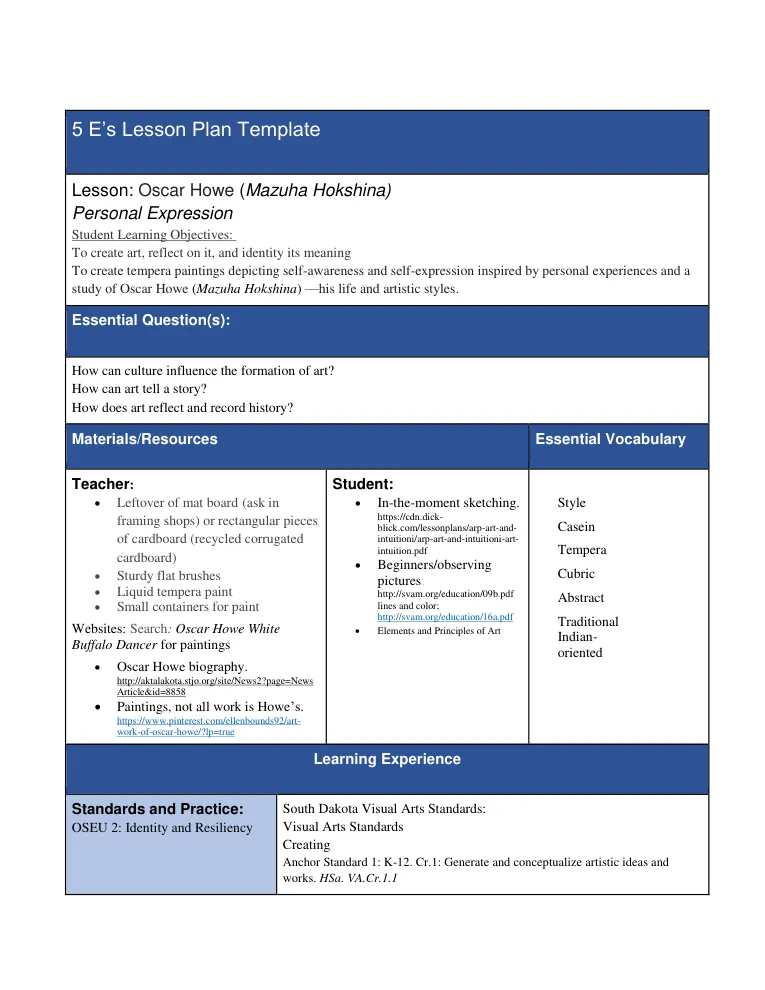
Oscar Howe, the Lakota artist/painter, brings forth Lakota culture through
his subject matter and “Indian-oriented” art techniques. Students imitate his
painting styles with the personal art they create.
Points 1 and 2 in the Explain: Learning Experiences section of this plan
demonstrate how students’ cultural backgrounds integrate into discussions
and learning.
I Can Statement(s):
•
I can identify style and patterns found within Oscar Howe paintings
•
I can explain the major themes Howe used and where he got most
of his subject matter in his works
•
I can create my own Oscar Howe-inspired work of art
•
I can observe key details in Howe’s paintings
•
I can find commonalties among Oscar Howe collections (colors,
mood, emotion) to replicate in my own work of art
•
I can use creative color, symmetrical balance and shapes in the
production of my work of art.
•
I can describe Howe’s most significant contributions to the world
Engage: Activating
Strategy/Hook:
“It is my greatest hope that my paintings may serve to bring the best things
of Indian culture into the modern way of life.” –Oscar Howe
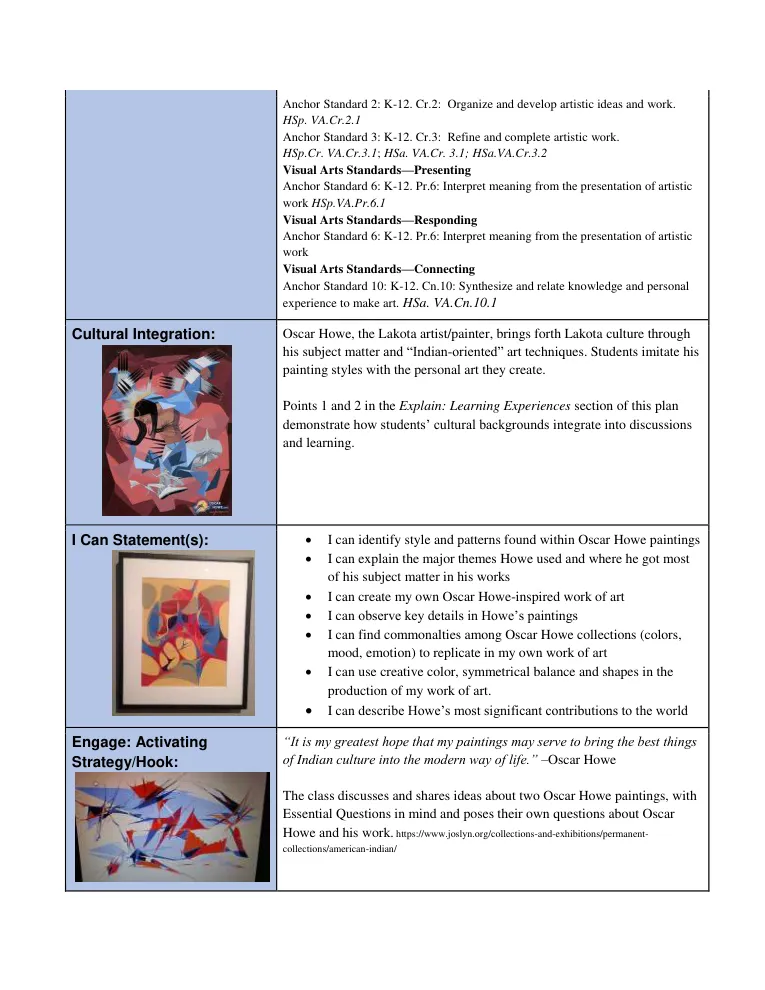
The class discusses and shares ideas about two Oscar Howe paintings, with
Essential Questions in mind and poses their own questions about Oscar
Howe and his work. https://www.joslyn.org/collections-and-exhibitions/permanent-
collections/american-indian/
Explore: Learning
Experiences
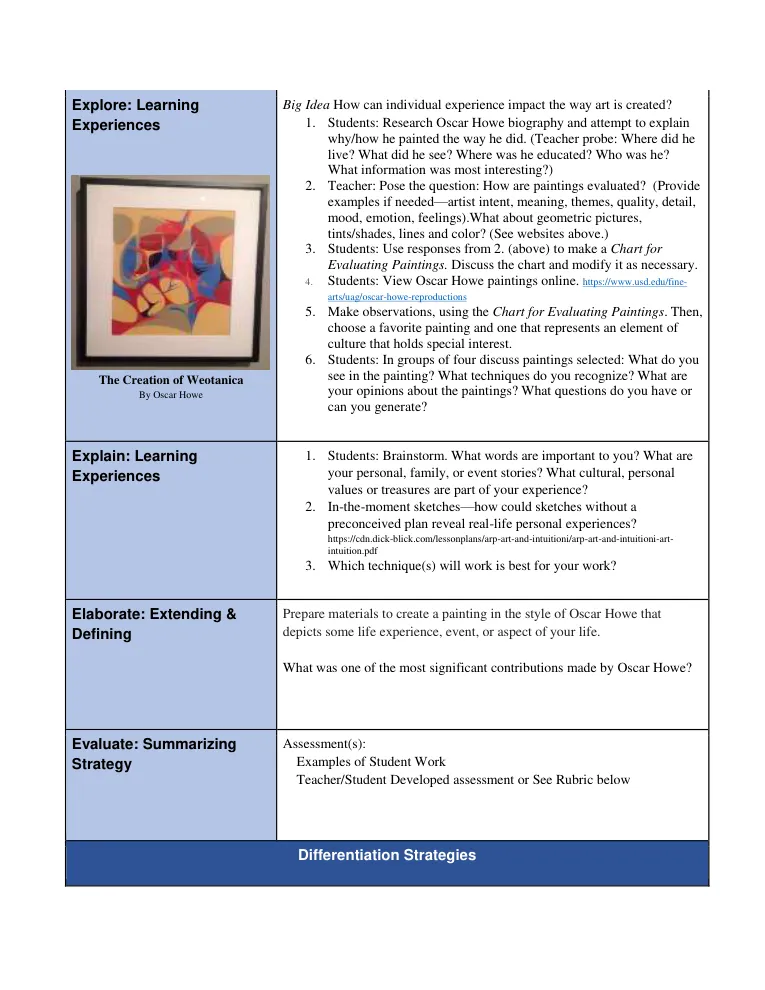
The Creation of Weotanica
By Oscar Howe
Big Idea How can individual experience impact the way art is created?
1. Students: Research Oscar Howe biography and attempt to explain
why/how he painted the way he did. (Teacher probe: Where did he
live? What did he see? Where was he educated? Who was he?
What information was most interesting?)
2. Teacher: Pose the question: How are paintings evaluated? (Provide
examples if needed—artist intent, meaning, themes, quality, detail,
mood, emotion, feelings).What about geometric pictures,
tints/shades, lines and color? (See websites above.)
3. Students: Use responses from 2. (above) to make a Chart for
Evaluating Paintings. Discuss the chart and modify it as necessary.
4.
Students: View Oscar Howe paintings online. https://www.usd.edu/fine-
arts/uag/oscar-howe-reproductions
5. Make observations, using the Chart for Evaluating Paintings. Then,
choose a favorite painting and one that represents an element of
culture that holds special interest.
6. Students: In groups of four discuss paintings selected: What do you
see in the painting? What techniques do you recognize? What are
your opinions about the paintings? What questions do you have or
can you generate?
Explain: Learning
Experiences
1. Students: Brainstorm. What words are important to you? What are
your personal, family, or event stories? What cultural, personal
values or treasures are part of your experience?
2. In-the-moment sketches—how could sketches without a
preconceived plan reveal real-life personal experiences?
https://cdn.dick-blick.com/lessonplans/arp-art-and-intuitioni/arp-art-and-intuitioni-art-
intuition.pdf
3. Which technique(s) will work is best for your work?
Elaborate: Extending &
Defining
Prepare materials to create a painting in the style of Oscar Howe that
depicts some life experience, event, or aspect of your life.
What was one of the most significant contributions made by Oscar Howe?
Evaluate: Summarizing
Strategy
Assessment(s):
Examples of Student Work
Teacher/Student Developed assessment or See Rubric below
Differentiation Strategies
Extension
Intervention
Language
Development
Repeat Nos.1, 4, and 5 in the Explore
section of this lesson plan to examine
works of other Lakota artists, such as
Arthur Amiotte, Donald Montileaux,
Richard Red Owl.
Collaborate to produce a collage of
student-created images
Assessment(s)
Formative
Summative
Assessment(s)
•
Student Daily Logs
•
Examples of Student Work in Progress
•
Teacher Observations and Questions
Teacher/Student Developed assessment (or See Rubric,
below)
Rubric and Teacher Reflection: (Next steps?)
Process
Below Avg.
Satisfactory
Excellent
1
Has clear vision of final product
1, 2, 3
4, 5, 6
7, 8, 9
2
Properly organized to complete project
1, 2, 3
4, 5, 6
7, 8, 9
3
Communicated efforts with
peers/teacher
1, 2, 3
4, 5, 6
7, 8, 9
Product
Below Avg.
Satisfactory
Excellent
1
Creativity
1, 2, 3
4, 5, 6
7, 8, 9
2
Acquired needed knowledge base
1, 2, 3
4, 5, 6
7, 8, 9
3
Demonstrates knowledge
1, 2, 3
4, 5, 6
7, 8, 9
4
Managed time wisely
1, 2, 3
4, 5, 6
7, 8, 9
5. Depicts self-awareness & expression
1, 2, 3
4, 5, 6
7, 8, 9, 10
Total Score:___________________________
Teacher Comments:
Source provenance: OSEU Lesson Plans Old ALL Combined.pdf · WoLakota Project archive. Reformatted for this collection.