The complete archived text is retained here, including details that may extend beyond the inquiry blueprint.
Read the full archived lesson text
5 E’s Lesson Plan Template
Lesson: Owehanhan—Indian Humor
One of the best ways to understand a people is to know what makes them laugh.
Objective: To create cartoons or a comic strip that depicts an aspect of your life and Indian humor, in a positive
way.
“What did the buffalo say to his son as the youngster was leaving for school?” Answer: “By-Son.”
Essential Question(s):
Why does humor hold a special place in Lakota life?
How it is that humor is a basic human need but exists in different forms depending on a peculiar culture?
How can humor work in the lives of all people?
Materials/Resources
Essential Vocabulary
Teacher:
Appendix Nos. 1 and 2
Basic Art Supplies
Student:
Materials for constructing comic strips
such as colored pencils, markers,
drawing paper
Humor
Corrective Humor
Iktomi
Heyoka
Parody, Satire, Irony
Learning Experience
Standards and Practice:
OSEU 2: Identity and Resiliency
Anchor Standard 1: K-12.Cr.1: Generate and conceptualize artistic ideas
and work. HSa.VA.Cr.1.2
Anchor Standard10: K-12.Cn.10: Synthesize and relate knowledge and
personal experiences to make art. HSa.VA.Cn.10.1
Cultural Integration:
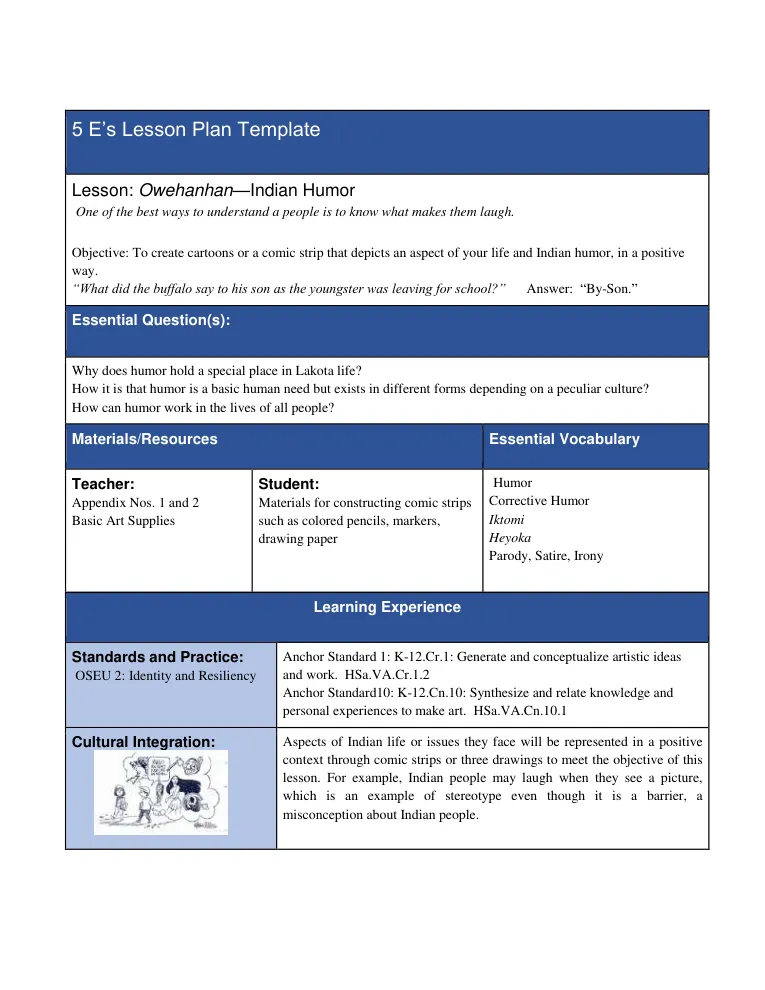
Aspects of Indian life or issues they face will be represented in a positive
context through comic strips or three drawings to meet the objective of this
lesson. For example, Indian people may laugh when they see a picture,
which is an example of stereotype even though it is a barrier, a
misconception about Indian people.
I Can Statement(s):
•
I can see how humor is an important aspect of Indian culture.
•
I can understand how humor works for Indian people.
•
I can use the idea that “laughter is the best medicine” in my life.
•
I can have a good laugh even when times are hard.
Engage: Activating
Strategy/Hook:
Explore: Learning
Experience
Students will be given think-time
for the statements listed, at right.
They will choose 2-3 they find
most interesting and write them
down. (Their statements will be
used in the Elaborate: Extending
and Defining section below)
The Big Idea:
Humor exists in many forms and is
essential as a basic human need.
o Indian humor is about identity
o Indian humor is much more than laughter
o Indian humor is medicine, a healing agent that we all need
o Indian humor is a reflection of our past and in all of us…
o Indian humor is the ability to be flexible while sometimes feeling
powerless against the government and cultural mainstream in
control of life
o Indian humor is unique and as such, is the heart of resilience and
survivability
o Indian humor is a way to understand and heal from personal or
historical trauma, as well as a way to fight adversity
o Indian humor is culturally distinct and complex
o Indian humor is means to escape from a dominant society that has
imposed its values on Indian people and measures Indians against
their standards
o Indian humor is much more than a social lubricant, it’s a tool, an
attitude, a mentality
o Indian humor is an answer to poverty, not the best one, but at least
it is a response
o Indian humor is way of survival
o Indian humor is being an optimist in a world of dominant culture
o Indian humor is sharing emotions with others
o Indian humor is being around Indians who are laughing and there is
nothing else like it in the world
Explain: Learning
Experiences
The comic strip or comics you draw
must depict an aspect of Indian life or
issue they face, in a positive context.
Choose an idea from your own life
experience and challenge yourself to
link it with the concept of Indian
humor.
Drawing the Comic
1. First sketch the frames.
2. Sketch the characters. Next, sketch
in where the characters will go.
3. Add speech bubbles, if characters
speak to each other. Sketch in where
the speech bubbles will go.
4. Sketch in backgrounds and scenes.
5. Do your line work and other
elements of art.
6. Add text.
7. Add color.
Activity: The class will examine a variety of cartoon strips and take notes
about what they see, with attention to the message (idea), format, color,
size, length, and characters. Following a class discussion about the
cartoons, each student will decide on a message he/she wants to
communicate in a comic strip or comic (3 separate messages) and use the
seven steps for Drawing the Comic, at left.
•
How can a message you find in a cartoon strip apply to any of the
points listed above in the Explore Learning Experience section of
this lesson? How does it relate to your own experience? How can
you explain the connection?
•
What are some defining moments of humor in your life?
•
What experiences have been funny?
•
What makes you laugh?
•
How can telling jokes or funny stories about your family or friends
be appropriate for sharing?
•
At what times would it inappropriate to tell a joke?
•
Can you explain why it may be appropriate to laugh at a funeral?
Elaborate: Extending &
Defining
Students will offer their statements
from the Explore: Learning
Experience section above, as part
of the “Opinion Continuum”
activity. (Attachment 1) Teacher
may ask open, probing questions to
get more information or clarify to
help students think more deeply
about their perspectives.”
Students will make a list of statements that hold the most meaning for
them— from the Explore: Learning Experience section of this lesson—
and connect them to their own personal experience
Indian humor takes many forms including: teasing, joking, storytelling
about Iktomi/foolish trickster or personal silly things/experiences, using
“corrective humor”, listening/dancing to ‘49 songs, and the clowning
around of the heyoka (clowns). See Attachment 2.
Evaluate: Summarizing
Strategy
Rumor has it that Columbus began his
journey with four ships. But one went
over the edge so he arrived in the new
world with only three.
Good thing Columbus was not looking
for Turkey or the Virgins (Islands).
Not all jokes are funny though. For
example, Indian humor is filled with
Each student will make a list of questions from the content contained in this
lesson plan. They will make flash cards that have questions on the front and
answers on the back. The class will play Question and Answer to “test”
their understanding of the objective: humor is an important aspect of Indian
life.
Columbus, Custer, and the BIA are favorite Indian jokes. Stupid,
incompetent and inept, it is easy to joke about them: What did Custer tell
the BIA agent before leaving for the Little Big Horn? He said, “Don’t do
anything until I get back.”
parody, satire, and irony to make
points about stereotype and cultural
ignorance. People presume to know,
when they really do not know, what it
is really like to be an Indian. Part of
getting to know Indians is learning
how other people treat them. To
experience racism and prejudice is part
of being Indian and Indian people have
learned to joke about it. From Fixco,
scholar. Daily Life of Native Americans in the
Twentieth Century.
It has been said that sometimes laughing is the only thing to do when you
have almost run out of tears. My grandmother had so many traumatic
experiences, she actually did run out of tears. Fixco explains that there is
very little difference between the emotional threads of crying and laughing.
It is a fine line as tears are involved in both emotions. The human emotion
of laughing has sustained Indian people throughout time. It is a way of
survival. Fixco, scholar. Daily Life of Native Americans in the Twentieth Century.
Differentiation Strategies
Extension
Intervention
Language Development
Students will examine a topic of
interest from the content on
Attachment 2. They will describe it
through any media of their choice
(illustrated story, for example).
Bruce Blitz How to Draw a
COMIC STRIP - YouTube
https://www.youtube.com/watch?v=XHtVJ
daqdqU
Assessment(s)
Formative
Summative
Teacher will check for understanding (Thumbs up,
middle, down) after giving explicit instructions as the
lesson proceeds.
•
Teacher will observe as students fill in comic strip
frames
See Rubric (Attachment 3)
Teacher Reflection: (Next steps?)
Attachment 1
Opinion Continuum
An "opinion continuum" gives students an active way to consider and express their opinions, listen to
others' opinions, and begin discussing the issue. Begin by establishing some ground rules for the
discussion. Ground rules should include:
•
listen carefully to statements made by other students
•
no interrupting
•
it's okay to disagree
Designate different corners of the room as "Strongly agree," "strongly disagree," and "not sure, don't
know or no opinion." Then read a statement and ask each student to react to the statement by moving to
the appropriate part of the room.
Begin with a trivial statement, such as "Chocolate is the best flavor of ice cream." Then move on to the
“Indian Humor is…” statements in the Explore: Learning and Experiencing section of this lesson.
Ask students representing each point of view to state several reasons why they hold their view. Make sure
to get a wide range of opinions. It is helpful to summarize what students say to make sure all students
understand each perspective. It is also helpful to ask open, probing questions to get more information or
clarifying questions to help students think more deeply about their own perspective. A variation is to have
each speaker summarize the opinion of the previous speaker before expressing his/her own views.
After several students with different opinions have shared their thoughts, ask if anyone would like to
change their opinion based on new information. It is important to acknowledge the value of remaining
open to new information and being able to change one's mind when presented with new information. This
is a way that we all learn.
Use some of the statements in the Explore: Learning and Experiencing section at the beginning of the
lesson. These steps can be repeated using other statements or by making up your own statements based
on what you think would make sense for your students—at a midpoint or at the end of the lesson. A vital
part of this lesson is to provide safety for opinions that might be unpopular.
Attachment 2
Indian humor takes many forms including teasing, joking, storytelling (personal silly things and
experiences; Iktomi/foolish trickster), listening/dancing to ‘49 songs, acknowledging heyoka (clowns) and
“corrective humor”.
Corrective Humor— Felix Cohen, the great legal scholar, tells about this: "A chief who forgets that he is
a public servant and tries to order others around has always been an object of ridicule." He wrote, "…and
Indian laughter has rippled down the centuries and upset many thrones."
Teasing— gradually people learned to anticipate teasing and began to tease themselves as a means of
showing humility and at the same time advocating a course of action they deeply believed in.
Vine DeLoria, Jr. (Sioux) Indian Humor warehouse.olc.edu/~prooks/webfolder/.../DeLoria_-_Indian_humor.pdf
f
Joking— According to the Lakota/Navajo cultural coordinator at the American Indian Center of Chicago,
this is not only American Indian Heritage Month, aka Native American Awareness Month, but, as he put
it, “Rent-an-Indian Month”. And this coming Thursday? In some circles, it is commemorated as
Thankstaking…Most Native people I know realize that mainstream Americans have no idea that Indian Humor, as it is called,
exists. “We’re either stoic and noble or tragically flawed, you know? I get so tired of that,” an Osage lawyer in Washington, DC
told me, sighing, before returning to what she called her “roast beast” sandwich. Disconnections run deep.
Non Natives ask me, furtively, “What do you call them?” Them. Well, because I’m not a them, I say Native Americans. Those
who are them, though, generally call one another — if the group goes beyond family, clan, or tribal affiliation — Indians. Here
again, though, is joke opportunity. A Lakota woman told me an uncle often carried on about having been “just an Indin,” as old
folks tended to pronounce it, then figured he had to call himself an American Indian, then worked on being a Native, then Native
American, then to keep all bases covered, identified himself as a Native American Indian, while going from being considered
Sioux to Lakota. At some point, he felt he should call himself “indigenous,” too. His recital ended, life was much simpler when
he was “just an Indin.”
Where did the notion of Native Americans not having a sense of humor come from? Maybe it started with photography, when
people had to stand unsmiling, still rather than blur the image. Maybe posing for photo ops with federal officials who were trying
to seize more of one’s land did not bring smiles, either. Nor have I ever seen happy faces in photos of Native people waiting for
promised rations (in exchange for the land) that were late, spoiled, meager, or all three. Photos of Native children unwillingly
taken from their homes to boarding schools to be “civilized,” by stripping them of their own civilization, also are bereft of humor
— bereft the operative word.
Things are much funnier now. There is, for example, the assumption by many nons that since the advent of Indian casinos, all
Indians are rich. That’s rich. The mascot issue is another laff riot: naming sports teams for a group of humans as if they are
inhuman. The Washington Redskins! Idaho’s Salmon Savages!
Around the world, Americans are known…for their humor. Why shouldn’t Native Americans contribute to that reputation, as
they contribute to America’s Armed Forces and, yes, tax base? Furthermore, how does any minority group cope with mind-
boggling cluelessness from outsiders? They laugh…
At a Native conference I attended, a Yakama woman described her frustrations trying to educate clueless nons about tribal
fishing rights. “College students,” she said, as if they should know better, ask, “`Are you full-blooded?’” The hundred or so
conference attendees gasped at this rudest of questions. “I say, `No, I’m a pint short. Just came back from the Red Cross.’”
This Thanksgiving, let us solemnly remember what one Native person said to another while watching the pilgrims arrive.
“There goes the neighborhood.” See more by Alison Owings at: HuffPosthttps://www.huffingtonpost.com/alison.../indian-humor-
during-thank_b_786651.html
Storytelling— Kenneth Lincoln author, Native American Resistance says that Indians survive through
laughter as we revitalize old stories. Indian humor is rooted in life lessons according to Deloria, Custer
Died for your Sins. The stories are lessons in morality and social order, especially those of Iktomi who
does humorous foolish things, even though his example has a sacred context. The spirituality nature
comes through as AICA executive director Janeen Antoine (Sicangu Lakota) has said, “Humor gives us a
cosmic fix and takes us out of our center of the universe, enabling us to laugh at ourselves.” The stories
bond friends, relatives, and communities; making them laugh brings them together. Fixco, scholar, Daily Life of
Native Americans in the Twentieth Century.
’49 Songs— are another genre of Indian humor. The "’49" song has humorous lyrics almost always in
English. These intertribal songs tell of unrequited love, heartache, poverty, and reservation life, all in
round-dance cadence. From WWII to the present, "49" songs - sometimes along with a six pack or two,
have put a happy ending to many pow-wow nights and convention afterhours.
Heyoka—Charles Trimble Red Willow, Oglala Lakota (indiancountrymedia network.com) says that
among the various roles of the heyoka, “the contrary” was that of making fun and laughter. Mylo
Redwater Smith, professional comedian, elaborates: Indian humor is much more than a social lubricant,
it’s a tool, an attitude, a mentality…just like the heyokas (Dakota comedians who are sacred) did a
long time ago.
Attachment 3
Comic Strip Rubric
Student Name _ Period
Organization
Original illustrations
are detailed,
attractive, creative
and reflect to Indian
issues/humor or
related personal
experiences.
Original illustrations
are somewhat
detailed, attractive,
and reflect Indian
issues/humor or
related personal
experiences.
Original illustrations
relate Indian
concepts found
within this lesson.
Illustrations are not
present OR they are
not original.
Clarity/ Neatness/
Organization
Comic Strip or
Cartoon is easy to
read clearly written
and drawn. All
information is
organized
appropriately.
Comic Strip or
Cartoon is easy to
read clearly written
and drawn. Most
information is
organized
appropriately.
Comic Strip or
Cartoon is
somewhat easy to
read and clearly
written and drawn.
Some information is
organized
appropriately.
Organization of
material is
confusing to the
reader. Comic Strip
or Cartoon is hard
to read and not
clearly written and
drawn.
Spelling,
Grammar &
Proofreading
No spelling errors
No more than 1
spelling error
No more than 3
spelling errors
Several spelling
errors
Dialogue/ Text
There is an
appropriate amount
of dialogue and text
to bring the
characters to life,
make the message
clear and it is always
clear which
character is
speaking.
There is too much
dialogue and text in
this story, but the
message is clear and
it clear which
character is
speaking.
There is not quite
enough dialogue or
text in this story to
make the message
clear, but it is always
clear which
character is
speaking.
The message is not
clear. It is not clear
which character is
speaking.
Source provenance: OSEU Lesson Plans Old ALL Combined.pdf · WoLakota Project archive. Reformatted for this collection.