The complete archived text is retained here, including details that may extend beyond the inquiry blueprint.
Read the full archived lesson text
Fine Arts 5 Es Lesson
Lesson: Šhuŋka Wakáŋ—Beautiful Pure Innocence With-Energy
Objective: To honor the Horse Nation in Lakota Society through creative art-making.
Lakĥota communities have yielded different words and even different meanings for the word, horse. Šhuŋka Wakáŋ, is the
most common contemporary way to say the word in the Lakota language. “Holy Dog,” is an interpretation, but Lakhota
elders say that in the traditional sense the word shunka means “pitiful,” not in the western mindset of downtrodden but as
“beautiful, innocent and pure.” Part of the Lakĥota word for horse, wakáŋ, reaches back to creation. When Iŋyáŋ, stone, let
his blood flow, his blood which ran blue became the waters of the world. His blood was Kaŋ, full of energy with power to
destroy and to give life. When the Lakĥóta say Wakáŋ, it means something with energy, energy with good and negative
potential. Taken altogether, Šhuŋka Wakáŋ means “Beautiful Pure Innocence With Energy.”
Thefirstschout.blogspot.co/2013/05/traditional-lakot-horsemanship-lives.html
Lakhota people…look at the horse as having its own nation…everything out there is a nation unto itself…everything has a
spirit. thefirstschout.blogspot.co/2013/05/traditional-lakot-horsemanship-lives.html
Essential Question(s):
Why it is that Lakota origin stories of the horse differ but are the same in other ways?
Why was the Horse Nation honored as “spiritual kin” as much as the Buffalo Oyate was in Lakota life?
How can communities retain cultural significance of horses in the future—onipikteca (that we shall live)?
Materials/Resources
Essential Vocabulary
Teacher:
•
Elements of Art
•
Principles of Art
•
Attachments:
Origin Stories
Jigsaw method for
readings, preparation
Student:
Art Supplies
šúŋkawakȟaŋ (“holy dog”)
Origin
Oyate
Ledger
Exploits
Wakan
Coup
Learning Experience
Standards and Practice:
OSEU 3: Culture and Language
The origin, thought and philosophy of
the Oceti Sakowin continues in the
contemporary lifestyles of tribal
members. Tribal cultures, traditions
Anchor Standard 2: K-12.Cr.2: Organize and develop artistic ideas and work.
6-8.VA.Cr. 2.1
6-8.VA.Cr.2.3
Anchor Standard 7: K-12.Re.7: Perceive and analyze artistic work.
6-8.VA.Re.7.1
and languages are incorporated and
observed by many tribal members both
on and off the reservations.
Cultural Integration:
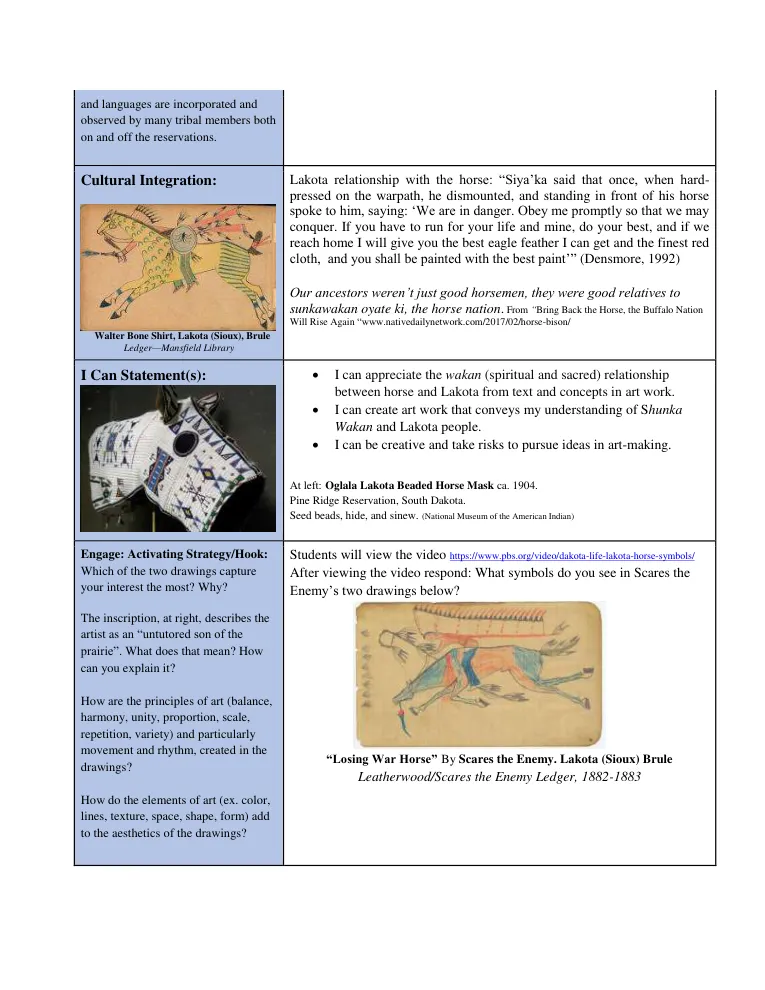
Walter Bone Shirt, Lakota (Sioux), Brule
Ledger—Mansfield Library
Lakota relationship with the horse: “Siya’ka said that once, when hard-
pressed on the warpath, he dismounted, and standing in front of his horse
spoke to him, saying: ‘We are in danger. Obey me promptly so that we may
conquer. If you have to run for your life and mine, do your best, and if we
reach home I will give you the best eagle feather I can get and the finest red
cloth, and you shall be painted with the best paint’” (Densmore, 1992)
Our ancestors weren’t just good horsemen, they were good relatives to
sunkawakan oyate ki, the horse nation. From “Bring Back the Horse, the Buffalo Nation
Will Rise Again “www.nativedailynetwork.com/2017/02/horse-bison/
I Can Statement(s):
•
I can appreciate the wakan (spiritual and sacred) relationship
between horse and Lakota from text and concepts in art work.
•
I can create art work that conveys my understanding of Shunka
Wakan and Lakota people.
•
I can be creative and take risks to pursue ideas in art-making.
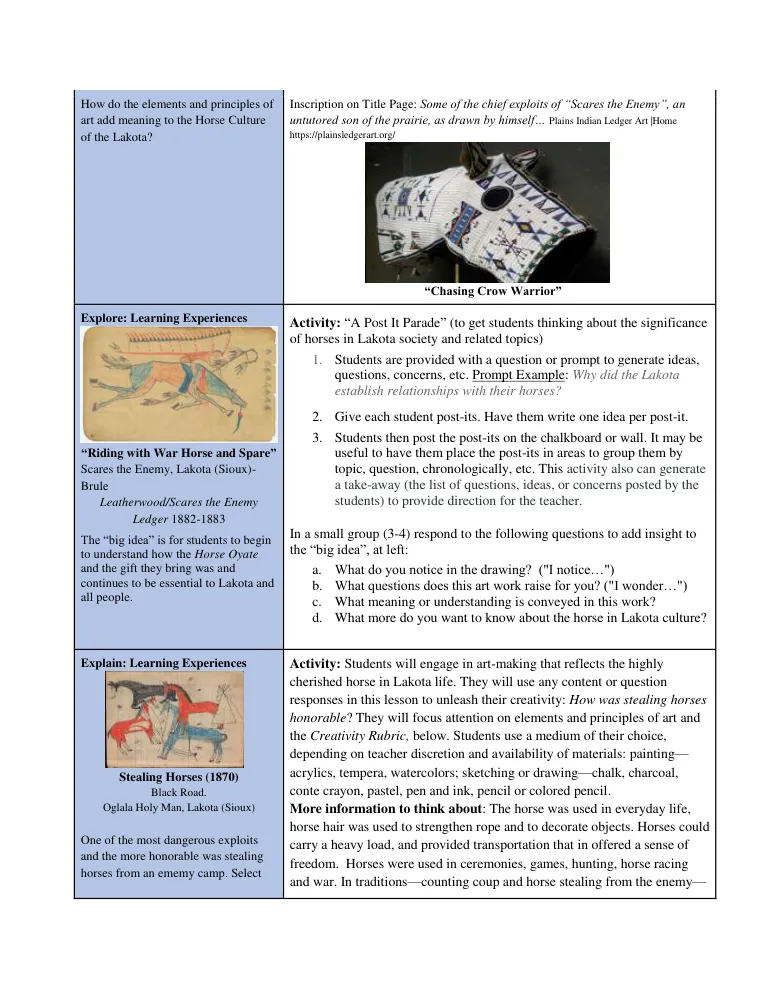
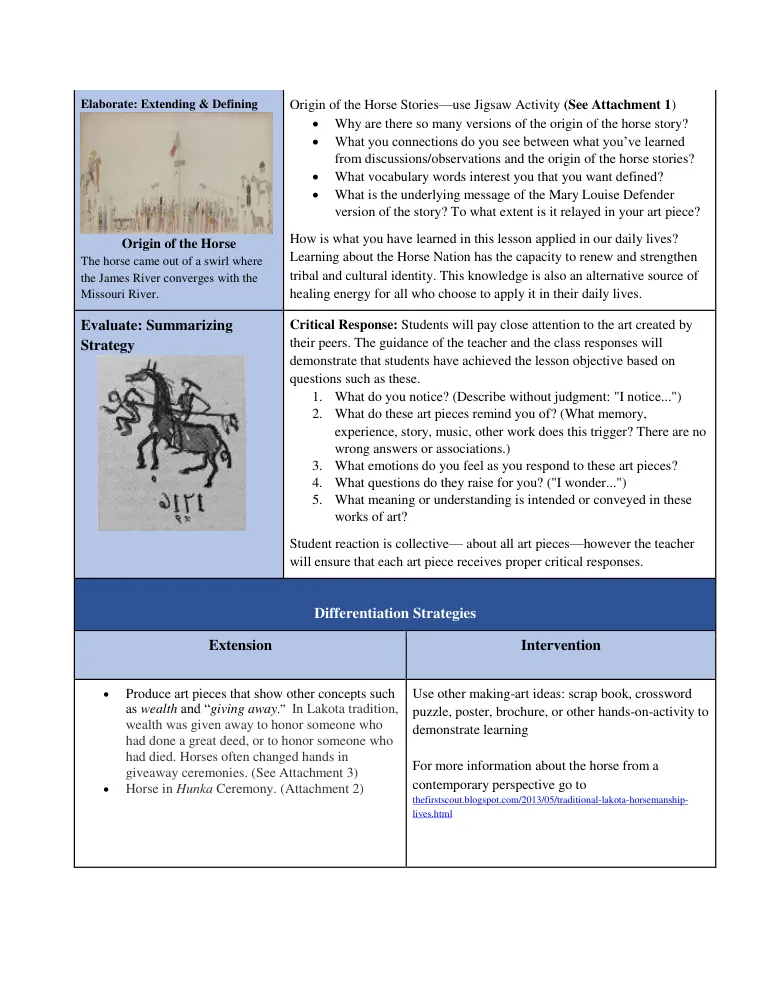
At left: Oglala Lakota Beaded Horse Mask ca. 1904.
Pine Ridge Reservation, South Dakota.
Seed beads, hide, and sinew. (National Museum of the American Indian)
Engage: Activating Strategy/Hook:
Which of the two drawings capture
your interest the most? Why?
The inscription, at right, describes the
artist as an “untutored son of the
prairie”. What does that mean? How
can you explain it?
How are the principles of art (balance,
harmony, unity, proportion, scale,
repetition, variety) and particularly
movement and rhythm, created in the
drawings?
How do the elements of art (ex. color,
lines, texture, space, shape, form) add
to the aesthetics of the drawings?
Students will view the video https://www.pbs.org/video/dakota-life-lakota-horse-symbols/
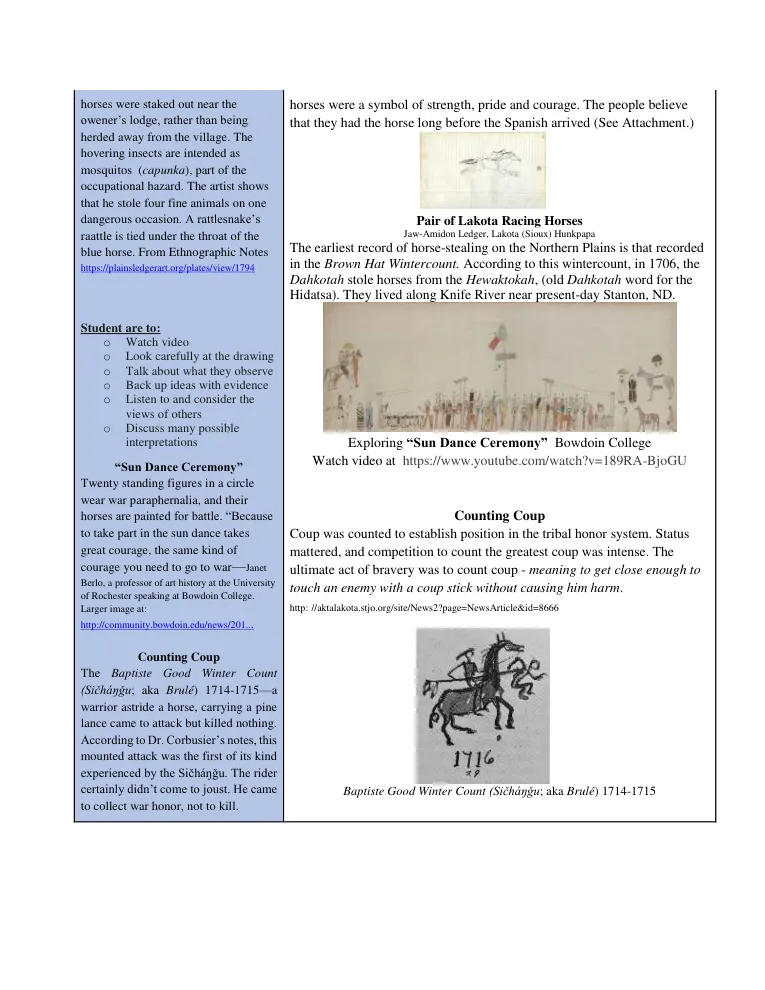
After viewing the video respond: What symbols do you see in Scares the
Enemy’s two drawings below?
“Losing War Horse” By Scares the Enemy. Lakota (Sioux) Brule
Leatherwood/Scares the Enemy Ledger, 1882-1883
How do the elements and principles of
art add meaning to the Horse Culture
of the Lakota?
Inscription on Title Page: Some of the chief exploits of “Scares the Enemy”, an
untutored son of the prairie, as drawn by himself… Plains Indian Ledger Art |Home
https://plainsledgerart.org/
“Chasing Crow Warrior”
Explore: Learning Experiences
“Riding with War Horse and Spare”
Scares the Enemy, Lakota (Sioux)-
Brule
Leatherwood/Scares the Enemy
Ledger 1882-1883
The “big idea” is for students to begin
to understand how the Horse Oyate
and the gift they bring was and
continues to be essential to Lakota and
all people.
Activity: “A Post It Parade” (to get students thinking about the significance
of horses in Lakota society and related topics)
1. Students are provided with a question or prompt to generate ideas,
questions, concerns, etc. Prompt Example: Why did the Lakota
establish relationships with their horses?
2. Give each student post-its. Have them write one idea per post-it.
3. Students then post the post-its on the chalkboard or wall. It may be
useful to have them place the post-its in areas to group them by
topic, question, chronologically, etc. This activity also can generate
a take-away (the list of questions, ideas, or concerns posted by the
students) to provide direction for the teacher.
In a small group (3-4) respond to the following questions to add insight to
the “big idea”, at left:
a. What do you notice in the drawing? ("I notice…")
b. What questions does this art work raise for you? ("I wonder…")
c. What meaning or understanding is conveyed in this work?
d. What more do you want to know about the horse in Lakota culture?
Explain: Learning Experiences
Stealing Horses (1870)
Black Road.
Oglala Holy Man, Lakota (Sioux)
One of the most dangerous exploits
and the more honorable was stealing
horses from an ememy camp. Select
Activity: Students will engage in art-making that reflects the highly
cherished horse in Lakota life. They will use any content or question
responses in this lesson to unleash their creativity: How was stealing horses
honorable? They will focus attention on elements and principles of art and
the Creativity Rubric, below. Students use a medium of their choice,
depending on teacher discretion and availability of materials: painting—
acrylics, tempera, watercolors; sketching or drawing—chalk, charcoal,
conte crayon, pastel, pen and ink, pencil or colored pencil.
More information to think about: The horse was used in everyday life,
horse hair was used to strengthen rope and to decorate objects. Horses could
carry a heavy load, and provided transportation that in offered a sense of
freedom. Horses were used in ceremonies, games, hunting, horse racing
and war. In traditions—counting coup and horse stealing from the enemy—
horses were staked out near the
owener’s lodge, rather than being
herded away from the village. The
hovering insects are intended as
mosquitos (capunka), part of the
occupational hazard. The artist shows
that he stole four fine animals on one
dangerous occasion. A rattlesnake’s
raattle is tied under the throat of the
blue horse. From Ethnographic Notes
https://plainsledgerart.org/plates/view/1794
Student are to:
o
Watch video
o
Look carefully at the drawing
o
Talk about what they observe
o
Back up ideas with evidence
o
Listen to and consider the
views of others
o
Discuss many possible
interpretations
“Sun Dance Ceremony”
Twenty standing figures in a circle
wear war paraphernalia, and their
horses are painted for battle. “Because
to take part in the sun dance takes
great courage, the same kind of
courage you need to go to war—Janet
Berlo, a professor of art history at the University
of Rochester speaking at Bowdoin College.
Larger image at:
http://community.bowdoin.edu/news/201...
Counting Coup
The Baptiste Good Winter Count
(Sičháŋǧu; aka Brulé) 1714-1715—a
warrior astride a horse, carrying a pine
lance came to attack but killed nothing.
According to Dr. Corbusier’s notes, this
mounted attack was the first of its kind
experienced by the Sičháŋǧu. The rider
certainly didn’t come to joust. He came
to collect war honor, not to kill.
horses were a symbol of strength, pride and courage. The people believe
that they had the horse long before the Spanish arrived (See Attachment.)
Pair of Lakota Racing Horses
Jaw-Amidon Ledger, Lakota (Sioux) Hunkpapa
The earliest record of horse-stealing on the Northern Plains is that recorded
in the Brown Hat Wintercount. According to this wintercount, in 1706, the
Dahkotah stole horses from the Hewaktokah, (old Dahkotah word for the
Hidatsa). They lived along Knife River near present-day Stanton, ND.
Exploring “Sun Dance Ceremony” Bowdoin College
Watch video at https://www.youtube.com/watch?v=189RA-BjoGU
Counting Coup
Coup was counted to establish position in the tribal honor system. Status
mattered, and competition to count the greatest coup was intense. The
ultimate act of bravery was to count coup - meaning to get close enough to
touch an enemy with a coup stick without causing him harm.
http: //aktalakota.stjo.org/site/News2?page=NewsArticle&id=8666
Baptiste Good Winter Count (Sičháŋǧu; aka Brulé) 1714-1715
Elaborate: Extending & Defining
Origin of the Horse
The horse came out of a swirl where
the James River converges with the
Missouri River.
Origin of the Horse Stories—use Jigsaw Activity (See Attachment 1)
•
Why are there so many versions of the origin of the horse story?
•
What you connections do you see between what you’ve learned
from discussions/observations and the origin of the horse stories?
•
What vocabulary words interest you that you want defined?
•
What is the underlying message of the Mary Louise Defender
version of the story? To what extent is it relayed in your art piece?
How is what you have learned in this lesson applied in our daily lives?
Learning about the Horse Nation has the capacity to renew and strengthen
tribal and cultural identity. This knowledge is also an alternative source of
healing energy for all who choose to apply it in their daily lives.
Evaluate: Summarizing
Strategy
Critical Response: Students will pay close attention to the art created by
their peers. The guidance of the teacher and the class responses will
demonstrate that students have achieved the lesson objective based on
questions such as these.
1. What do you notice? (Describe without judgment: "I notice...")
2. What do these art pieces remind you of? (What memory,
experience, story, music, other work does this trigger? There are no
wrong answers or associations.)
3. What emotions do you feel as you respond to these art pieces?
4. What questions do they raise for you? ("I wonder...")
5. What meaning or understanding is intended or conveyed in these
works of art?
Student reaction is collective— about all art pieces—however the teacher
will ensure that each art piece receives proper critical responses.
Differentiation Strategies
Extension
Intervention
•
Produce art pieces that show other concepts such
as wealth and “giving away.” In Lakota tradition,
wealth was given away to honor someone who
had done a great deed, or to honor someone who
had died. Horses often changed hands in
giveaway ceremonies. (See Attachment 3)
•
Horse in Hunka Ceremony. (Attachment 2)
Use other making-art ideas: scrap book, crossword
puzzle, poster, brochure, or other hands-on-activity to
demonstrate learning
For more information about the horse from a
contemporary perspective go to
thefirstscout.blogspot.com/2013/05/traditional-lakota-horsemanship-
lives.html
Assessment(s)
Formative
Checklist—a peer critique of preparatory sketching for
revising art-making activity:
Summative
o
Uses idea-generating techniques to develop original ideas.
o
Evaluates quality of ideas for best ones to shape into an art piece.
o
Asks questions, for new perspective to improve on selected idea.
o
Seeks out & uses feedback/critique to revise to concept.
o
Uses ingenuity/imagination outside of conventional boundaries.
This is a good Creativity Rubric for assessing
originality, knowledge, tools, and reflection. Print it
out at: http://ihsnyc.org/portfolio/creativerubric.pdf
Teacher Reflection: (Next steps?)
Attachment 1
Missouri River Mythos By: Dakotah Goodhouse
The arrival of the horse on the Missouri River.
The Dakota-Lakota people have many story variations of the horse and its arrival on the Northern
Plains. All of the stories relate the respect for the mystery of creation and all its unrevealed sacred gifts
for humanity. That respect for the horse and the connection that the Lakota felt for it is reflected in the
names for this first encounter, such as: Elk-Dog, Holy Dog, Spirit Dog, or Mysterious Dog. In Dakota or
Lakota, the word for dog is simply Sunka (to be a dog; pronounced shoon-KAH).
Previously, the Dakota-Lakota had no word for horse, and at first sight, probably said something like
Le anpetu kin sunka wan lila wakan ca wawayanke welo, meaning: this day, a dog was very powerful and
I saw it.” The dog was domesticated and commonplace, the horse wasn’t just big but powerful- and it
could help them.
Jigsaw Activity can be used with origin stories that follow.
• Divide students into small jigsaw groups (3-6) choosing one student as the leader.
• Divide the day’s lesson into 3-6 segments, depending on the size of the groups and the amount of material that needs to be covered.
• Assign each student to learn one segment, making sure students have direct access only to their segment.
• Give students time to read their segment at least twice and become familiar with it.
• Form temporary “expert groups” by having one student from each jigsaw group join other students assigned to the same segment to share their
information learned.
• Bring the students back to their original jigsaw group, and have each student share his/her segment with the rest of the group. • At the end of the
session, have some form of assessment (e.g., quiz, discussion questions, written paper, graphic organizer, etc.) available to check for
understanding.
This shows students that individual accountability for learning all the information, although presented as a group, is the objective of the activity
Origin Story. Mary Louise Defender-Wilson, Wagmuhawin (Gourd Woman), a traditional story-
teller of the Ihanktowana Dakota (Yanktonai), and enrolled member of the Standing Rock Sioux Tribe
shares the story of the horse and its arrival… According to Defender-Wilson, a long time ago, there were
two men who went out hunting along the Mnisose (Missouri River). They called the river Mnisose,
pronounced Mih-NEE shoh-shay; Mni meaning Water, sose meaning Roiling, A-stir, or Swirling. Think
of stirring a cup of coffee after you’ve added cream or sugar.
These two hunters followed the course of Mnisose and noticed that a great swirl began to appear in the
river. As they stood transfixed watching the swirl grow, a violent thunderstorm suddenly manifested itself
about them. The two hunters kept as much out of the way of the storm as anyone caught in the rain could,
but they trained their eyes on the swirl in the river. As they stood watching the churning water, a bolt of
lightning came out of the sky and struck it.
From the middle of the swirl appeared what looked like a head with a long face. As this head with a
long face followed the swirl about in circles, a long neck was revealed as the head and face were lifted out
of the water, then [there was] a great body, like that of an elk. This creature fought the current of the
swirl, broke free, and swam for the shore where the hunters stood watching.
The creature ascended the bank of the Mnisose, shook itself, and walked into the grasses where it
began to graze. The hunters knew then it was similar to the bison, elk, and deer. Curious about the
creature, the hunters watched it for a while and then decided to approach it, but as they neared it, it ran
away. As close as hunters were able to get to the creature, they noticed that it had a little one with it,
which was just as skittish as the mother. The hunters thought that the creature and its little one were
somewhat like the other four-leggeds, wild and wary of people, but also unlike deer, elk, moose, and
bison. The hunters and the creatures knew there was a connection between the other.
The hunters went back to their people and told them of the grace and strength of this new creature and
its awareness of the connection to them. They talked amongst themselves about the nature of the creatures
seeming domesticated nature and its purpose in the natural world. The people eventually came to the
conclusion that the creature was sent to help the people in hunting, travelling, and moving.
The people met amongst themselves some more about how best to approach and appropriate this new
creature in village life. They finally involved the village singers to compose a song of invitation to the
creature and its little one, because they didn’t want to capture them and force them into a new life.
The people believed this new creature was sent to them to ease their burdens, like the sunka. In those
long ago days, the “dog days” as the elders call them, dogs helped the women haul things like firewood or
personal belongings on a sunonk unpa (a dog-drag, or dog travois; pronounced shoon OHNK oon-PAH)
alongside the men or women as they also hauled their belongings on wanjiksila (a one-person travois;
pronounced wahn-ZEEK-shee-LAH). The dogs served as guard dogs, especially as watchdogs over
children, for in those days enemy tribes used to steal children, even as the Teton used to take children
from the enemy.
The singers composed and sang the first horse songs, to tame them, and brought them into village life.
As the horse adjusted to life among the people, it came to help them. The people learned to fashion
saddles, bridles, and sununkonpa (a pony-drag, or travois; pronounced shoon-OON-k-ohn-pah).
The “dog days” ended. The days of the Plains Indian horse culture began. Defender-Wilson tells the
story with the lesson of respect for all of the gifts of the creator.
The John K. Bear Wintercount, an Ihanktowana (Yanktonai) pictographic record of the history of that
tribe, tells us when the horse arrived. Waniyetu ehani, Sung noni ota kin, translated to mean, there were
many wild horses this year. Counting back from key entries which are correlated to major events like
smallpox, war, or astronomical events, this particular reference to horses is the earliest date at 1692.
In 1692, the Ihanktowana Dakota were living in earthlodge villages, not unlike the Arikara, Hidatsa, and
Mandan Indians, along the Cansansan Wakpa (Whitewood River; pronounced chahn-SAHn-sahn wahk-
PAH), known today as the James River. Where the Cansansan Wakpa and Mnisose converge was a
favorite wintering site of the Ihanktowana. It is this author’s conjecture that the Ihanktowana were
arriving to this site in the fall, camping there over the winter, or leaving there in the spring, when they
encountered the horse.
It may be that as some hunters crested a hill along the banks of the Missouri River, as a thunderstorm
was approaching, horses were coming out of the river from the swirls they created themselves as they
swam.
Of course, the horse was here in North America thousands of years ago, up until the last ice age.
It may be that as the environment changed they were unable to adapt or that the Paleo-Indians hunted
them to extinction. The essence of the American mustang had already run these grounds, the free spirit of
the horse in North America was only to be rediscovered when the Spanish brought horses with them.
All these first encounters with the horse and these earliest native records relate to it all originating
along the Missouri River. For many of the First Nations living today in North Dakota, the Missouri River
is where the American Indian horse culture began. The arrival of the horse changed everything from trade
and travel to warfare. For natives living along the river on the Upper Missouri, their sense of place
embraced a larger view of the Northern Plains. They and the horses they rode belong here.
Greg Holy Bull, in Red Scaffold on the Cheyenne River Sioux Indian Reservation… story of
the Lakĥóta story of the horse. thefirstscout.blogspot.com/2013/05/traditional-lakota-horsemanship-lives.html
A long time ago, the people traveled west to some mountains, then turned south where they encountered a
camp of people whom they had never before met. In that camp, they noticed too, that there was an animal
that they had never before seen. Unfortunately, enthusiasm of first contact swiftly broke down and
violence broke out. During the conflict, the horses broke free and scattered. Warriors went into the new
enemies’ camp during the fight and stole women thinking to make wives of them. The people, the
Lakĥota, made a run north with the enemy in hot pursuit. Gradually, it happened that the enemy lost heart
and turned back. The people slowed their flight in response the enemy retreat and to their wonder,
encountered the harras. Warriors wanted these horses and tried taking them without success. In the
evening, after camp was established, the enemy women went out in the field and sang to the horses which
drew them in. With the horses drawn closer to the familiarity and soothing tone of the women, warriors
would attempt to capture them to no avail. All the while the tiyošpaye kept moving. A day came when
they came to a river, there they made an abrupt turn east, back to their ancestral territory, and lo, the
harras followed. Gradually the horses and warriors came to an understanding and so that’s how this one
band of Lakĥota came to have the horse.
Note: According to the story, the enemy whom the Lakĥóta took women and horses from were the
Spanish.
A story… from Mr. Albert Foote Sr. who heard from his Lala (grandfather) the origin of the horse
thefirstscout.blogspot.com/2013/05/traditional-lakota-horsemanship-lives.html
A long time ago, Thuŋkášhila [Grandfather, in reference to a higher power] had an omníčiye [a
gathering] of all the nations in one place. There, Thuŋkášhila told them there would one day appear a two-
legged, that’s coming. “They’re going to be uŋšíka [pitiful]. They’re not going to be able to see as good as
you. They’re not going to be able to hear as good as you. They’re not going to be as strong as you. And
they’re not going to be as fast as you are. So, who amongst you is willing to help them?”
said Thuŋkášhila. After this question was posed, one of the šung wakaŋ took off
running. Thuŋkášhila then sent Waŋbli [the Eagle] after, “Talk to him. And ask him if he’ll help the two-
legged.” The eagle caught up to the horse, “Why are you running?” The horse replied, “They’re going to
be a burden to me. They’re going to ride me and they’re going to want me to carry their things.” The
eagle alighted on the horse’s rump and said, “This is how much of a burden they’re going to be.” But the
horse kicked that eagle off of him. Eagle went back to the gathering and told Thuŋkášhila what
transpired. Thuŋkášhila said, “No. You must go back and convince him.” Eagle returned to the horse, but
by then it had started to rain and horse had been running for a long time and was sweating profusely.
Again, eagle said, “Let me show you how much of a burden they’re going to be,” and again alighted onto
horse’s back, and shook himself, and as eagle shook himself, his center plume came out and came to rest
on horse’s back. Horse began to protest with wild bucks back and forth, but because he was sweaty from
running and wet from the rainfall, horse could not dislodge the feather. Eventually, horse relented and
said, “I’ll be the one. I’ll be the one to carry their burden.
Attachment 2
THE HUNKA CEREMONY.
[There is] a practice of assuming the Hunka relationship has existed among the Lakota since ancient
times. It is probable that at first there was little ceremony other than an agreement between two persons;
but that when the practice became more common the Shamans assumed control, adding rites until the
ceremony assumed its present form. The most common designation of the ceremony is, "They Waved
Horse-tails over Each Other." This appears to fix the time when the ceremony was given its present
form, for it alludes to a prominent rite of the ceremony. According to the Oglala calendar a certain year is
designated as "When They Waved Horse-tails over Each Other."
The Lakota custom was to name each year according to some event that was peculiar to, or first
noticeable, during that year. Therefore, it is probable that the year "When They Waved Horse-tails over
Each Other" was the year when the Hunka ceremony was first performed with the rite of waving horse-
tails over each other, or, at least, the year when this rite was first noticeable. This year corresponds to
A.D. 1805. Perhaps at that time the horse was a rare animal to the Lakota and as its tail was the most
noticeable feature, the Lakota considered it sacred, with the potency of sacred things, in the same manner
as they considered sacred the tail of a buffalo. The old Lakota still so consider horse-tails and wave them
over others to cause an amicable influence. 1 Oglala Sun Dance: The Hunka Ceremony: The Hunka Ceremony
www.sacred-texts.com/nam/pla/sdo/sdo34.htm
Attachment 3
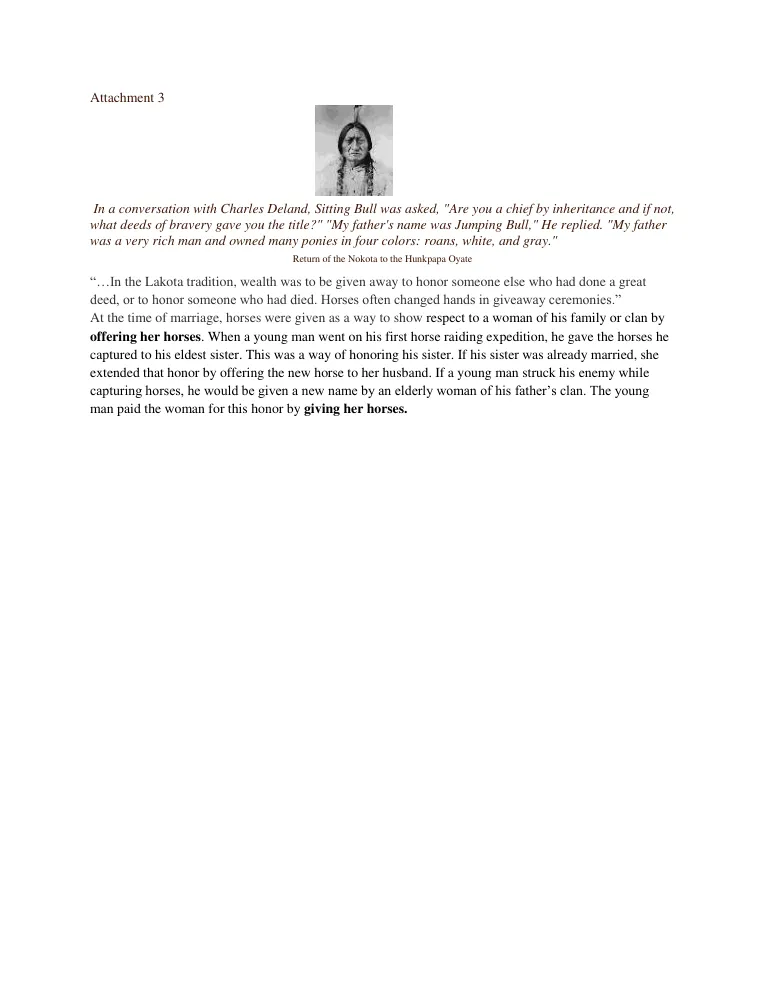
In a conversation with Charles Deland, Sitting Bull was asked, "Are you a chief by inheritance and if not,
what deeds of bravery gave you the title?" "My father's name was Jumping Bull," He replied. "My father
was a very rich man and owned many ponies in four colors: roans, white, and gray."
Return of the Nokota to the Hunkpapa Oyate
“…In the Lakota tradition, wealth was to be given away to honor someone else who had done a great
deed, or to honor someone who had died. Horses often changed hands in giveaway ceremonies.”
At the time of marriage, horses were given as a way to show respect to a woman of his family or clan by
offering her horses. When a young man went on his first horse raiding expedition, he gave the horses he
captured to his eldest sister. This was a way of honoring his sister. If his sister was already married, she
extended that honor by offering the new horse to her husband. If a young man struck his enemy while
capturing horses, he would be given a new name by an elderly woman of his father’s clan. The young
man paid the woman for this honor by giving her horses.
Source provenance: OSEU Lesson Plans Old ALL Combined.pdf · WoLakota Project archive. Reformatted for this collection.