The complete archived text is retained here, including details that may extend beyond the inquiry blueprint.
Read the full archived lesson text
5 E’s Lesson Plan Template
Lesson: Hinhanska (White Owl) Part 3
“See Hinhanska— See Me”
Part 3 Objective: To use an image, symbols, and art elements-principles for self-expression through visual art
Note:
Lesson: Hinhanska (White Owl), Part 1 sets the foundation for this lesson and for Lesson: Hinhanska (White Owl)
Part 2, although any of the three lessons can stand-alone.
Essential Question(s):
•
How can symbols in a portrait help one think about identity?
•
How can a close-look of visual art open the mind to new creative possibilities?
•
How do artists use traditional cultural symbols to convey meaning?
•
How does culture—yours or someone else’s—add meaning to a visual art piece?
Materials/Resources
Essential
Vocabulary
Teacher:
•
Attachment A—“About the owl…”
•
Art Supplies for drawing
•
Elements and Principles of Art - YouTube
https://www.youtube.com/watch?v=qIOfbozTIY8
•
Practice Looking at Art
https://www.mfah.org/learn/practice-looking-art
•
Strategies: Look, Describe, Think, and
Connect
•
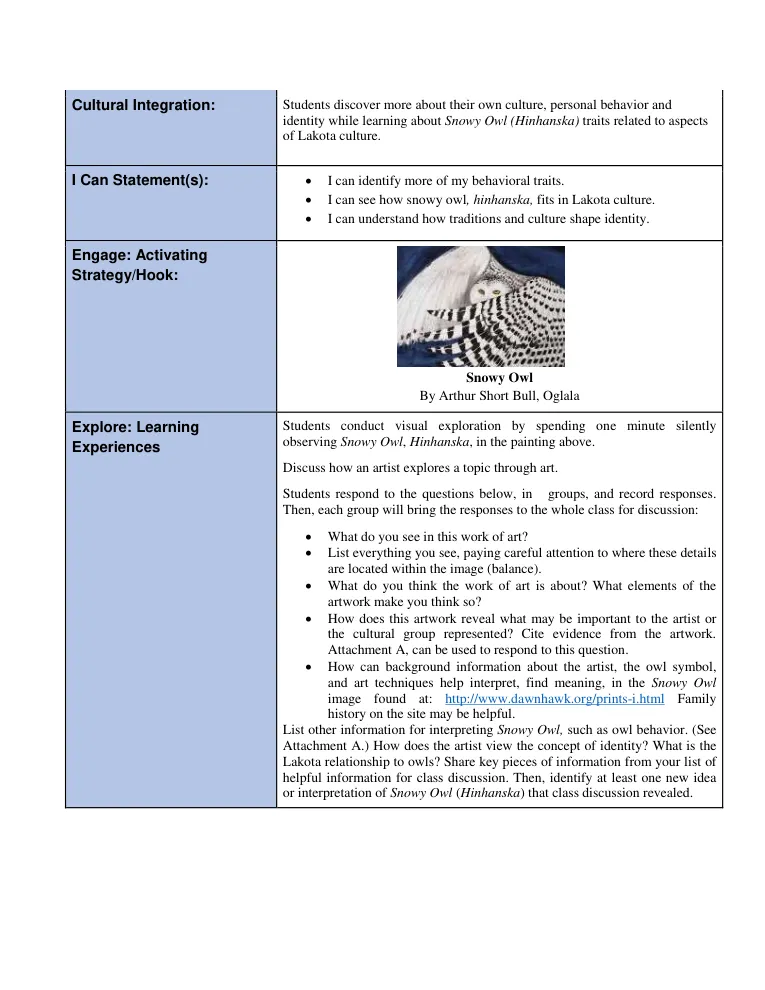
Snowy Owl
http://www.dawnhawk.org/prints-i.html
Student:
•
Snowy Owl Pictures,
Paintings, Sculpture
(Internet Search to see
interesting owl images)
•
Internet Search for
symbols (ideas)
•
Rubric Provided by
teacher (Attachment C)
•
Elements and
Principles of Art
•
Hinhanska
•
Composition
Learning Experience
Standards and Practice:
OSEU: Identity and Resiliency
Anchor Standard 2: K-12.Cr.2: Organize and develop artistic ideas and work.
6-8.VA.Cr.1 and 6-8.VA.Cr.2.3
Anchor Standard 3: K-12.Cr.3: Refine and complete artistic work.
6-8.VA.Cr.3.1
Cultural Integration:
Students discover more about their own culture, personal behavior and
identity while learning about Snowy Owl (Hinhanska) traits related to aspects
of Lakota culture.
I Can Statement(s):
•
I can identify more of my behavioral traits.
•
I can see how snowy owl, hinhanska, fits in Lakota culture.
•
I can understand how traditions and culture shape identity.
Engage: Activating
Strategy/Hook:
Snowy Owl
By Arthur Short Bull, Oglala
Explore: Learning
Experiences
Students conduct visual exploration by spending one minute silently
observing Snowy Owl, Hinhanska, in the painting above.
Discuss how an artist explores a topic through art.
Students respond to the questions below, in groups, and record responses.
Then, each group will bring the responses to the whole class for discussion:
•
What do you see in this work of art?
•
List everything you see, paying careful attention to where these details
are located within the image (balance).
•
What do you think the work of art is about? What elements of the
artwork make you think so?
•
How does this artwork reveal what may be important to the artist or
the cultural group represented? Cite evidence from the artwork.
Attachment A, can be used to respond to this question.
•
How can background information about the artist, the owl symbol,
and art techniques help interpret, find meaning, in the Snowy Owl
image found at: http://www.dawnhawk.org/prints-i.html Family
history on the site may be helpful.
List other information for interpreting Snowy Owl, such as owl behavior. (See
Attachment A.) How does the artist view the concept of identity? What is the
Lakota relationship to owls? Share key pieces of information from your list of
helpful information for class discussion. Then, identify at least one new idea
or interpretation of Snowy Owl (Hinhanska) that class discussion revealed.
Explain: Learning
Experience
Teacher : Share See Hinhanska—
See Me Rubric on Attachment C
with students
Activity. Students will create a See Hinhanska—See Me, portrait. To begin,
they will take another close-look at Short Bull’s Snowy Owl painting to find
elements and principles of art in the image. They may incorporate of some of
these in their drawing, replication of the Short Bull painting, or reproduction a
favorite image found in the snowy owl search on the Internet. If student
artwork is not an original piece, a statement such as: “Inspired by (artist’s
name)” must be made to cite the source and give artist credit.
Responses from questions in the Explore: Learning Experiences section,
above, and ideas that pertain to Snowy Owl (Hinhanska) from a Lakota culture
perspective will help students think about how their drawing should look.
The student will also think about how their own identity and culture will be
incorporated into the drawing, the title of which will be: “See Hinhanska—See
Me.” The following questions may be helpful for reflections: What do I love
to do? How would my perfect day look? What brought me joy as a child?
What scares me? Additional review:
•
What is the message I want to send? How will I use elements and
principles of art for spreading my message to others?
•
What symbol(s) do I want in my work or will I discover other
symbols that best represent who I am? (Hinhanska, White Owl Part 2,
if it was completed). For example: Do I see myself as strong, wise,
youthful, happy, sad, and fulfilled (or anything else)?
When finished with the initial drawing, students will have a peer critique of
their art piece and will comment on a classmate’s artwork, using Attachment
B: Peer Assessment—Critique of Self-Identity Symbols in Art.
Elaborate:
Extending/Defining
Keep the peer critique of your work in mind as you think back to the Snowy
Owl image. Has your interpretation of Short Bull’s piece changed? In what
way?
•
What discussion points from talking with your partner changed your
interpretation?
•
What circumstances or events in the artist’s life are reflected within
Short Bull’s painting?
•
What symbol(s) did Short Bull include within his piece? What do they
reveal about the identity of the subject (the owl)? Do you think this
portrait reveals anything about the artist? Why or why not?
•
What evidence do you have to support your conclusions?
•
Why do you think this painting is called Snowy Owl?
What would you like to change or add to your drawing as a result of new
information and peer critique, including elements and principles of art? Make
changes to revise and complete your art: “See Hinhanska—See Me”.
Evaluate: Summarizing
Strategy
Student’s Questioning Strategy.
What compliment and one thoughtful suggestion can I give myself?
What was the most important feedback I got from my teacher or peer as I
worked my way through this activity?
What was something new that I noticed about myself or my classmates
during this activity? How was this activity helpful or important to me?
Reflecting—what questions, issues, or ideas arose during the activity?
Differentiation Strategies
Extension
Intervention
Language
Development
Lesson: Hinhanska Part 1
Lesson: Hinhanska Part 2
Allow think-time and/or give students a dose of
a self-expression and exploration from a
teacher-lead guided mediation or “fantasy
journey.” Dance or yoga moves, tai chi, sky
watching or other nature experiences are other
activities. They tend to quiet the rational mind
and open up the intuitive mind and its
connection to magical creative forces that get
artistic juices flowing.
Assessment(s)
Formative
Summative
Attachment B
Peer Assessment—Critique of Self-Identity Symbols in
Art
Ann
See Attachment C—See Hinhanska, See Me Rubric
Teacher Reflection: (Next steps?)
Attachment A
About Owls…
•
Names are owl-specific. For example, the Lakota word for an owl in general is hinhan. A snowy owl is
hinhanska. A short-eared owl is hinhan gi. A long-eared owl is hinhan kap'ipila. A burrowing owl is
hinhan makhotila. A barn owl is hinhan san. A great horned owl is hinhan tanka. A screech owl is
unhnagichala.
•
The owl has been identified as a messenger in some form, often serving as intermediary between humans
and Tunkasila, the Creator
•
Some Lakota believe owl messengers forewarn death, others say messages are not always bad.
•
Owls can predict the weather; they gather together before a storm.
•
It has been said the Lakota had an Owl Society where warriors fought at night and painted dark rings
around their eyes to have the sight of an owl.
•
The owl, as messenger, brings prophetic news to the Lakota, either of the future or of events happening at a
great distance. There are those [owls] empowered with great foresight and the ability to see potential future
outcomes.
•
Owls are either considered to be embodied spirits of the dead, or associated with such spirits. The owl
connections with death, the afterlife, and rebirth are powerful forces recognized by Lakota people and are
exemplified by the Old Owl Woman or hiha'n winu'cala who stands guard at the road to afterlife, at the end
of the Milky Way.
•
The owl serves as a spiritual guide. For example, the Great White Owl was a spirit helper for Frank Fools
Crow, Lakota spiritual leader. And, people who have had a vision or dream can wear related regalia in the
hope they may gain desired characteristics associated with the being.
•
The owl is among bird spirts who may be a part of a ceremonies, such as the lowanpi and Lakota yuwipi
(healing). They are summoned, communicate with the spiritual leader, and leave.
•
The owl, like other birds or animals, can be “mimicked” by Lakota people who have a vision or a dream
about them.
From Lakota speakers: Winged Messenger Nations: birds in American Indian Oral Traditions
http://nativeede.wixsite.com/wingedmessenger/role-of-birds and other sources.
“Let children walk with Nature, let them see the beautiful blendings and communions of death and life, their joyous
inseparable unity, as taught in woods and meadows, plains and mountains and streams of our blessed star, and they
will learn that death is stingless indeed, and as beautiful as life.”—John Muir (Naturalist)
Appendix B
Peer Assessment—Critique of Self-Identity Symbols in Art
Your name:
Name of peer whose art you are critiquing:
Instructions: The purpose of an art critique is to provide constructive criticism that can help your
peer improve as an artist by engaging in a thoughtful assessment of their work. This art critique
should be a positive dialogue between the artist and the viewer.
In your peer assessment/art critique, you should:
1. Interpret – What do you see or notice first? Why? What are your reactions?
2. Compliment – Let the artist know what you like and point out strengths.
3. Question – Learn from the artist. Ask about techniques, including elements and
principles of art; the subject or artist’s intention.
4. Suggest – Express something that may help the artist improve in the future.
When it is your turn to be critiqued, take notes and use the feedback as you are creating your
artwork.
Attachment C See Hinhanska—See Me Rubric
4
3
2
1
0
Replication
Accuracy
_____
Student copied
Hinhanska accurately
drew shapes,
proportions, contours
and details. Drawing is
expressive and detailed.
Attempted to draw
what was seen.
Hinhanska drawing is
expressive and
somewhat detailed.
Drew what was seen
for the most part.
Hinhanska drawing is
somewhat detailed.
You can tell what the
student was
observing in the
drawing, although
Hinhanska drawing
lacks almost all
details.
Student did not do
an observational
drawing.
Hinhanska drawing
has no details.
Personal
/Symbols
_____
Student successfully
incorporated more than
two symbols into image.
Symbols are hidden
messages representing
self, family and/or the
student’s culture. They
are meaningful, yet open
to interpretation.
Student attempted to
incorporate two
symbols about self.
Symbols did not
necessarily represent
family, tradition, or
culture to meet the
challenge of the
activity/assignment.
Student has two
symbols but they but
they are both about
one idea (e. g.,
basketball), self-
awareness is
incomplete.
Student has one
symbol but it stands
alone, is not blended
into the hinhanska
image. No problem-
solving to connect
self with the owl or it
did not work.
No symbols are
included to
represent self-
awareness in the
drawing.
Elements of
Art
_____
Student understands and
uses the elements (line,
shape, form, space,
texture, value, & color)
to create successful,
interesting artwork. Has
a strong sense of line.
Student uses the
elements to create a
successful artwork.
Understands basics but
has not experimented.
Student uses real and
implied line.
Student attempts to
use elements but
shows a minimal
understanding of the
basics. Student uses
real line.
Student shows a
minimal
understanding of
basic elements of art.
Student uses real line.
It is clear that the
student does not
understand how to
use the elements.
No attempt at
organizing the
elements.
Composition
_____
Student understands and
maintains principles of
art (rhythm, movement,
balance, proportion,
variety, emphasis,
harmony and unity) in
the composition. .
Student used the
principles of art to
create an interesting
composition. Utilized
the positive and
negative space well on
paper.
Student attempted to
use principles to create
composition. Tried to
use the positive and
negative space well;
drawing takes up ½-
3/4 of the paper.
Student did not use
the principles well to
create an interesting
composition. Did not
use space well;
drawing takes up ½
of the paper space.
Student did not use
the art principles to
create interesting
composition. It is
small- takes up less
than ¼ of the
paper.
Creativity
_____
Student applied lesson
concepts in a way that
student's personality and
voice comes through the
Hinhanska image.
The student's
personality comes
through in parts of the
drawing as authentic
and blends into the
Hinhanska image.
There is some
evidence of creativity,
reflection of self in the
owl image. Student
personality, voice need
to be stronger.
Student has not
demonstrated
sufficient ability to
solve problem with
creative solution.
No creativity
attempted, nothing
thing new or
different added.
Craftsman-
ship /
Presentation
_____
Artwork is created and
maintained without tears,
smudges, or stray
marks. Neatly signed in
appropriate spot, with
source cited and credit
given to artist.
Artwork is created and
maintained fairly
neatly without tears,
minimal smudges or
stray marks. Artwork
neat and credit given
to artist.
Artwork is created and
maintained with an
attempt at
neatness. Artwork
may be torn, smudged
or have stray marks.
Artwork is signed.
Artwork is poorly
created. Artwork is
torn, smudged, or has
stray marks that
distract from the
image. Artwork
needed to be neatly
signed.
Artwork is not
finished, was
folded, crumpled
up, ripped, etc. No
signature on
artwork.
Source provenance: OSEU Lesson Plans Old ALL Combined.pdf · WoLakota Project archive. Reformatted for this collection.