The complete archived text is retained here, including details that may extend beyond the inquiry blueprint.
Read the full archived lesson text
5 E’s Lesson Plan Template
Lesson: Hinhanska (White Owl) Part 2
“See Me”
Part 2 Objective: To examine personal characteristics that define personality and shape identity
Note:
Lesson: Hinhanska, (White Owl) Part 1 sets the foundation for this lesson and for Lesson: Hinhanska (White Owl) Part 3,
although any of the three parts can be stand-alone lessons.
Essential Question(s):
•
How does culture shape identity?
•
How do actions, behavior and attitude develop personality?
•
How can symbols represent identity and culture?
•
How do artists use traditional cultural symbols to convey meaning?
Materials/Resources
Essential Vocabulary
Teacher
1. Google Search to gather
examples of symbols for
students
2. Ideas, collage materials and
supplies: Loughran, Maire.
"Collage Materials and Supplies."
thoughtco.com/collage-materials-
and-supplies-193075.
3. Use material, above, or:
acrylic paints, sizing, primer,
synthetic bristle brushes for
acrylic paint—flats and rounds
(choice of size); white glue,
canvas, pointed metal palette
knife (2” - 2 ½” blade) for
mixing colors; palette paper pad
for mixing paint; mounting board
or plywood particle board
Student: Use this list or
materials listed in Point 2
under Teacher Materials
•
Brushes, House-
painting brushes 2”
to 4” for applying
colors
•
Elmer’s glue
•
Leftover house paints
•
Optional: fabric,
wallpaper, magazine
pictures, cardboard,
old brown paper,
color shopping bags,
styrofoam sheets
•
Personality
•
Identity
•
Culture
•
Personality
•
Symbols
•
Characteristic
s/ Traits
•
Ethnic Group
Learning Experience
Standards and
Practice:
OSEU 2: Identity-Resiliency
Anchor Standard 10: K-2.Cn.10: Synthesize and relate knowledge and personal
experiences to make art. HSa.VA.Cn.10.1
Anchor Standard 3: K-2.Cr.3: Refine and complete artistic work. HSp.VA.Cr.3.
Cultural Integration:
Youth Culture
http://examples.yourdictionary.com
/examples-ofyouth-culture.htm
Students examine their own culture to gain a more complete picture of their
identity and express it through the use of symbols.
I Can Statement(s):
I can know more about me—character traits that shape my personality.
I can know more about my culture—family values/beliefs that influence my
identity.
I can use symbols and elements and principles of art,—to communicate who I
am.
Engage: Activating
Strategy/Hook:
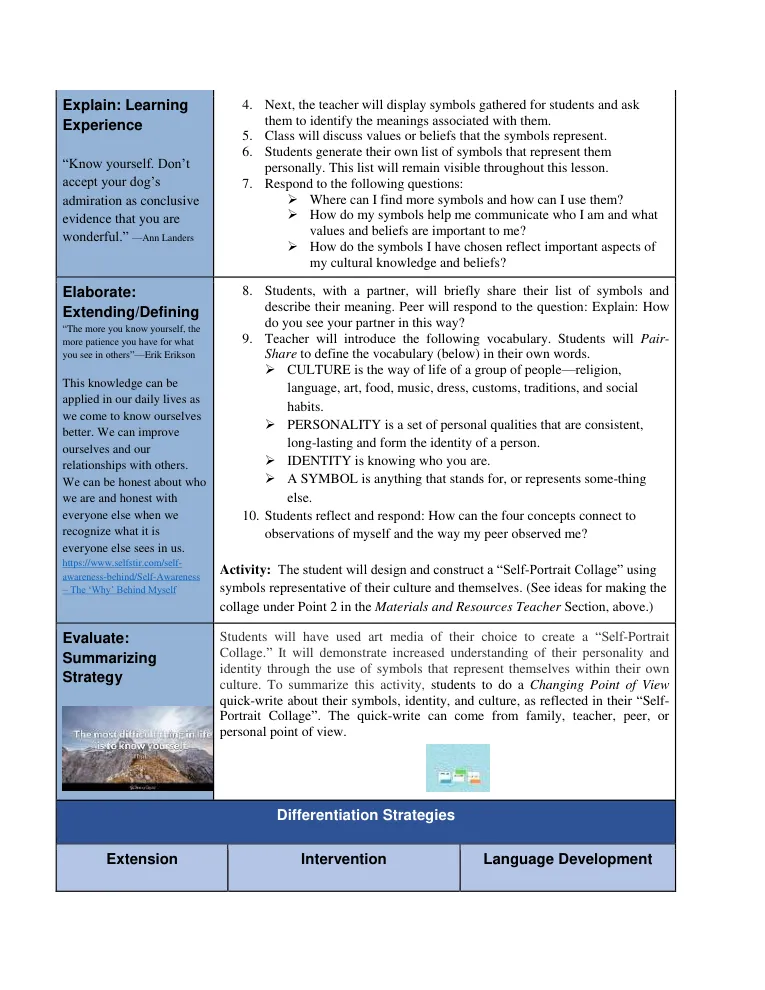
Dominant Personality Trait
Dominant Personality Trait (Wait a minute for each image to pop up on this
website) What you see on this website activity will reveal your strongest
characteristic: Wisdom, courage, passion, honesty, kindness, or intuition
http://www.playbuzz.com/answers10/this-abstract-image-test-will-determine-your-dominant-personality-trait
1. What behaviors make this my strongest characteristic?
2. What are some of my other dominant traits? (Continue with No. 1,
below)
3. If I don’t like the reveal, how can I change this part of my personality?
4. Do my classmates and others see me like this?
Explore: Learning
Experiences
When we know who we
truly are, we can work on
building a trusting and
honest relationship with
ourselves.
https://www.selfstir.com/self-
awareness-Behind/Self-Awareness
– The ‘Why’ Behind Myself
1. Students may use some of the lists found on Attachment A to continue
exploration of their behavior.
2. Students record 10 traits from the lists that reflect their personality.
3. Students think about their culture by asking:
a)
How were holidays and special occasions celebrated? Any special traditions?
b)
What events had an impact while growing up?
c)
What symbols are important to me and my family or what might they be? Why are
these symbols important?
d)
What beliefs, values, interests, and traditions do these symbols communicate?
e) What ethnic/cultural group do I identify with?
Explain: Learning
Experience
“Know yourself. Don’t
accept your dog’s
admiration as conclusive
evidence that you are
wonderful.” —Ann Landers
4. Next, the teacher will display symbols gathered for students and ask
them to identify the meanings associated with them.
5. Class will discuss values or beliefs that the symbols represent.
6. Students generate their own list of symbols that represent them
personally. This list will remain visible throughout this lesson.
7. Respond to the following questions:
Where can I find more symbols and how can I use them?
How do my symbols help me communicate who I am and what
values and beliefs are important to me?
How do the symbols I have chosen reflect important aspects of
my cultural knowledge and beliefs?
Elaborate:
Extending/Defining
“The more you know yourself, the
more patience you have for what
you see in others”—Erik Erikson
This knowledge can be
applied in our daily lives as
we come to know ourselves
better. We can improve
ourselves and our
relationships with others.
We can be honest about who
we are and honest with
everyone else when we
recognize what it is
everyone else sees in us.
https://www.selfstir.com/self-
awareness-behind/Self-Awareness
– The ‘Why’ Behind Myself
8. Students, with a partner, will briefly share their list of symbols and
describe their meaning. Peer will respond to the question: Explain: How
do you see your partner in this way?
9. Teacher will introduce the following vocabulary. Students will Pair-
Share to define the vocabulary (below) in their own words.
CULTURE is the way of life of a group of people—religion,
language, art, food, music, dress, customs, traditions, and social
habits.
PERSONALITY is a set of personal qualities that are consistent,
long-lasting and form the identity of a person.
IDENTITY is knowing who you are.
A SYMBOL is anything that stands for, or represents some-thing
else.
10. Students reflect and respond: How can the four concepts connect to
observations of myself and the way my peer observed me?
Activity: The student will design and construct a “Self-Portrait Collage” using
symbols representative of their culture and themselves. (See ideas for making the
collage under Point 2 in the Materials and Resources Teacher Section, above.)
Evaluate:
Summarizing
Strategy
Students will have used art media of their choice to create a “Self-Portrait
Collage.” It will demonstrate increased understanding of their personality and
identity through the use of symbols that represent themselves within their own
culture. To summarize this activity, students to do a Changing Point of View
quick-write about their symbols, identity, and culture, as reflected in their “Self-
Portrait Collage”. The quick-write can come from family, teacher, peer, or
personal point of view.
Differentiation Strategies
Extension
Intervention
Language Development
Lesson: Hinhanska (White
Owl) Part 1 See Hihanska—
See Lakota Culture”
Lesson: Hinhanska (White
Owl) Part 3, “See
Hinhanska—See Me”
Design a group or classroom collage
Assessment(s)
Formative
Summative
List 10 Things - Midway through the lesson,
ask students to list ten things they have
learned to this point. Gather the lists and read
through them to get an idea of students
understanding. Look for gaps in learning or
misunderstandings to address as the lesson
progresses. L
See Attachment B
Teacher Reflection: (Next steps?)
Attachment A
Examples of Youth Culture http://examples.yourdictionary.com/examples-of-youth-culture.html
Here are lists of words that describe behavior in general.
First are words that refer to what may be perceived as good behavior:
Adaptable
Brave
Confident
Cooperative
Courageous
Debonair
Decisive
Determined
Generous
Hilarious
Honorable
Kind
Lively
Pleasant
Productive
Protective
Receptive
Reflective
Responsible
Romantic
Self-assured
Sensitive
Shrewd
Unusual
Witty
Wonderful
Zany
Zealous
Next are words that describe an opposite behavior. All people exhibit these behaviors from time to time. For
others these are dominant behaviors. It is easier to see these behaviors in others but more difficult to admit they
may be dominant in ourselves:
Abrasive
Abusive
Angry
Anxious
Belligerent
Boorish
Cowardly
Crazy
Creepy
Cruel
Dangerous
Defiant
Erratic
Finicky
Flashy
Flippant
Foolish
Furtive
Guarded
Jittery
Malicious
Mysterious
Obnoxious
Outrageous
Panicky
Secretive
Strange
Threatening
Unsuitable
Vengeful
Wary
Finally, people behave differently at home than at school or work, and in the company of certain people. Let’s
look at different types of behavior and some words that describe them behavior in social situations:
Caring: desire to help people Charming: pleasant, delightful
Considerate: thinking of others Enthusiastic: has strong feelings; ardent
Excitable: gets excited easily Faithful: being loyal
Funny: causing people to laugh Kind: thoughtful, caring
Attachment B
Visual Symbols Collage
Excellent:
Student effort is evident in the
utmost capacity.
Very Good – Good:
Student effort
is evident.
Fair:
Some student
effort is evident.
Poor:
Student effort
is not evident.
Student
Evaluation
Teacher
Evaluation
Image Selection
Student thoughtfully selected multiple
types of symbol images to represent
themselves as a whole (not just one idea –
ex basketball only images) Student
incorporated symbolic images (as
discussed in class).
30
19-16
15-7
6-0
Technical Construction
The collage shows considerable attention
to construction. The collage is
exceptionally attractive in design and
layout to communicate the message the
artist wants to send.
20
19-16
15-7
6-0
Design
Graphics are trimmed or cropped to an
appropriate size and interesting shape and
are arranged well, some in front and some
behind. Care has been taken to balance
the pictures across the collage
(elements/principles of art).
20
19-16
15-7
6-0
Overall Impression
The collage fully communicates the
author’s understanding of the relationship
among culture, personality, and identity
clearly and creatively.
30
9-8
7-5
4-0
Total Points
100
Source provenance: OSEU Lesson Plans Old ALL Combined.pdf · WoLakota Project archive. Reformatted for this collection.