The complete archived text is retained here, including details that may extend beyond the inquiry blueprint.
Read the full archived lesson text
5 E’s Lesson Plan Template
Lesson: Hinhanska (White Owl) Part 1
“See Hinhanska—See Lakota Culture”
Part 1 Objective: To use Lakota culture, elements/principles of art, and personality traits to interpret visual art
This lesson sets the foundation for Lessons: Hinhanska (White Owl) Parts 2 and 3, although any of the three can
be used as stand-alone lessons.
Essential Question(s):
How can visual art to “speak to you?”
What elements and principles of art can feed directly into the overall feel and meaning of art work?
How does art exposure impact us?
Materials/Resources
Essential
Vocabulary
Teacher:
•
The Magic of the Snowy Owl (Youtube)
https://www.owlpages.com/owls/articles.php?c=4
•
Pencils and paper for students
https://www.wikihow.com/Sketch
•
Hinhanska (Snowy Owl) music Arvel Bird
https://arvelbird.com/track/1015028/hinhan-ska-snowy-
owl
•
Practice Looking at Art (art skills)
https://www.mfah.org/learn/practice-looking-art
•
This Personality Trait Predicts Success
https://finance.yahoo.com/news/personality-trait-most-
often-predicts-153124913.html
•
Elements and Principles of Art (14:20
minutes well spent)
https://www.youtube.com/watch?v=qIOfbozTIY8
Student:
•
Computer with Internet
•
Sketch Notebook or
Drawing Paper (See
Teacher Materials)
•
Personality Traits
Information
http://examples.yourdictionary.co
m/examples-of-personality-
traits.html
The Principle of Design
https://www.youtube.com/watch?v=GigfWyF
Ae7
•
Hinhan (Owl)
•
Hinhanska
(White Owl)
•
Characteristics
•
Traits
•
Personality
Learning Experience
Standards and Practice:
OSEU 2: Identity and Resiliency
Anchor Standard 1: K-2.Cr.1: Generate and conceptualize artistic ideas and
work. HSp.VA.Cr.1.2
Anchor Standard 9: K-2.Re.9: Evaluate artistic work based on critical and
sensitive response to various visual art experiences. HSp.VA.Re.9.1
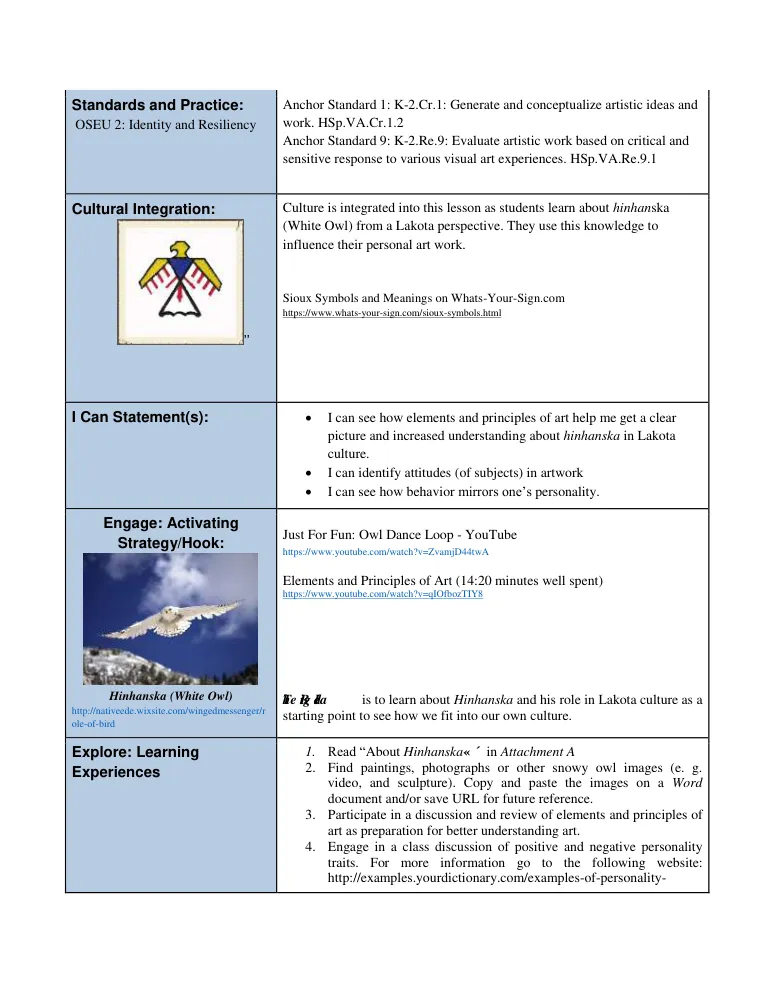
Cultural Integration:
’’
Culture is integrated into this lesson as students learn about hinhanska
(White Owl) from a Lakota perspective. They use this knowledge to
influence their personal art work.
Sioux Symbols and Meanings on Whats-Your-Sign.com
https://www.whats-your-sign.com/sioux-symbols.html
I Can Statement(s):
•
I can see how elements and principles of art help me get a clear
picture and increased understanding about hinhanska in Lakota
culture.
•
I can identify attitudes (of subjects) in artwork
•
I can see how behavior mirrors one’s personality.
Engage: Activating
Strategy/Hook:
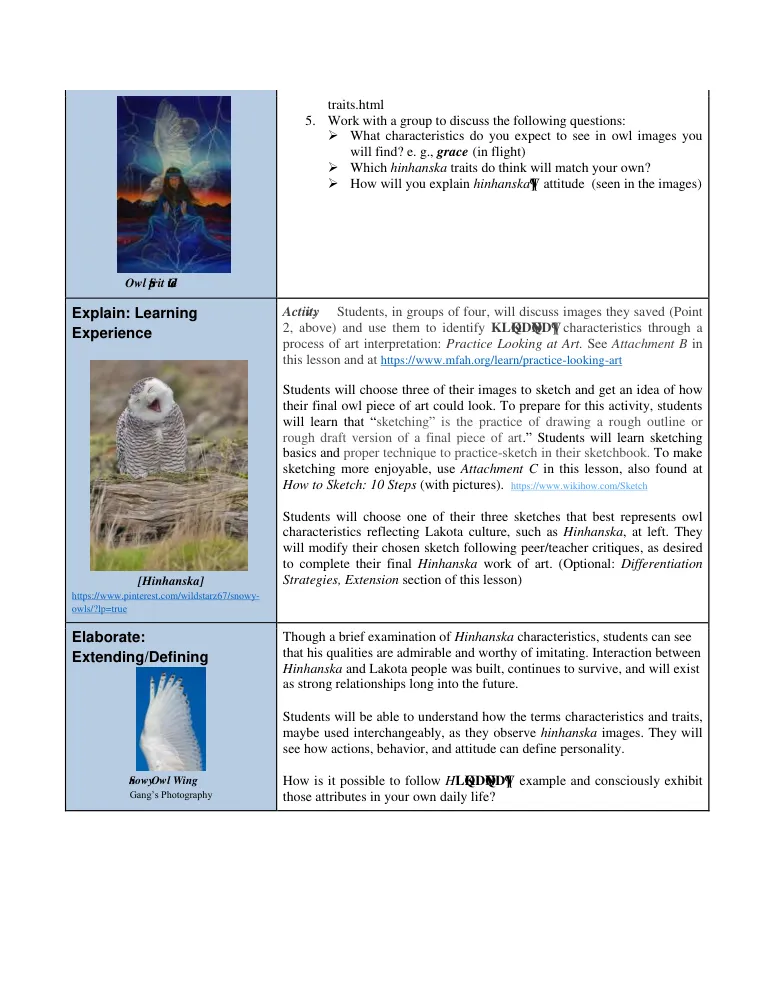
Hinhanska (White Owl)
http://nativeede.wixsite.com/wingedmessenger/r
ole-of-bird
Just For Fun: Owl Dance Loop - YouTube
https://www.youtube.com/watch?v=ZvamjD44twA
Elements and Principles of Art (14:20 minutes well spent)
https://www.youtube.com/watch?v=qIOfbozTIY8
The Big Idea is to learn about Hinhanska and his role in Lakota culture as a
starting point to see how we fit into our own culture.
Explore: Learning
Experiences
1. Read “About Hinhanska…” in Attachment A
2. Find paintings, photographs or other snowy owl images (e. g.
video, and sculpture). Copy and paste the images on a Word
document and/or save URL for future reference.
3. Participate in a discussion and review of elements and principles of
art as preparation for better understanding art.
4. Engage in a class discussion of positive and negative personality
traits. For more information go to the following website:
http://examples.yourdictionary.com/examples-of-personality-
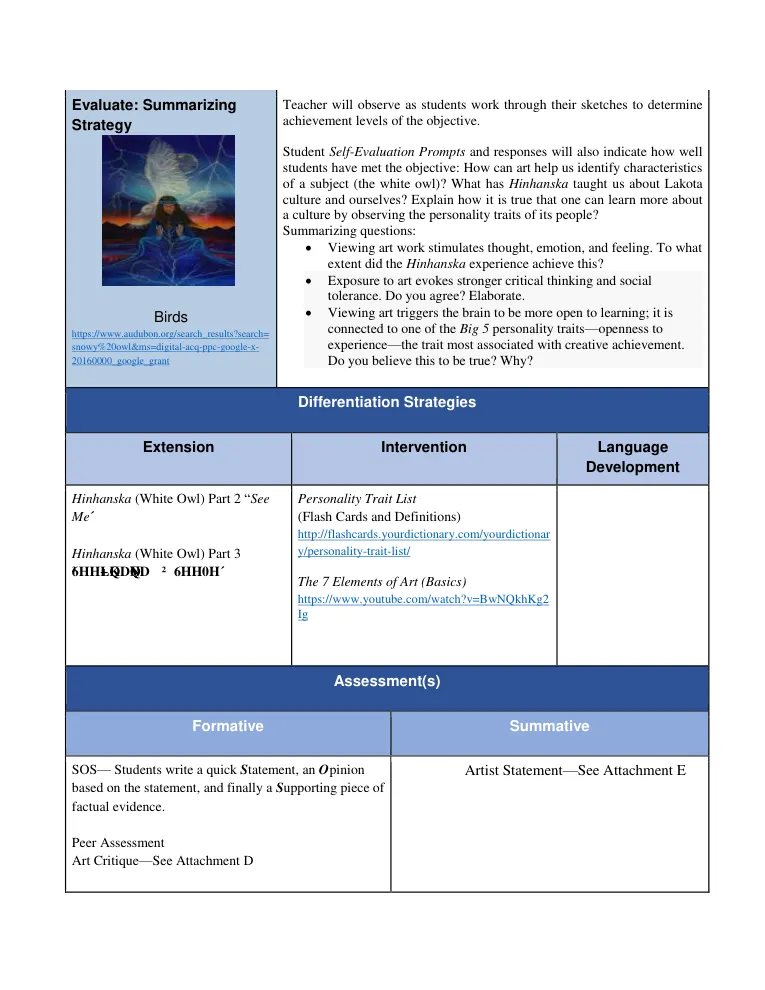
Owl Spirit Guide
traits.html
5. Work with a group to discuss the following questions:
What characteristics do you expect to see in owl images you
will find? e. g., grace (in flight)
Which hinhanska traits do think will match your own?
How will you explain hinhanska’s attitude (seen in the images)
Explain: Learning
Experience
[Hinhanska]
https://www.pinterest.com/wildstarz67/snowy-
owls/?lp=true
Activity. Students, in groups of four, will discuss images they saved (Point
2, above) and use them to identify hinhanska’s characteristics through a
process of art interpretation: Practice Looking at Art. See Attachment B in
this lesson and at https://www.mfah.org/learn/practice-looking-art
Students will choose three of their images to sketch and get an idea of how
their final owl piece of art could look. To prepare for this activity, students
will learn that “sketching” is the practice of drawing a rough outline or
rough draft version of a final piece of art.” Students will learn sketching
basics and proper technique to practice-sketch in their sketchbook. To make
sketching more enjoyable, use Attachment C in this lesson, also found at
How to Sketch: 10 Steps (with pictures). https://www.wikihow.com/Sketch
Students will choose one of their three sketches that best represents owl
characteristics reflecting Lakota culture, such as Hinhanska, at left. They
will modify their chosen sketch following peer/teacher critiques, as desired
to complete their final Hinhanska work of art. (Optional: Differentiation
Strategies, Extension section of this lesson)
Elaborate:
Extending/Defining
Snowy Owl Wing
Gang’s Photography
Though a brief examination of Hinhanska characteristics, students can see
that his qualities are admirable and worthy of imitating. Interaction between
Hinhanska and Lakota people was built, continues to survive, and will exist
as strong relationships long into the future.
Students will be able to understand how the terms characteristics and traits,
maybe used interchangeably, as they observe hinhanska images. They will
see how actions, behavior, and attitude can define personality.
How is it possible to follow Hinhanska’s example and consciously exhibit
those attributes in your own daily life?
Evaluate: Summarizing
Strategy
Birds
https://www.audubon.org/search_results?search=
snowy%20owl&ms=digital-acq-ppc-google-x-
20160000_google_grant
Teacher will observe as students work through their sketches to determine
achievement levels of the objective.
Student Self-Evaluation Prompts and responses will also indicate how well
students have met the objective: How can art help us identify characteristics
of a subject (the white owl)? What has Hinhanska taught us about Lakota
culture and ourselves? Explain how it is true that one can learn more about
a culture by observing the personality traits of its people?
Summarizing questions:
•
Viewing art work stimulates thought, emotion, and feeling. To what
extent did the Hinhanska experience achieve this?
•
Exposure to art evokes stronger critical thinking and social
tolerance. Do you agree? Elaborate.
•
Viewing art triggers the brain to be more open to learning; it is
connected to one of the Big 5 personality traits—openness to
experience—the trait most associated with creative achievement.
Do you believe this to be true? Why?
Differentiation Strategies
Extension
Intervention
Language
Development
Hinhanska (White Owl) Part 2 “See
Me”
Hinhanska (White Owl) Part 3
“See Hinhanska—See Me”
Personality Trait List
(Flash Cards and Definitions)
http://flashcards.yourdictionary.com/yourdictionar
y/personality-trait-list/
The 7 Elements of Art (Basics)
https://www.youtube.com/watch?v=BwNQkhKg2
Ig
Assessment(s)
Formative
Summative
SOS— Students write a quick Statement, an Opinion
based on the statement, and finally a Supporting piece of
factual evidence.
Peer Assessment
Art Critique—See Attachment D
Artist Statement—See Attachment E
Teacher Reflections:
Attachment A
•
About Owls… Names are owl-specific. For example, The Lakota word for an owl in general is hinhan. A
snowy owl is hinhan ska. A short-eared owl is hinhan gi. A long-eared owl is hinhan kap'ipila. A
burrowing owl is hinhan makhotila. A barn owl is hinhan san. A great horned owl is hinhan tanka. A
screech owl is unhnagichala.
•
The owl has been identified as a messenger in some form, often serving as intermediary between humans
and Tunkasila, the Creator
•
Some Lakota believe owl messengers forewarn death, others say messages are not always bad.
•
Owls can predict the weather; they gather together before a storm.
•
It has been said the Lakota had an Owl Society where warriors fought at night and painted dark rings
around their eyes to have the sight of an owl.
•
The owl, as messenger, brings prophetic news to the Lakota, either of the future or of events happening at a
great distance. Some owls are empowered with great foresight and ability to see potential future outcomes.
•
Owls are either considered to be embodied spirits of the dead, or associated with such spirits. The owl
connections with death, the afterlife, and rebirth are powerful forces recognized by Lakota people and are
exemplified by the Old Owl Woman, hiha'n winu'cala, who stands guard at the road to afterlife, at the end
of the Milky Way. “Let children walk with Nature, let them see the beautiful blendings and communions of
death and life, their joyous inseparable unity, as taught in woods and meadows, plains and mountains and
streams of our blessed star, and they will learn that death is stingless indeed, and as beautiful as life.”—
John Muir (Naturalist)
•
The owl serves as a spiritual guide. For example, the Great White Owl was a spirit helper for Frank Fools
Crow, Lakota spiritual leader. (Other helpers: Crazy Horse wore hawk feathers in in hair because the hawk
was his helper.) People who have had a vision or dream can wear related regalia in the hope they may gain
desired characteristics associated with the being.
•
The owl is among bird spirts who may be a part of a ceremonies, such as the lowanpi and Lakota yuwipi
(healing). They are summoned, communicate with the spiritual leader, and leave.
•
The owl, like other birds or animals, can be “mimicked” by Lakota people who have a vision or a dream
about them. The person may then wear related regalia hoping to gain desired characteristics associated with
the owl. –From Lakota speakers. Winged Messenger Nations: birds in American Indian Oral Tradition
shttp://nativeede.wixsite.com/wingedmessenger/role-of-birdsTraditionshttp://nativeede.wixsite.com/wingedmessenger/role-of-birds
and other sources.
Attachment B
Practice Looking at Art https://www.mfah.org/learn/practice-looking-art Strategies: LOOK, DESCRIBE,
THINK, and CONNECT. Engaging with a work of art is a meaningful and lasting experience. The
following four-step process encourages close looking and careful thinking with any work of art.
The Four-Step Process. To view slideshow Click on hyperlink, above
1. LOOK
Take time to look at the work of art.
•
Encourage students to take in the entire work of art, paying close attention to details. Ask the
question, “What do you notice?” and encourage students to take inventory of everything they see.
•
Instruct students to look at a work of art for 30 seconds, and then to turn around and try to
remember everything they observed. When they are looking at the work of art again, ask them
about the details that they remember. What did they overlook?
2. DESCRIBE
Talk about what you see in the work of art.
•
Encourage students to describe all of the things that they see. Explore line, shape, color,
composition, material, and subject matter.
•
Instruct students to use expressive language to describe what they see in detail. For example,
instead of saying, “I see the sky,” they could say, “I see a dark, foreboding sky full of heavy
clouds that sulk across the composition.”
3. THINK
Interpret and assign meaning to the work of art.
•
Discuss the following with your students:
o
What story is taking place? What is the setting, or the time and place depicted?
o
What is the mood of the work? How do you know?
o
What is this work of art about?
o
What do you think the artist was trying to communicate through the creation of this work
of art?
4. CONNECT
Relate what you see to your own life, or to other works of art or images you have seen.
•
Discuss the following with your students:
o
What does this work of art remind you of? Why?
o
How does this work of art relate to an aspect of your own life?
o
Compare this work of art to other images/objects that you have seen, either in a museum
or in your everyday life. How are they similar? How are they different?
Attachment C
HOW TO SKETCH: 10 Steps (with pictures) – wike How
https://www.wikihow.com/Sketch
Part 1: LEARNING THE BASICS (Modified in places to fit the owl lesson)
1. Get the right materials. Just like with any art form, it is difficult to sketch when using poor quality (or
the wrong) materials. Try to gather up all the right materials, including:
•
H pencils. H pencils are the hardest pencils, and are used for sketching thin, straight, non-blend-
able lines. These are mostly used for architecture and business sketches. Get an assortment
including 8H, 6H, 4H, and 2H pencils (8H is the hardest, 2H is the softest).
•
B pencils. B pencils are the softest pencils, and are used for making smudged and blurry lines and
for shading your sketch. These are the favorites of many artists. Get an assortment including 8B,
6B, 4B, and 2B (8B is the softest, 2B is the hardest).
•
Fine art paper. Sketching on regular printer paper may be easy, but the paper is thin and doesn't
hold the pencil as well. Use fine art paper with a bit of texture for the easiest time sketching, and
for the best overall appearance.
2. Choose your best owl images. For beginners, it is easiest to sketch from the image, rather than by
using your imagination to create an image to draw. Using the three owl images you chose, take several
minutes, again, to study them prior to beginning to sketch. Pay attention to these things:
•
Find the source of light. Locating the primary light source will determine where you sketch the
lightest and where you sketch the darkest.
•
Look for any movement. Whether actual movement from a real-life subject or perceived
movement in an image, determining movement in your subject will determine the shape/direction
you make your sketch strokes.
•
Pay attention to primary shapes. All objects are made up of a combination of the basic shapes
(square, circle, triangle, etc.). Look for shapes that underlay your subject, and sketch these first.
3. Don't draw too heavily. A sketch is intended to be the base or draft of an image. Therefore, when you
start your sketch you should use a light hand and lots of short, quick strokes. This will make it easier to
test out different ways of drawing the owl, and will allow you to erase mistakes much easier as well.
4. Try doing a gesture drawing. Gesture drawing is a form of sketching where you use continuous
movements and connected lines to draw your subject, without ever looking at your paper. Although it
sounds difficult, it can help you to get a good idea of the basic forms in your drawing, and help to set a
base for your final drawing. To do a gesture drawing, look only at your subject and move your hand
accordingly on the paper. When possible, avoid lifting your pencil and use overlapping lines. Later, you
can go back and erase the extra lines and perfect your sketch.
This is good practice for sketching - kind of like a pre-sketch. See next page to continue…
HOW TO SKETCH…Continued
https://www.wikihow.com/Sketch
Part 2: Practicing Sketching
5. Gather all materials listed. Make sure you have enough light. You can sketch at a table, in the park,
in the middle of the city in a sketchbook, on regular paper, or even on a napkin.
•
You will try different versions of the same object to brainstorm and later decide which you like
best.
6. Before you start sketching, practice some hand movements. For example, you can draw circles or
horizontal lines for five-ten minutes to warm up your hand.
7. Starting with your H pencil, use light strokes with loose hands. Move your hand very
quickly, using minimal pressure, almost glossing over the page without stopping. Get
comfortable with the paper you are working with. At this initial stage, you should barely be able
to see the strokes. Consider this to be the foundation of your sketch.
8. For the next stage, use the darker 6 B pencil. When you achieve the perfect shape in Step 3, you can
then define your strokes more precisely with this darker pencil. Keep adding details. Start adding inner
shapes. Make sure they are to scale. For example, when drawing a parking ramp, you want to make sure
that the entrances and parking spots are the appropriate size.
•
When you are finished using this pencil, you will notice smudges on the pages since the lead on
this pencil is softer than the previous one. Remove all smudges with the eraser.
•
Make sure you use a soft eraser like the putty eraser so that your erasing does not rip off the top
layer of the page. The putty eraser will lighten your lines, not completely eradicate them.
9. Add further details and perfect your lines and presentation until you are satisfied that you have
captured the perfect representation.
10. Optional: When you have completed your sketch, apply a fixative to seal the image.
Attachment D
Peer Assessment—Art Critique
Your name:
Name of peer whose art you are critiquing:
Instructions: The purpose of an art critique is to provide your constructive criticism that can help your
peer improve as an artist by engaging in a thoughtful assessment of their work. This art critique should be
a positive dialogue between the artist and the viewer.
In your peer assessment/art critique, you should:
1. Interpret – What do you see or notice first? Why? What are your reactions?
2. Compliment – Let the artist know what you like and point out strengths.
3. Question – Learn from the artist. Ask about techniques, subject or intention.
4. Suggest – Express something that may help the artist improve in the future.
When it is your turn to be critiqued, take notes and use the feedback as you are modifying to complete
your artwork.
Attachment E
Questions for Artist’s Statement/Self-Evaluation
Your Name: _____________________________ Date: ________________________________
Instructions: The process of refection is an important aspect in the production of original artwork because
it increases self-awareness and personal growth. As an artist, you will compose an artist’s statement
(approximately one page in length) in which you will consider what you have learned from this lesson
and how you have grown as an artist. In your artist’s statement, respond thoughtfully to the following
questions.
1. What was the inspiration for creating this piece of artwork?
2. How did your peer critiques help to revise and improve your design?
3. How did what you learned About Owls… inspire or prepare you for your art piece?
4. What did you learn from viewing paintings and owl images that communicate characteristics to help
you express your own ideas and express identity?
5. How was the Elements of Art review useful for helping you develop the artistic skills and techniques
you used in your art?
6. Describe what you did to create this artwork.
7. What concepts you learned while creating this artwork?
8. What is your favorite part of your art piece? Why?
9. What part of art work do you think is most effective at communicating your overall intended meaning?
10. What surprised you about this project?
11. What would you change if you were to create it again? Why?
Source provenance: OSEU Lesson Plans Old ALL Combined.pdf · WoLakota Project archive. Reformatted for this collection.