The complete archived text is retained here, including details that may extend beyond the inquiry blueprint.
Read the full archived lesson text
5 E’s Lesson Plan Template
Lesson: Heyoka, A Dakota Clown
If you look at this world most things flow in a clockwise cycle but you also have that small element in life that
goes in the opposite direction—Pete V. Catches (Zintkala Oyate), From An Interview with Lakota Medicine Man
Objective: To produce a one-page graphic that connects some aspect(s) of the Lakota heyoka concept with one’s
own life
Essential Question(s):
How is the heyoka a teacher in society today?
How can graphic art communicate clear messages interesting ways?
How can ancient traditions have an impact on contemporary lifestyles?
Materials/Resources
Essential
Vocabulary
Teacher:
•
Principles of Graphic Design (web design,
text emphasis)
http://cglab.ca/~morin/teaching/2405/notes/crap.pdf
•
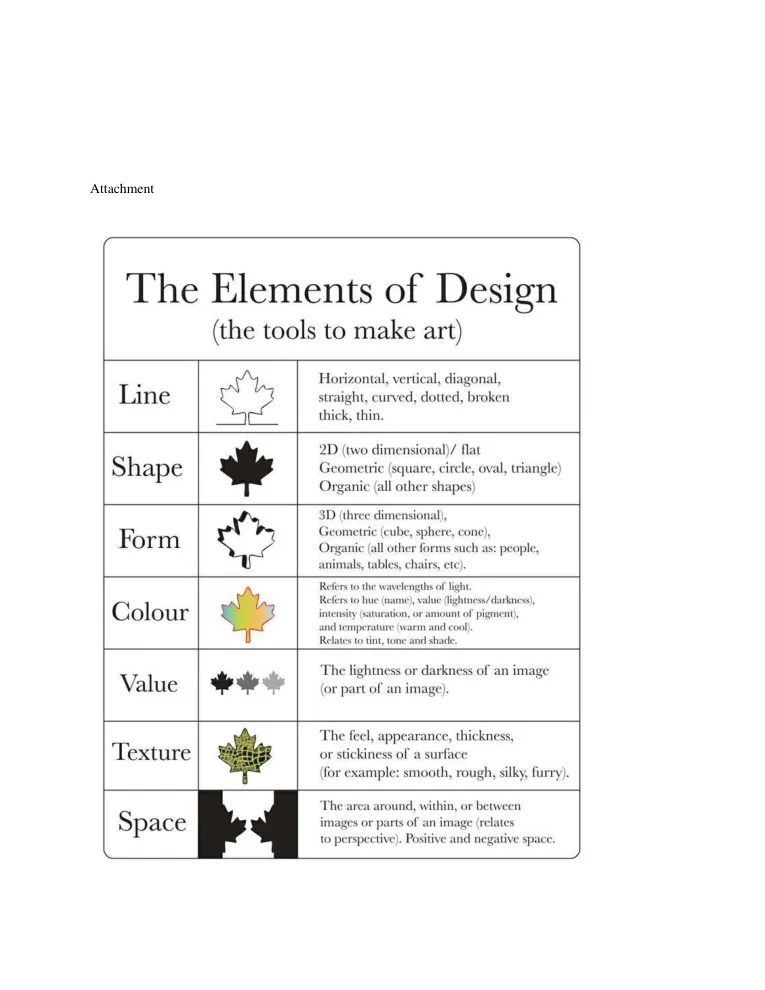
Basic Elements (See Attachment—line,
shape color, etc.)
http://www.cs.bham.ac.uk/~rxb/DesignMedia/graphic%20
design%20basics.pdf
Student:
Check out Learning Layouts for
Single-Page Graphic Designs for
examples at:
http://www.dgp.toronto.edu/~donovan/layout
/designLayout.pdf
Consider Basic Elements (See
Chart on Attachment) and
teacher explanation to produce a
one-page layout design.
•
Heyoka
•
Graphic Art
(digital today)
•
Alignment
•
Balance
Learning Experience
Standards and Practice:
OSEU 3: Culture and Language
Anchor Standard 11: K-12.Cn.11: Relate artistic ideas and works with
societal, cultural and historical context to deepen understanding
HSp.VA.Cn.11.1
Cultural Integration:
“The clown [Heyoka] gets his strange
powers from the Wakinyan, the sacred
flying-ones, the thunderbirds.”
“…everything has a deeper
meaning…to us, a [Heyoka] clown is
somebody sacred, funny, powerful,
ridiculous, holy, shameful, and
visionary. He is all of this and more.”
--from Lame Deer Seeker of Visions
“The [Heyóka] functions both as a mirror and a teacher, using extreme
behaviors to mirror others, thereby forcing them to examine their own
doubts, fears, hatreds, and weaknesses. [The Heyóka] also has the power to
heal emotional pain…” https://www.scribd.com/document/49809867/HEYOKA-INFO
“For people who are as poor as us, who have lost everything, who had to
endure so much death and sadness, laughter is a precious gift. When we
were dying like flies from white man's disease, when we were driven into
reservations, when the government rations did not arrive and we were
starving, watching the pranks and capers of [heyoka] were a blessing..”
--from Lame Deer Seeker of Visions
I Can Statement(s):
•
I can identify important human characteristics exemplified by
heyoka behavior.
•
I can think critically to express ideas and feelings about art and
cultural concepts.
•
I can produce graphics using basic Elements of Art to communicate
my messages.
Engage: Activating
Strategy/Hook:
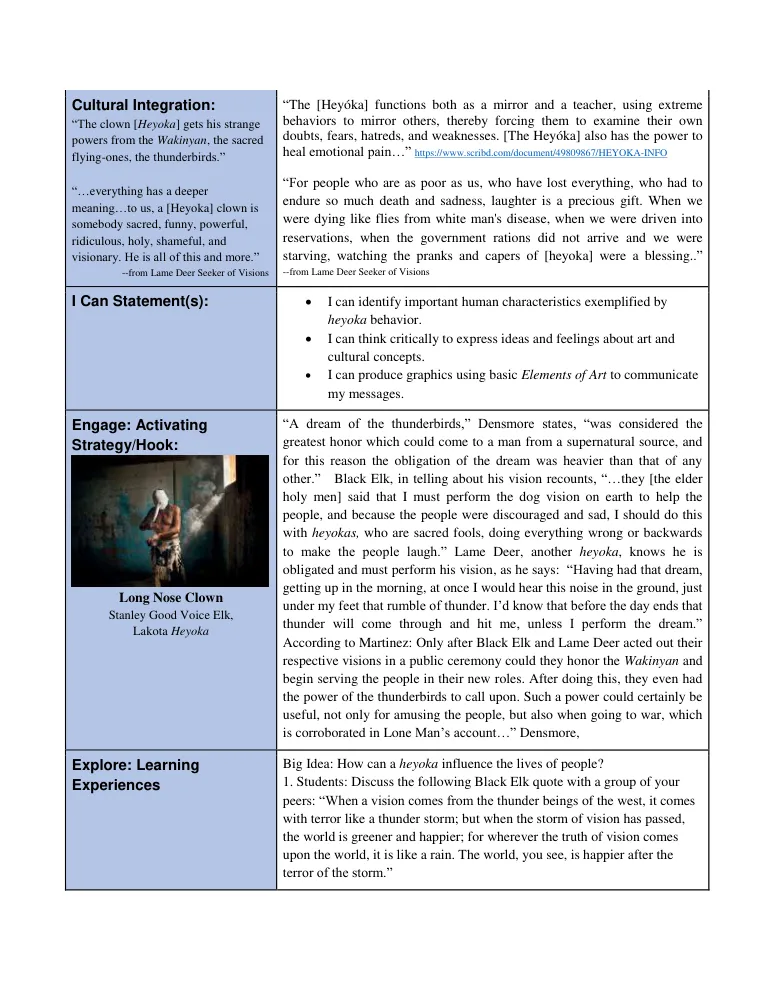
Long Nose Clown
Stanley Good Voice Elk,
Lakota Heyoka
“A dream of the thunderbirds,” Densmore states, “was considered the
greatest honor which could come to a man from a supernatural source, and
for this reason the obligation of the dream was heavier than that of any
other.” Black Elk, in telling about his vision recounts, “…they [the elder
holy men] said that I must perform the dog vision on earth to help the
people, and because the people were discouraged and sad, I should do this
with heyokas, who are sacred fools, doing everything wrong or backwards
to make the people laugh.” Lame Deer, another heyoka, knows he is
obligated and must perform his vision, as he says: “Having had that dream,
getting up in the morning, at once I would hear this noise in the ground, just
under my feet that rumble of thunder. I’d know that before the day ends that
thunder will come through and hit me, unless I perform the dream.”
According to Martinez: Only after Black Elk and Lame Deer acted out their
respective visions in a public ceremony could they honor the Wakinyan and
begin serving the people in their new roles. After doing this, they even had
the power of the thunderbirds to call upon. Such a power could certainly be
useful, not only for amusing the people, but also when going to war, which
is corroborated in Lone Man’s account…” Densmore,
Explore: Learning
Experiences
Big Idea: How can a heyoka influence the lives of people?
1. Students: Discuss the following Black Elk quote with a group of your
peers: “When a vision comes from the thunder beings of the west, it comes
with terror like a thunder storm; but when the storm of vision has passed,
the world is greener and happier; for wherever the truth of vision comes
upon the world, it is like a rain. The world, you see, is happier after the
terror of the storm.”
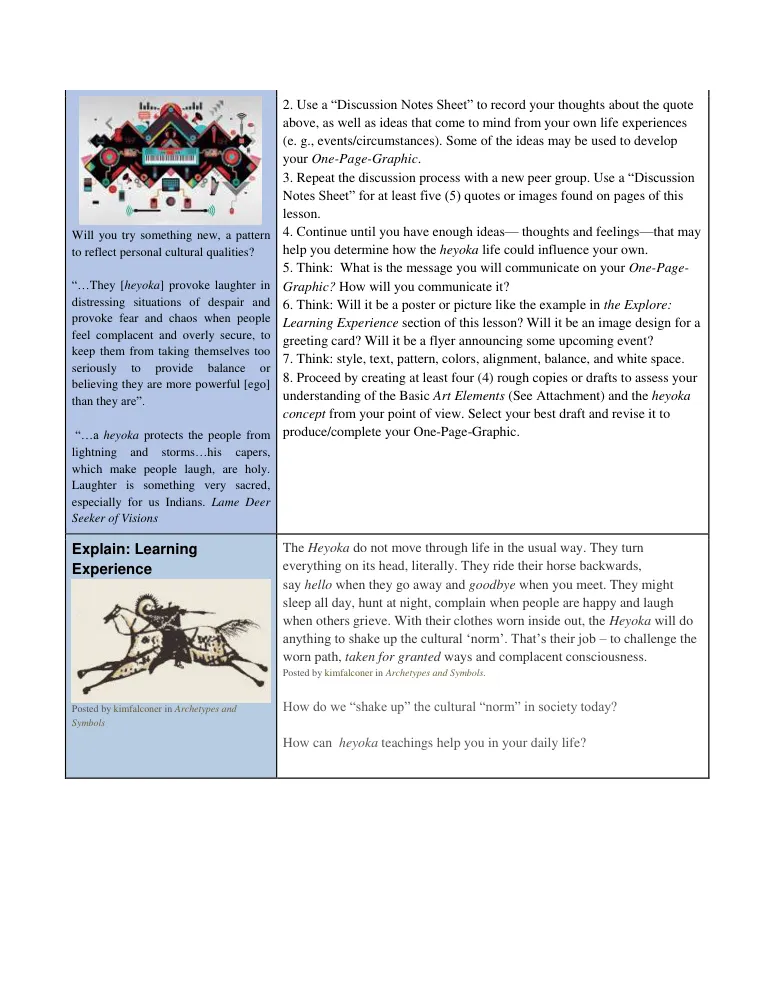
Will you try something new, a pattern
to reflect personal cultural qualities?
“…They [heyoka] provoke laughter in
distressing situations of despair and
provoke fear and chaos when people
feel complacent and overly secure, to
keep them from taking themselves too
seriously
to
provide
balance
or
believing they are more powerful [ego]
than they are”.
“…a heyoka protects the people from
lightning
and
storms…his
capers,
which make people laugh, are holy.
Laughter is something very sacred,
especially for us Indians. Lame Deer
Seeker of Visions
2. Use a “Discussion Notes Sheet” to record your thoughts about the quote
above, as well as ideas that come to mind from your own life experiences
(e. g., events/circumstances). Some of the ideas may be used to develop
your One-Page-Graphic.
3. Repeat the discussion process with a new peer group. Use a “Discussion
Notes Sheet” for at least five (5) quotes or images found on pages of this
lesson.
4. Continue until you have enough ideas— thoughts and feelings—that may
help you determine how the heyoka life could influence your own.
5. Think: What is the message you will communicate on your One-Page-
Graphic? How will you communicate it?
6. Think: Will it be a poster or picture like the example in the Explore:
Learning Experience section of this lesson? Will it be an image design for a
greeting card? Will it be a flyer announcing some upcoming event?
7. Think: style, text, pattern, colors, alignment, balance, and white space.
8. Proceed by creating at least four (4) rough copies or drafts to assess your
understanding of the Basic Art Elements (See Attachment) and the heyoka
concept from your point of view. Select your best draft and revise it to
produce/complete your One-Page-Graphic.
Explain: Learning
Experience
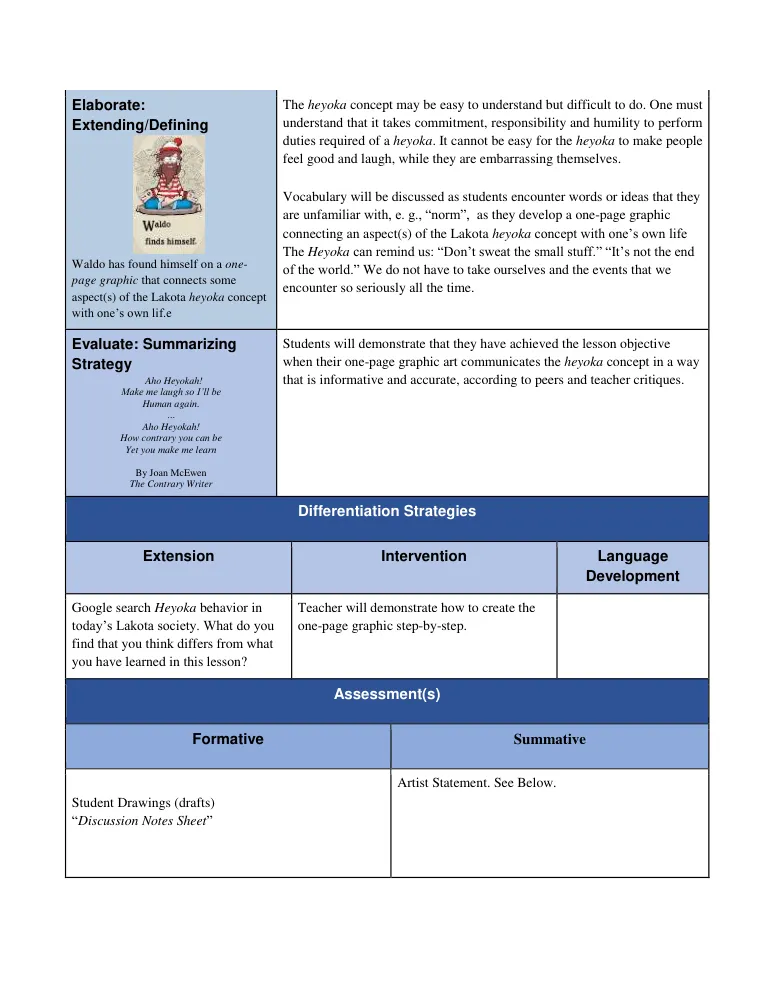
Posted by kimfalconer in Archetypes and
Symbols
The Heyoka do not move through life in the usual way. They turn
everything on its head, literally. They ride their horse backwards,
say hello when they go away and goodbye when you meet. They might
sleep all day, hunt at night, complain when people are happy and laugh
when others grieve. With their clothes worn inside out, the Heyoka will do
anything to shake up the cultural ‘norm’. That’s their job – to challenge the
worn path, taken for granted ways and complacent consciousness.
Posted by kimfalconer in Archetypes and Symbols.
How do we “shake up” the cultural “norm” in society today?
How can heyoka teachings help you in your daily life?
Elaborate:
Extending/Defining
Waldo has found himself on a one-
page graphic that connects some
aspect(s) of the Lakota heyoka concept
with one’s own lif.e
The heyoka concept may be easy to understand but difficult to do. One must
understand that it takes commitment, responsibility and humility to perform
duties required of a heyoka. It cannot be easy for the heyoka to make people
feel good and laugh, while they are embarrassing themselves.
Vocabulary will be discussed as students encounter words or ideas that they
are unfamiliar with, e. g., “norm”, as they develop a one-page graphic
connecting an aspect(s) of the Lakota heyoka concept with one’s own life
The Heyoka can remind us: “Don’t sweat the small stuff.” “It’s not the end
of the world.” We do not have to take ourselves and the events that we
encounter so seriously all the time.
Evaluate: Summarizing
Strategy
Aho Heyokah!
Make me laugh so I’ll be
Human again.
…
Aho Heyokah!
How contrary you can be
Yet you make me learn
By Joan McEwen
The Contrary Writer
Students will demonstrate that they have achieved the lesson objective
when their one-page graphic art communicates the heyoka concept in a way
that is informative and accurate, according to peers and teacher critiques.
Differentiation Strategies
Extension
Intervention
Language
Development
Google search Heyoka behavior in
today’s Lakota society. What do you
find that you think differs from what
you have learned in this lesson?
Teacher will demonstrate how to create the
one-page graphic step-by-step.
Assessment(s)
Formative
Summative
Student Drawings (drafts)
“Discussion Notes Sheet”
Ann
Ann
Artist Statement. See Below.
Teacher Reflection: (Next steps?)
Artist Statement
Use this chart to help you construct an artist statement about your artwork
1. DESCRIBE YOUR ARTWORK
Some questions to consider: What does your artwork look like? What is the subject matter? What
is the title of your work? What elements or principles are most obvious in your work?
2. HOW DID YOU CREATE YOUR ART?
Some questions to consider: What media is your artwork made from? What tools, techniques or
processes did you use to create your artwork?
3. WHAT IS THE BIG IDEA BEHIND YOUR ARTWORK?
Some questions to consider: What or who inspired your artwork? Does your work express a
personal or social issue? What emotions did you try to show in your artwork?
4. WHAT WERE YOUR GOALS FOR THIS ARTWORK?
Some questions to consider: What are your goals as an artist? Did this piece help you reach your
goals? Why or why not?
5. WHAT ARE YOUR THOUGHTS OVERALL OF YOUR ARTWORK?
Some questions to consider: What did you learn in creating this artwork? Is the final piece what
you imagined? How so? How will this piece influence your future artworks?
Attachment
Source provenance: OSEU Lesson Plans Old ALL Combined.pdf · WoLakota Project archive. Reformatted for this collection.