The complete archived text is retained here, including details that may extend beyond the inquiry blueprint.
Read the full archived lesson text
5 E’s Lesson Plan Template
Lesson: Hanwi (Moon)
Also called Hanhepi Wi (Nighttime Wi)
Objective: To see the impact the moon (Hanwin) has on people, their lives and the earth.
Essential Question(s):
How has Lakota culture continued to embrace Hanwi’s example for women to pass on their wisdom and
continuous enduring strength to others?
How can Lakota narratives teach lessons that increase our understanding of human nature?
Materials/Resources
Essential Vocabulary
Teacher:
Excepts and Appendix, attached
Student:
Software for creating digital art
Waning moon
Waxing moon
Crescent moon
Learning Experience
Standards and Practice:
OSEU 3: Culture and Language
Anchor Standard 2: K-12.Cr.2: Organize and develop artistic idea and work.
6-8.VA.Cr.2.1
6-8.VA.Cr.2.3
Cultural Integration:
Excerpts from “When the People Laughed at the Moon” (as told by George
Sword) are the basic cultural constructs for this lesson.
I Can Statement(s):
•
I can see how Lakota narratives explain positions and movements
of the moon.
•
I can look at the moon from different perspectives to create digital
art.
•
I can appreciate how narratives and the principles of art create
meaning to increase cultural understanding
Engage: Activating
Strategy/Hook:
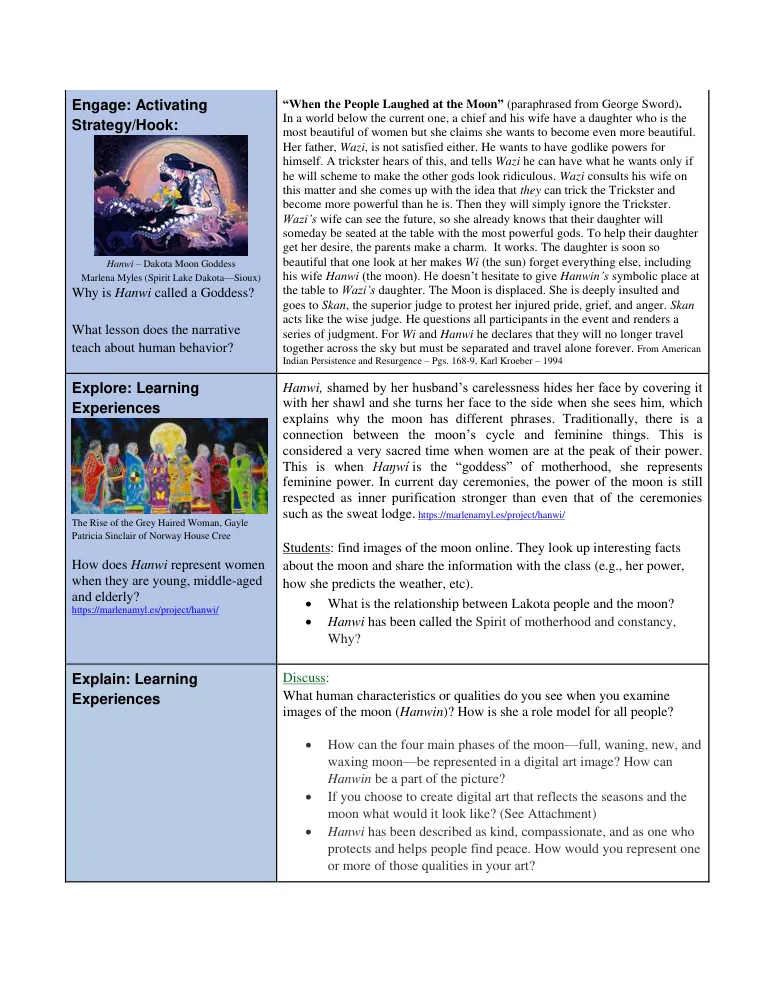
Hanwi – Dakota Moon Goddess
Marlena Myles (Spirit Lake Dakota—Sioux)
Why is Hanwi called a Goddess?
What lesson does the narrative
teach about human behavior?
“When the People Laughed at the Moon” (paraphrased from George Sword).
In a world below the current one, a chief and his wife have a daughter who is the
most beautiful of women but she claims she wants to become even more beautiful.
Her father, Wazi, is not satisfied either. He wants to have godlike powers for
himself. A trickster hears of this, and tells Wazi he can have what he wants only if
he will scheme to make the other gods look ridiculous. Wazi consults his wife on
this matter and she comes up with the idea that they can trick the Trickster and
become more powerful than he is. Then they will simply ignore the Trickster.
Wazi’s wife can see the future, so she already knows that their daughter will
someday be seated at the table with the most powerful gods. To help their daughter
get her desire, the parents make a charm. It works. The daughter is soon so
beautiful that one look at her makes Wi (the sun) forget everything else, including
his wife Hanwi (the moon). He doesn’t hesitate to give Hanwin’s symbolic place at
the table to Wazi’s daughter. The Moon is displaced. She is deeply insulted and
goes to Skan, the superior judge to protest her injured pride, grief, and anger. Skan
acts like the wise judge. He questions all participants in the event and renders a
series of judgment. For Wi and Hanwi he declares that they will no longer travel
together across the sky but must be separated and travel alone forever. From American
Indian Persistence and Resurgence – Pgs. 168-9, Karl Kroeber – 1994
Explore: Learning
Experiences
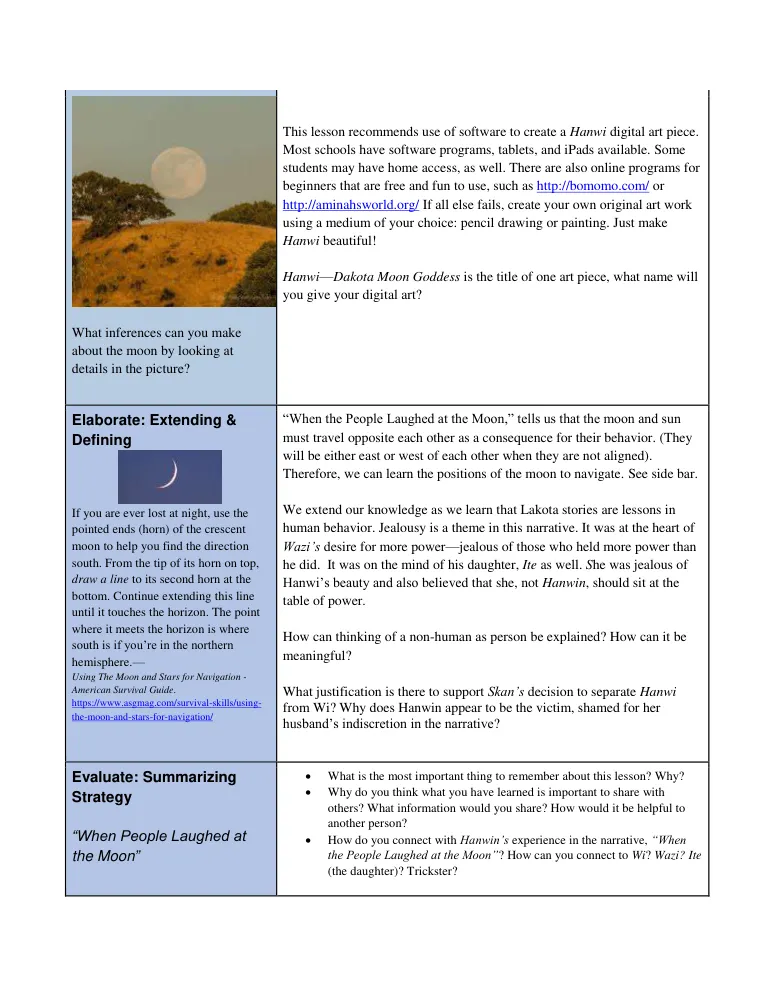
The Rise of the Grey Haired Woman, Gayle
Patricia Sinclair of Norway House Cree
How does Hanwi represent women
when they are young, middle-aged
and elderly?
https://marlenamyl.es/project/hanwi/
Hanwi, shamed by her husband’s carelessness hides her face by covering it
with her shawl and she turns her face to the side when she sees him, which
explains why the moon has different phrases. Traditionally, there is a
connection between the moon’s cycle and feminine things. This is
considered a very sacred time when women are at the peak of their power.
This is when Haŋwí is the “goddess” of motherhood, she represents
feminine power. In current day ceremonies, the power of the moon is still
respected as inner purification stronger than even that of the ceremonies
such as the sweat lodge. https://marlenamyl.es/project/hanwi/
Students: find images of the moon online. They look up interesting facts
about the moon and share the information with the class (e.g., her power,
how she predicts the weather, etc).
•
What is the relationship between Lakota people and the moon?
•
Hanwi has been called the Spirit of motherhood and constancy,
Why?
Explain: Learning
Experiences
Discuss:
What human characteristics or qualities do you see when you examine
images of the moon (Hanwin)? How is she a role model for all people?
•
How can the four main phases of the moon—full, waning, new, and
waxing moon—be represented in a digital art image? How can
Hanwin be a part of the picture?
•
If you choose to create digital art that reflects the seasons and the
moon what would it look like? (See Attachment)
•
Hanwi has been described as kind, compassionate, and as one who
protects and helps people find peace. How would you represent one
or more of those qualities in your art?
What inferences can you make
about the moon by looking at
details in the picture?
This lesson recommends use of software to create a Hanwi digital art piece.
Most schools have software programs, tablets, and iPads available. Some
students may have home access, as well. There are also online programs for
beginners that are free and fun to use, such as http://bomomo.com/ or
http://aminahsworld.org/ If all else fails, create your own original art work
using a medium of your choice: pencil drawing or painting. Just make
Hanwi beautiful!
Hanwi—Dakota Moon Goddess is the title of one art piece, what name will
you give your digital art?
Elaborate: Extending &
Defining
If you are ever lost at night, use the
pointed ends (horn) of the crescent
moon to help you find the direction
south. From the tip of its horn on top,
draw a line to its second horn at the
bottom. Continue extending this line
until it touches the horizon. The point
where it meets the horizon is where
south is if you’re in the northern
hemisphere.—
Using The Moon and Stars for Navigation -
American Survival Guide.
https://www.asgmag.com/survival-skills/using-
the-moon-and-stars-for-navigation/
“When the People Laughed at the Moon,” tells us that the moon and sun
must travel opposite each other as a consequence for their behavior. (They
will be either east or west of each other when they are not aligned).
Therefore, we can learn the positions of the moon to navigate. See side bar.
We extend our knowledge as we learn that Lakota stories are lessons in
human behavior. Jealousy is a theme in this narrative. It was at the heart of
Wazi’s desire for more power—jealous of those who held more power than
he did. It was on the mind of his daughter, Ite as well. She was jealous of
Hanwi’s beauty and also believed that she, not Hanwin, should sit at the
table of power.
How can thinking of a non-human as person be explained? How can it be
meaningful?
What justification is there to support Skan’s decision to separate Hanwi
from Wi? Why does Hanwin appear to be the victim, shamed for her
husband’s indiscretion in the narrative?
Evaluate: Summarizing
Strategy
“When People Laughed at
the Moon”
•
What is the most important thing to remember about this lesson? Why?
•
Why do you think what you have learned is important to share with
others? What information would you share? How would it be helpful to
another person?
•
How do you connect with Hanwin’s experience in the narrative, “When
the People Laughed at the Moon”? How can you connect to Wi? Wazi? Ite
(the daughter)? Trickster?
Differentiation Strategies
Extension
Intervention
Language Development
Solar Eclipse Unit
http://eclipse.montana.edu/wp-
content/uploads/2016/08/LP2_5ENGSSLe
ssonPlanningTemplate.pdf
The Story of the Moon Boy with
Velma Kills Back –
https://www.wolakotaproject.or
g/the-story-of-the-moon-boy-
with-velma-kills-back/
Read Wi and Hanwi version
called Phases of the Moon:
Lesson 1, Pg., 6 Total Solar Eclipse
Unit in 5E Format 7th Grade Earth Science
August ...
Assessment(s)
Formative
Summative
Students will share their digital art pieces, explain the
meaning and request peer comments.
Rate the digital art on a scale of 1-5, 5 being
excellent:
1. The pieces can be viewed online
2. The image is original. There are no issues
with copyright
3. Creativity. The piece stands out as unique.
4. Interest. Image or design catches and
maintains the viewer's interest (visual
communication)
5. Visual Impact Color, image supports the
desired mood
6. Process. Student completely explains the
process and steps in creating the piece.
SCORE _______ of 30
Teacher Reflection: (Next steps?)
Attachment
Lakota Thirteen Moon Calendar –
Akta Lakota Museum & Cultural Center
aktalakota.stjo.org/site/News2?page=NewsArticle&id=8991
Wetú — The Moons of Renewal and Growth—the calendar begins with Spring
Each spring, the camp circle moved to higher ground. Men fixed and created weapons and resumed hunting. Women
gathered early berries and roots and repaired the tipis. Children enjoyed the warm weather after the confines of
winter.
1. Magáksicaagli Wí — Moon When Ducks Come Back
2. Wíhákata Cépapi Wi — Moon of Making Fat
3. Wójupi Wi — Moon When the Leaves are Green
Blokétu — The Warm Moons (Summer)
During summer, the camp circle followed the migrating buffalo and moved often. Women worked to maintain the
camp and were responsible for transporting and unpacking the family’s belongings; they also prepared food and
made and set up tipis. Girls helped gather firewood and water and received instruction in quillwork decoration. Boys
practiced their hunting skills on small animals. Men made weapons, hunted for game and defended the camp.
Summer was also a time of celebrations and ceremonies.
4. Wípazuka Wasté Win — Moon of the June Berries
5. Canpásapa Wi — Moon When the Chokecherries Are Ripe
6. Wasúton Wi — Moon of the Harves
Ptanyétu — The Moons of Change (Autumn)
As summer gave way to fall, the Lakota got ready for winter. Food was gathered to last the winter season.
Women prepared meat from the buffalo that the men hunted. Underground storage caches were filled with
dried meat and fruit, and large quantities of firewood were stocked.
7. Canwápegi Wi — Moon When the Leaves Turn Brown
8. Canwapekasna Wi — Moon When the Wind Shakes off Leaves
9. Waníyetu Wi — Moon of the Rutting Deer
Waniyetu — The Cold and Dark Moons (Winter)
Winter signaled the beginning of a quieter time, during which a single camp site was used for the season. While
women made and mended clothing, men went on raiding parties to ensure the camp’s safety and strength. Winter
was also a time for fun. Children gathered around the fire to listen to the words of their grandparents. Lakota elders
preserved community history by telling stories and recounting past times. There also was time for games, dancing
and visiting.
10. Wanicokan Wi—Moon When the Deer Sheds Their Horns
11. Wiótehika Wi — The Hard Moon
12. Cannápopa Wi — Moon When Trees Crack From The Cold
13. Istáwicayazan Wi — Moon of Sore Eyes (Snow Blindness)
Source provenance: OSEU Lesson Plans Old ALL Combined.pdf · WoLakota Project archive. Reformatted for this collection.