Archived standards are preserved as originally published and may differ from current standards.
IDM adaptation of an archived lesson originally written in another format. Questions and activity summaries have been adapted for IDM; the complete original wording and materials are retained below. Fields absent from the source are identified.
Compelling question
What does the Story of the Giants teach about perseverance?
Standards & practices
SL.8.1
RL.8.9
Staging the question
Read or listen to the Story of the Giants.
Supporting inquiries
Supporting question 1
What does the Story of the Giants teach about perseverance?
Formative performance task
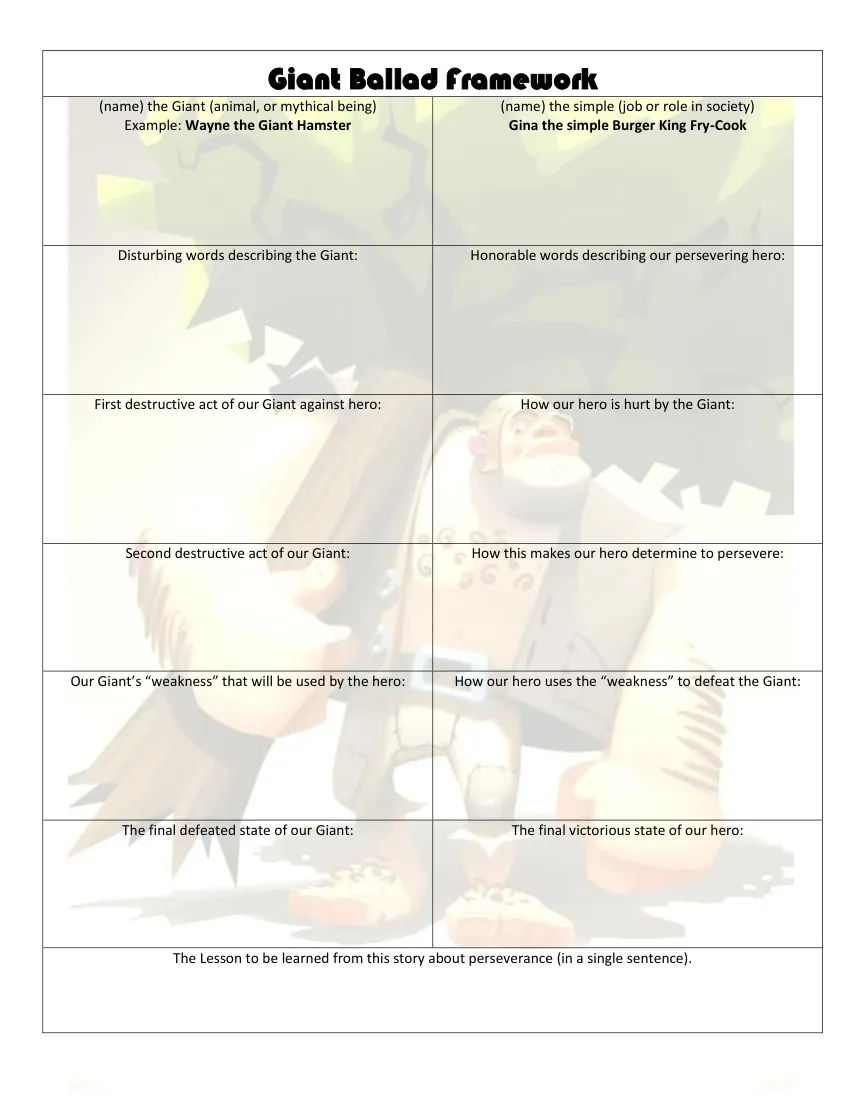
Discuss perseverance and the story’s values. Write a narrative with a hero, a giant, its weakness, and how the challenge is overcome. Use the source worksheet.
Featured sources
Use the complete source text, illustrations, worksheets, and matched Elder sources reproduced below. Named readings and external media are identified in the original text.
Summative performance task · Argument
Use the original lesson’s assessment criteria and culminating activity reproduced in the source text. A separate IDM argument prompt was not stated.
Extension
See the complete archived lesson for its original extensions, where provided.
Taking informed action
A separate informed-action task was not stated in the archived lesson.
Elder sources included in this lesson
No specific Elder video could be matched to the archived lesson’s source references.
Also named in the source: Joseph Marshall III. A specific video was not identified for these references.
Original text & supporting materials
The complete archived text is retained here, including details that may extend beyond the inquiry blueprint.
Read the full archived lesson text
Language Arts Lesson Plan
Story of the Giants
Oceti Sakowin Essential Understandings:
•
OESU 2, Indicator 1 for 6-8th: Students are able to
identify two of the values, rights, philosophy, and
beliefs of Oceti Sakowin people.
•
OSEU 5, Indicator 1 for 6-8th: Students are able to
defend the cultural beliefs of the Oceti Sakowin
and how they are demonstrated.
Common Core State Standards:
•
CCSS.ELA-Literacy.SL.8.1 Engage effectively in a range
of collaborative discussions (one-on-one, in groups,
and teacher-led) with diverse partners on grade 8 topics, texts, and issues, building on others’ ideas and
expressing their own clearly.
•
CCSS.ELA-Literacy.W.8.3 Write narratives to develop real or imagined experiences or events using
effective technique, relevant descriptive details, and well-structured event sequences.
•
CCSS.ELA-Literacy.RL.8.9 Analyze how a modern work of fiction draws on themes, patterns of events, or
character types from myths, traditional stories, or religious works such as the Bible, including describing
how the material is rendered new.
Introduction:
•
Perseverance is a value central to Oceti Sakowin culture and has been communicated and
encouraged for centuries through storytelling and song.
•
Many contemporary stories of perseverance (novels, films, short-stories) have their basis in
traditional oral stories, ancient texts and myths from around the world—including the
traditional lands of the Oceti Sakowin Oyate.
•
Creating such stories collaboratively gives students an opportunity to interact with peers around
the elements of character traits and conflicts that build the character of perseverance within
stories and in real life.
•
Powerful stories of perseverance—biographical, fictional or traditional—can lend support for
the practice of perseverance in everyday life.
Lesson:
•
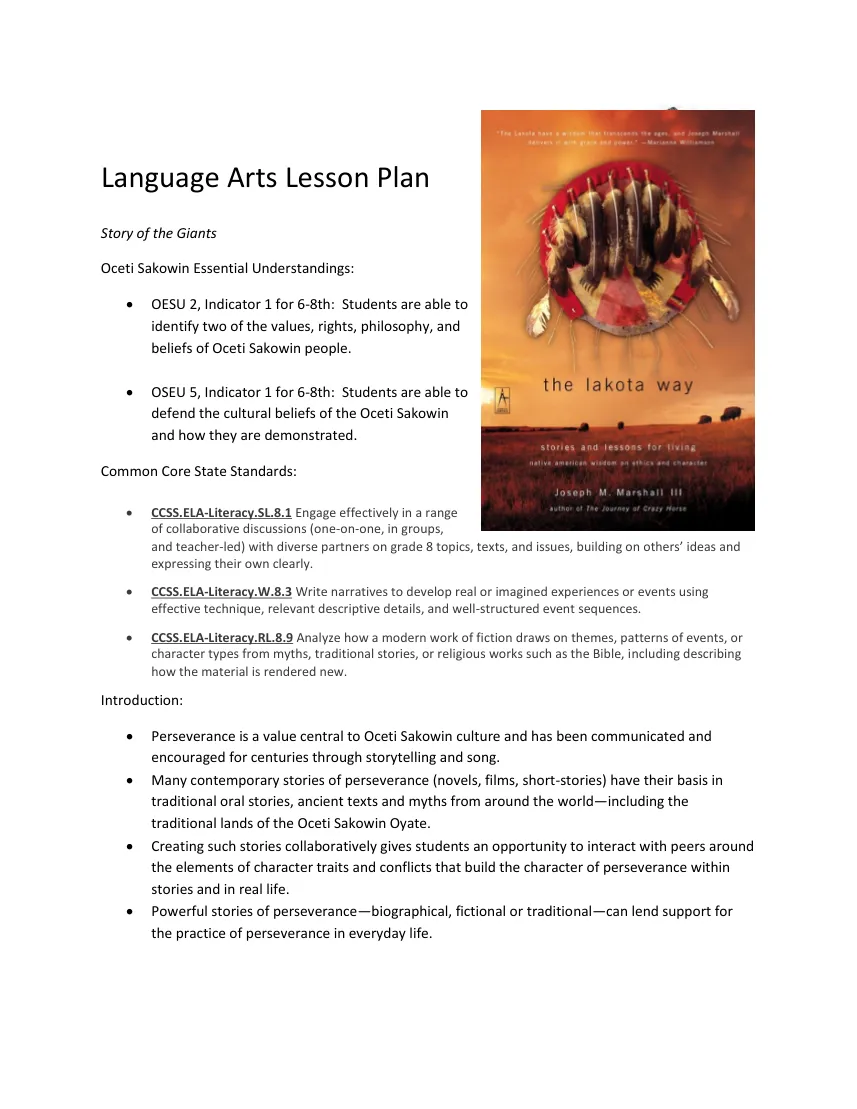
Begin by listening to the Perseverance story about Iya the Giant in chapter 2 of The Lakota Way
by Joseph Marshall III
•
Break into small groups or partners and brainstorm a list of possible characters, character traits,
challenges and a resolution for a “Giant” story of your own in which characters who are at an
initial disadvantage overcome some “Giant” through perseverance. Include a discussion of what
a traditional “ballad” is.
•
Student groups fill out the Giant Ballad Framework and whole class collaboratively writes a
Giant ballad as guided by teacher.
•
What does it mean to persevere? What are the real-life situations that demand perseverance?
How might stories or songs of perseverance help us to persevere?
•
Consider showing the OSEU video on perseverance.
Possible Follow-Up Activities:
•
Have students write other similar stories using other genres (poetry, short-story, drama, etc.)
•
Have students write an informational text (memoir, personal essay, concept analysis,
philosophical treatise, etc.) on the concept of perseverance.
Giant Ballad Framework
(name) the Giant (animal, or mythical being)
Example: Wayne the Giant Hamster
(name) the simple (job or role in society)
Gina the simple Burger King Fry-Cook
Disturbing words describing the Giant:
Honorable words describing our persevering hero:
First destructive act of our Giant against hero:
How our hero is hurt by the Giant:
Second destructive act of our Giant:
How this makes our hero determine to persevere:
Our Giant’s “weakness” that will be used by the hero:
How our hero uses the “weakness” to defeat the Giant:
The final defeated state of our Giant:
The final victorious state of our hero:
The Lesson to be learned from this story about perseverance (in a single sentence).
Original page 1 · illustrations and source materialsOriginal page 3 · illustrations and source materials