Archived standards are preserved as originally published and may differ from current standards.
IDM adaptation of an archived lesson originally written in another format. Questions and activity summaries have been adapted for IDM; the complete original wording and materials are retained below. Fields absent from the source are identified.
Compelling question
How can art express a community’s memories?
Standards & practices
Not specified in the archived lesson.
Staging the question
Discuss artists and audiences and view the memory and winter count sources.
Supporting inquiries
Supporting question 1
How can art express a community’s memories?
Formative performance task
Select a meaningful classroom community event, create an image, and explain its title, reasons for choosing it, and limits of the representation on the worksheet.
Featured sources
Use the complete source text, illustrations, worksheets, and matched Elder sources reproduced below. Named readings and external media are identified in the original text.
Summative performance task · Argument
Use the original lesson’s assessment criteria and culminating activity reproduced in the source text. A separate IDM argument prompt was not stated.
Extension
See the complete archived lesson for its original extensions, where provided.
Taking informed action
A separate informed-action task was not stated in the archived lesson.
Elder sources included in this lesson
No specific Elder video could be matched to the archived lesson’s source references.
Original text & supporting materials
The complete archived text is retained here, including details that may extend beyond the inquiry blueprint.
Read the full archived lesson text
High School Art Lesson
“Picturing Our Lives: Artistic Expression for a Community”
Common Core State Standards:
SL.9-10.1 - Initiate and participate effectively in a range of collaborative discussions (one-on-one, in groups, and teacher-
led) with diverse partners on grades 9-10 topics, texts, and issues, building on others’ ideas and expressing their own
clearly and persuasively.
SD Visual Arts Standards:
Still in adoption process
OSEU:
ESSENTIAL UNDERSTANDING 5:
History told from the Oceti Sakowin perspective, through oral tradition and written accounts, frequently conflicts with
the stories mainstream historians tell and becomes subjective information. Currently historical perspective is being
revisited to be more inclusive.
ESSENTIAL UNDERSTANDING 2: There is variety and resiliency among individual Tribal people as identity is developed,
defined and redefined by entities, organization and people. A continuum of tribal identity, unique to each individual,
ranges from assimilated to traditional lifestyle. There is no “generic American Indian”.
Lesson:
Begin with a brief conversation around WHOM we make art for…
•
Do you follow your own guidance? Work to please yourself when you create?
•
Do you ever work specifically for an audience? How does that impact your creative process?
•
Have you ever created something specifically to someone else’s specifications? Is that more difficult than
creating to your own specifications? Easier? Why?
•
What about creating FOR a community? What might you need to take into consideration?
View the video “Lakota Star Knowledge” (in Prezi or at https://youtu.be/VyK1Oqoqcg8 )
•
How would it feel to hold the responsibility for the remembering of your whole community? How would it feel
to be responsible for recording that memory artistically?
•
What if the chosen event for Winter Count wasn’t the one YOU would have chosen? How might you approach
that?
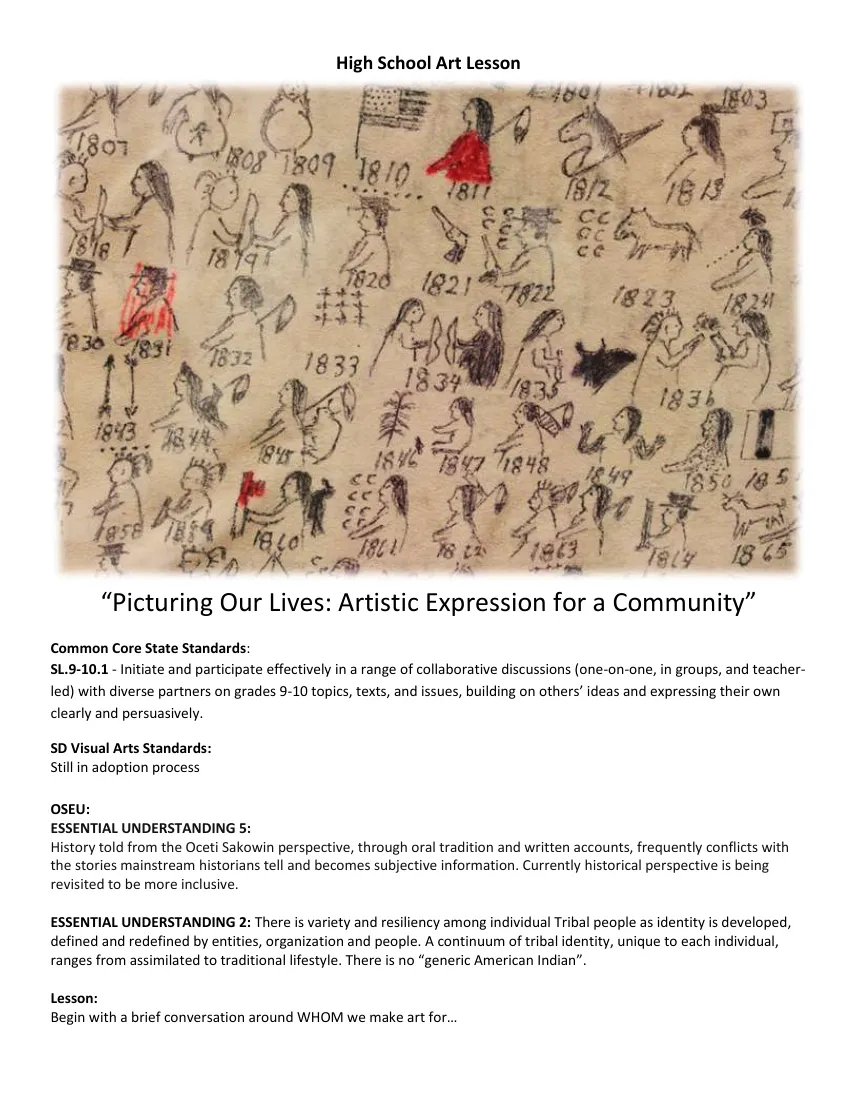
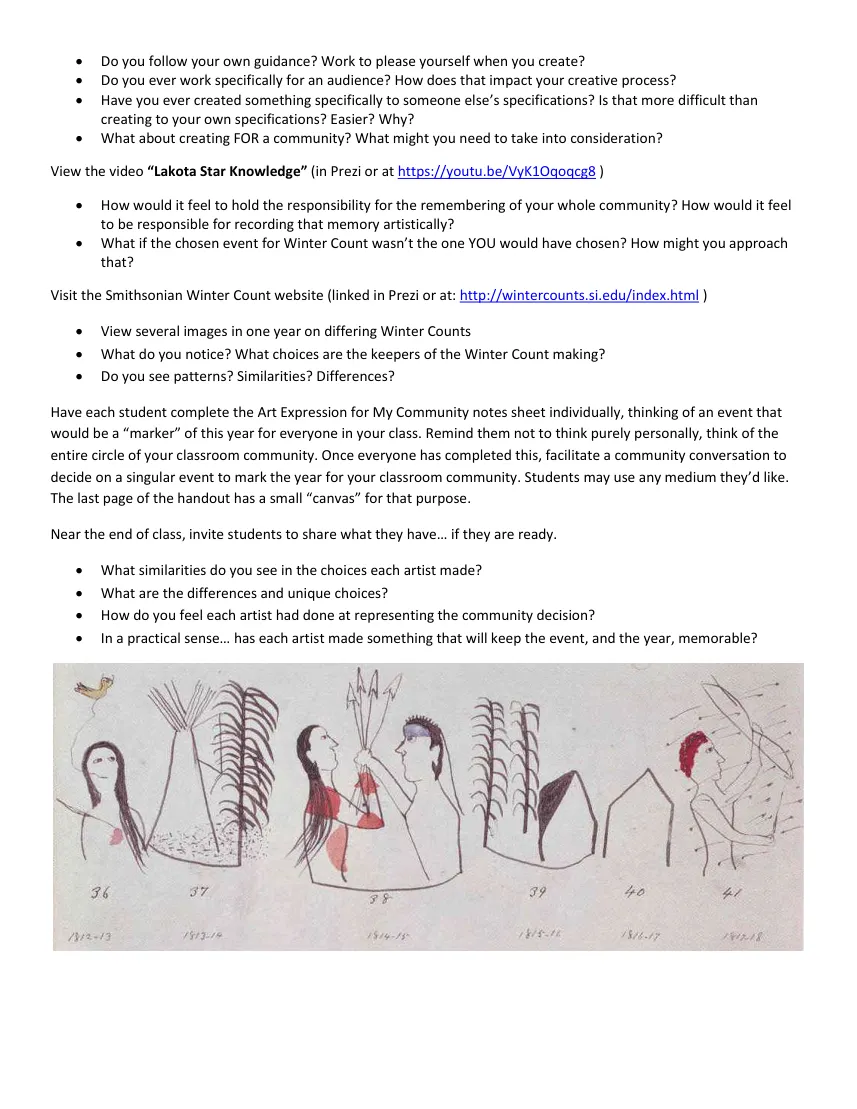
Visit the Smithsonian Winter Count website (linked in Prezi or at: http://wintercounts.si.edu/index.html )
•
View several images in one year on differing Winter Counts
•
What do you notice? What choices are the keepers of the Winter Count making?
•
Do you see patterns? Similarities? Differences?
Have each student complete the Art Expression for My Community notes sheet individually, thinking of an event that
would be a “marker” of this year for everyone in your class. Remind them not to think purely personally, think of the
entire circle of your classroom community. Once everyone has completed this, facilitate a community conversation to
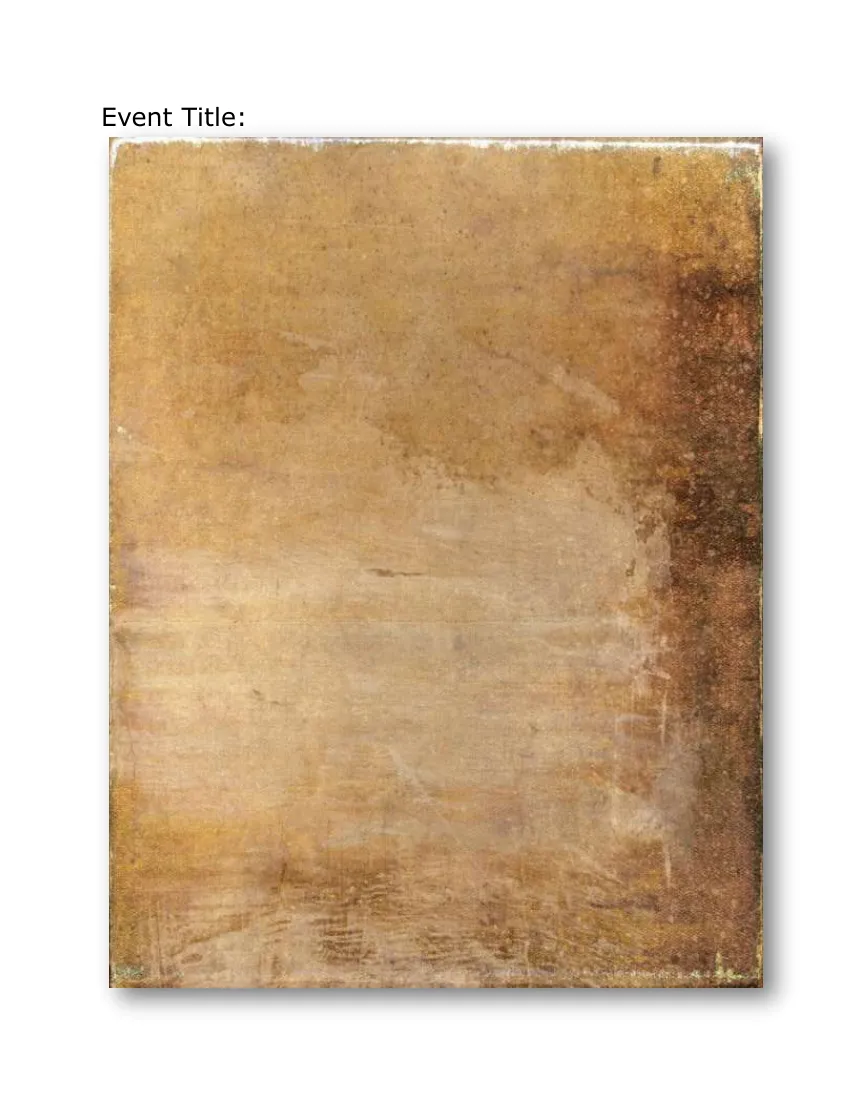
decide on a singular event to mark the year for your classroom community. Students may use any medium they’d like.
The last page of the handout has a small “canvas” for that purpose.
Near the end of class, invite students to share what they have… if they are ready.
•
What similarities do you see in the choices each artist made?
•
What are the differences and unique choices?
•
How do you feel each artist had done at representing the community decision?
•
In a practical sense… has each artist made something that will keep the event, and the year, memorable?
Art Expression FOR my community…
What event do I believe would make a memorable
subject for everyone in this class?
Why would this event be a good event to capture
in a drawing?
Are there any drawbacks to choosing this event
instead of some other?
Event Title:
Original page 1 · illustrations and source materialsOriginal page 2 · illustrations and source materialsOriginal page 4 · illustrations and source materials