The complete archived text is retained here, including details that may extend beyond the inquiry blueprint.
Read the full archived lesson text
5 E’s Lesson Plan Template
Lesson: Ledger Art— Part 2
“The Old and the New”—My Journal
Objective:
To create a ledger art journal that reflects aspects of Lakota culture and personal experiences.
Ledger Art Part 1—“Rosebud School Album” sets the foundation for this lesson and for Lesson: Ledger Art Part
3—“A Dream Story”, although any of the three parts can be stand-alone lessons.
Essential Question(s):
How do people develop ideas and understandings of society, culture, and history through their interactions with
and analysis of art?
How can individual awareness developed through engagement with visual imagery lead to art appreciation, and
understanding of others?
Materials/Resources
Essential Vocabulary
Teacher:
Drawing media include a
variety of pencil grades and
sizes; colored pencils, pastels,
chalk, conte crayon, charcoal,
watercolors.
Plains Indian Ledger Art |
Home
https://plainsledgerart.org
Click on View Ledgers, click on Select
Tribe; Click on any of the six (6) Lakota
(Sioux) Tribes.
Elements and Principles of Art
(14:20 minutes well spent)
https://www.youtube.com/watch?v=qIOfb
ozTIY8
Student:
Ledger, journal, or composition
notebook
2 Different kinds of erasers
Line Pattern
Shape Rhythm
Form Ledger
Color, Value
Texture
Space
Learning Experience
Standards and Practice:
OSEU: 3: Culture and Language
Anchor Standard 2: K-12.Cr. 2.1: Organize and develop artistic ideas and
work. 6-8.VA. Cr.2.1; 6-8.VA.Cr.2.3
Anchor Standard 8: K-12.Re.8: Interpret intent and meaning in artistic
work. 6-8.VA.Re.8.1
Anchor Standard 10: K-12.Cn10: Synthesize and relate knowledge and
personal experiences to make art. 6-8.VA.Cn.10.1
Cultural Integration:
“…Some of the best-known “ledger”
art was created at Fort Marion, in Saint
Augustine, Florida. Between 1875 and
1878, seventy-two Cheyenne, Kiowa,
Comanche, Arapaho, and Caddo men
were imprisoned there because of their
involvement in events connected to the
Red River Wars in Indian Territory
(later Oklahoma). Encouraged to draw
by their military captors, twenty-six of
the prisoners, mostly Cheyenne and
Kiowa, produced hundreds of drawings
and a number of books detailing their
former lives as warriors, hunters, and
suitors as well as their new lives as
prisoners and students…”
Keeping History: Plains Indian Ledger Drawing
Ledger Drawings - National Museum of
American History
http://americanhistory.si.edu/documentsgallery/e
xhibitions/ledger_drawing_3.html
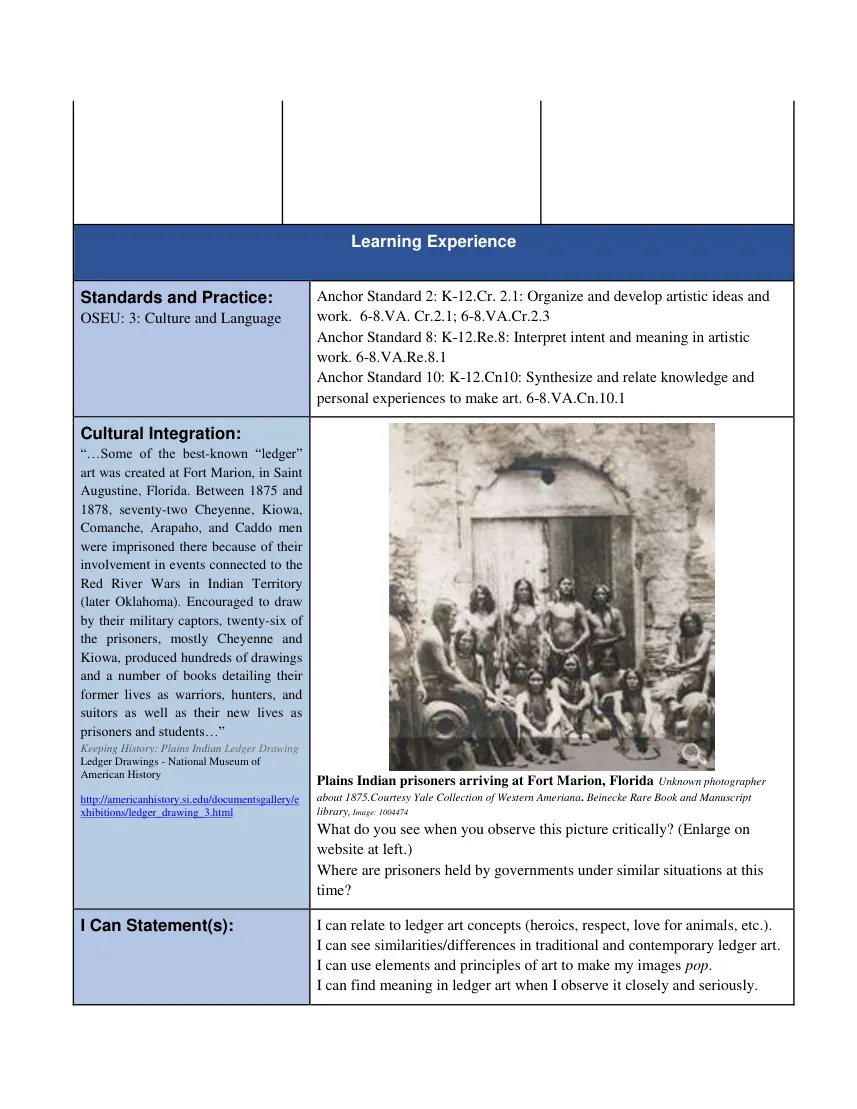
Plains Indian prisoners arriving at Fort Marion, Florida Unknown photographer
about 1875.Courtesy Yale Collection of Western Ameriana. Beinecke Rare Book and Manuscript
library, Image: 1004474
What do you see when you observe this picture critically? (Enlarge on
website at left.)
Where are prisoners held by governments under similar situations at this
time?
I Can Statement(s):
I can relate to ledger art concepts (heroics, respect, love for animals, etc.).
I can see similarities/differences in traditional and contemporary ledger art.
I can use elements and principles of art to make my images pop.
I can find meaning in ledger art when I observe it closely and seriously.
Engage: Activating
Strategy/Hook:
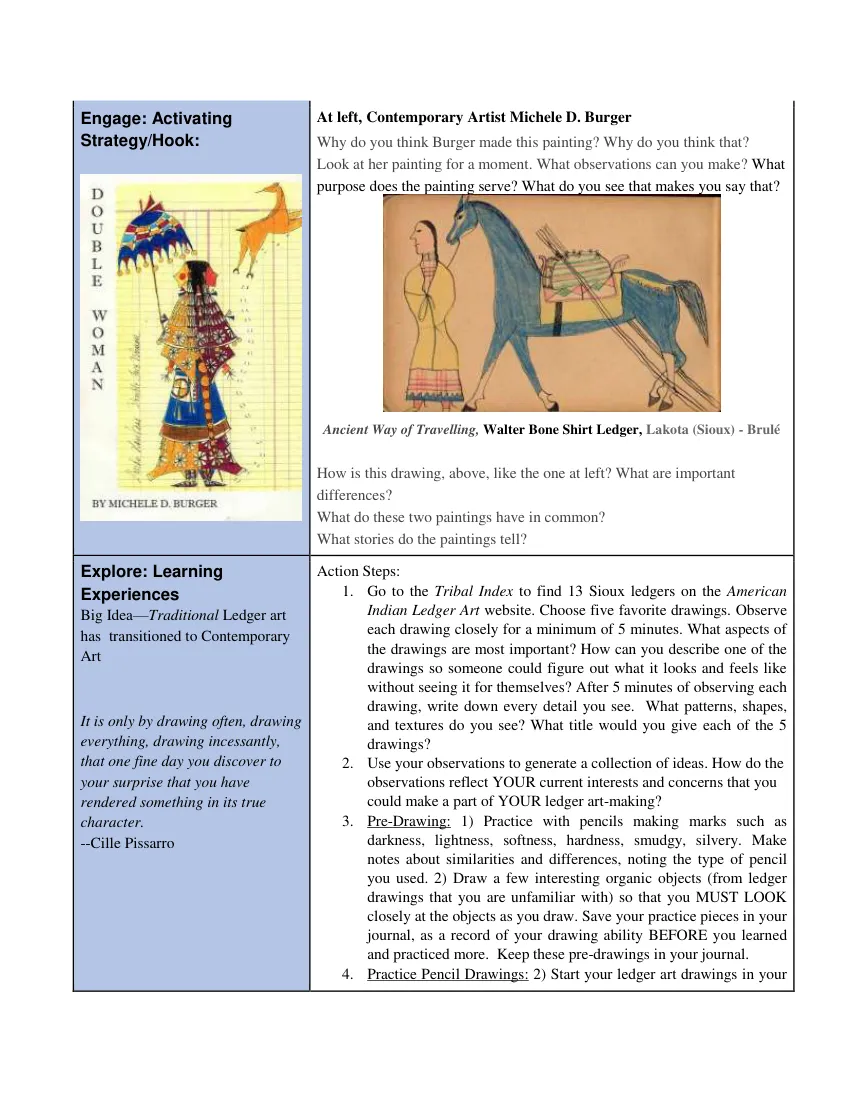
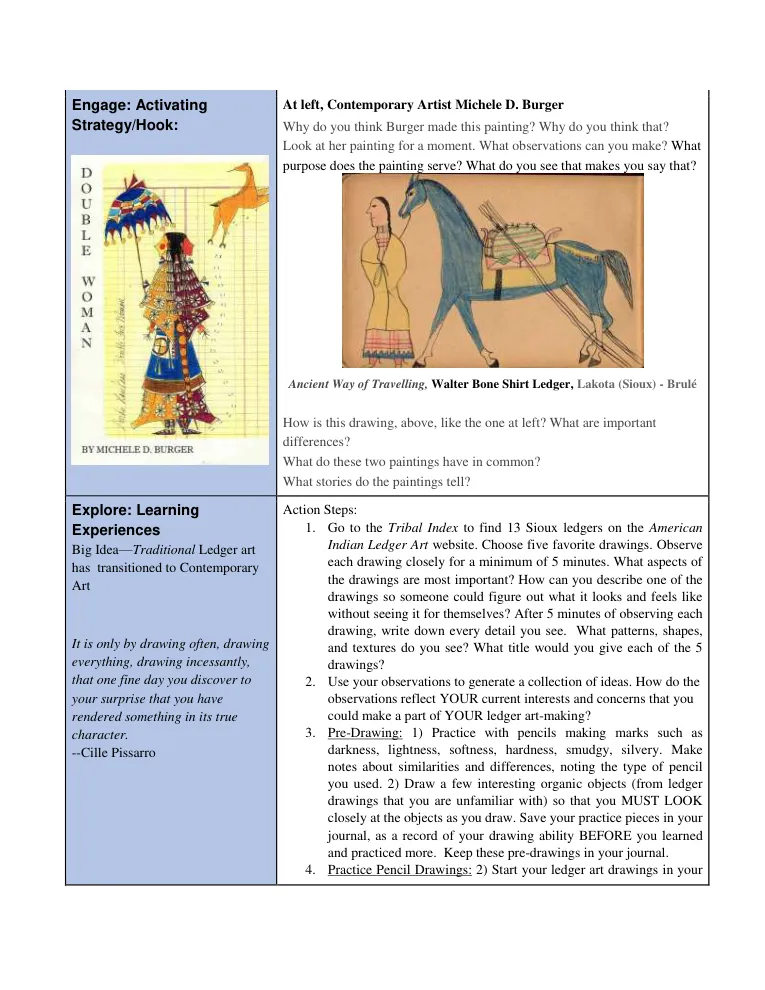
At left, Contemporary Artist Michele D. Burger
Why do you think Burger made this painting? Why do you think that?
Look at her painting for a moment. What observations can you make? What
purpose does the painting serve? What do you see that makes you say that?
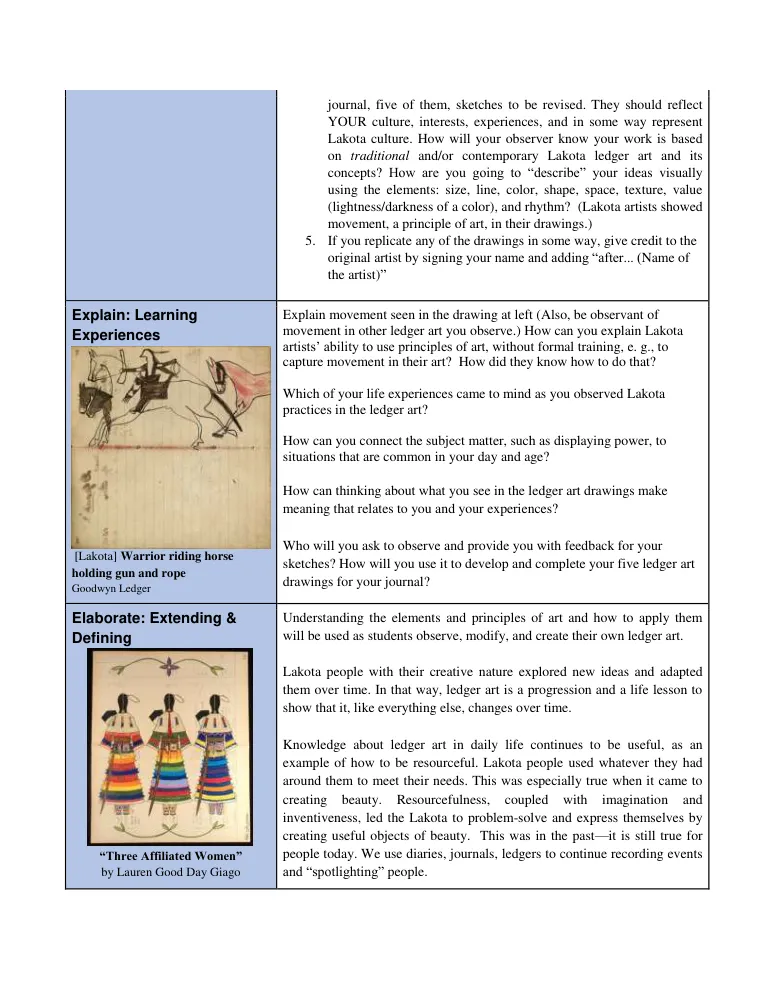
Ancient Way of Travelling, Walter Bone Shirt Ledger, Lakota (Sioux) - Brulé
How is this drawing, above, like the one at left? What are important
differences?
What do these two paintings have in common?
What stories do the paintings tell?
Explore: Learning
Experiences
Big Idea—Traditional Ledger art
has transitioned to Contemporary
Art
It is only by drawing often, drawing
everything, drawing incessantly,
that one fine day you discover to
your surprise that you have
rendered something in its true
character.
--Cille Pissarro
Action Steps:
1. Go to the Tribal Index to find 13 Sioux ledgers on the American
Indian Ledger Art website. Choose five favorite drawings. Observe
each drawing closely for a minimum of 5 minutes. What aspects of
the drawings are most important? How can you describe one of the
drawings so someone could figure out what it looks and feels like
without seeing it for themselves? After 5 minutes of observing each
drawing, write down every detail you see. What patterns, shapes,
and textures do you see? What title would you give each of the 5
drawings?
2. Use your observations to generate a collection of ideas. How do the
observations reflect YOUR current interests and concerns that you
could make a part of YOUR ledger art-making?
3. Pre-Drawing: 1) Practice with pencils making marks such as
darkness, lightness, softness, hardness, smudgy, silvery. Make
notes about similarities and differences, noting the type of pencil
you used. 2) Draw a few interesting organic objects (from ledger
drawings that you are unfamiliar with) so that you MUST LOOK
closely at the objects as you draw. Save your practice pieces in your
journal, as a record of your drawing ability BEFORE you learned
and practiced more. Keep these pre-drawings in your journal.
4. Practice Pencil Drawings: 2) Start your ledger art drawings in your
journal, five of them, sketches to be revised. They should reflect
YOUR culture, interests, experiences, and in some way represent
Lakota culture. How will your observer know your work is based
on traditional and/or contemporary Lakota ledger art and its
concepts? How are you going to “describe” your ideas visually
using the elements: size, line, color, shape, space, texture, value
(lightness/darkness of a color), and rhythm? (Lakota artists showed
movement, a principle of art, in their drawings.)
5. If you replicate any of the drawings in some way, give credit to the
original artist by signing your name and adding “after... (Name of
the artist)”
Explain: Learning
Experiences
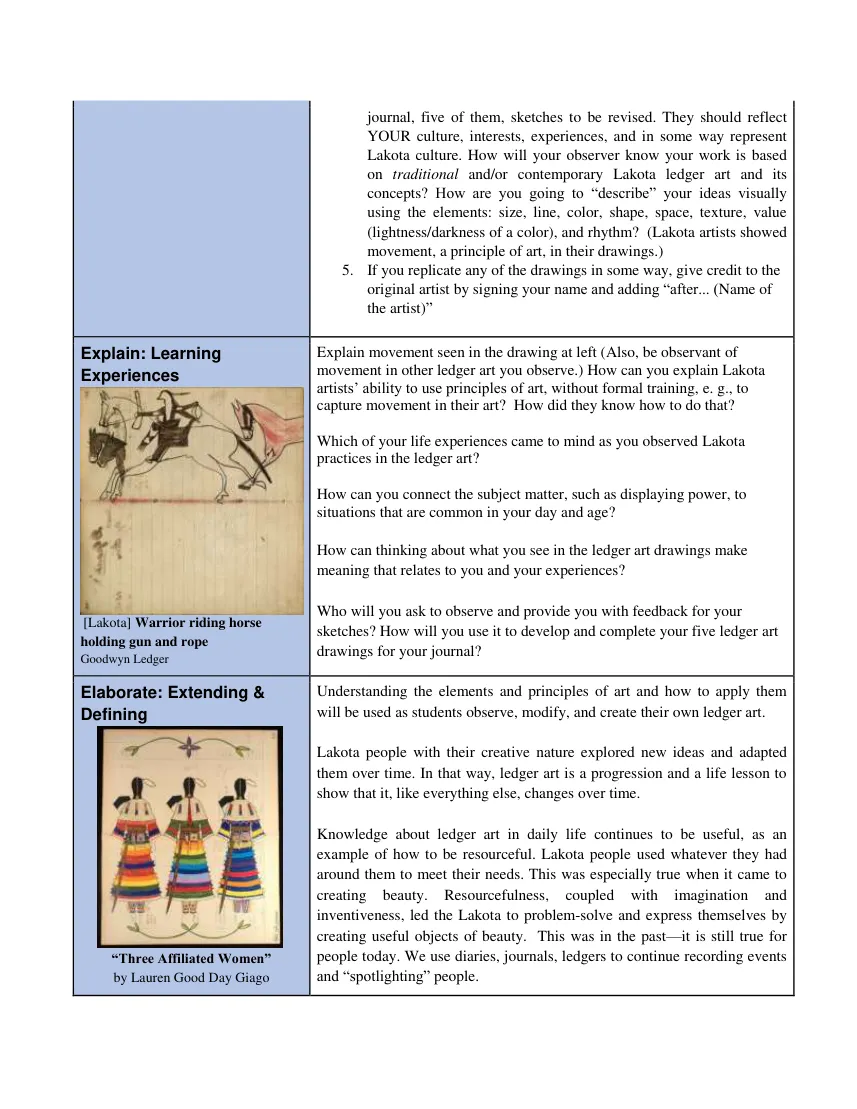
[Lakota] Warrior riding horse
holding gun and rope
Goodwyn Ledger
Explain movement seen in the drawing at left (Also, be observant of
movement in other ledger art you observe.) How can you explain Lakota
artists’ ability to use principles of art, without formal training, e. g., to
capture movement in their art? How did they know how to do that?
Which of your life experiences came to mind as you observed Lakota
practices in the ledger art?
How can you connect the subject matter, such as displaying power, to
situations that are common in your day and age?
How can thinking about what you see in the ledger art drawings make
meaning that relates to you and your experiences?
Who will you ask to observe and provide you with feedback for your
sketches? How will you use it to develop and complete your five ledger art
drawings for your journal?
Elaborate: Extending &
Defining
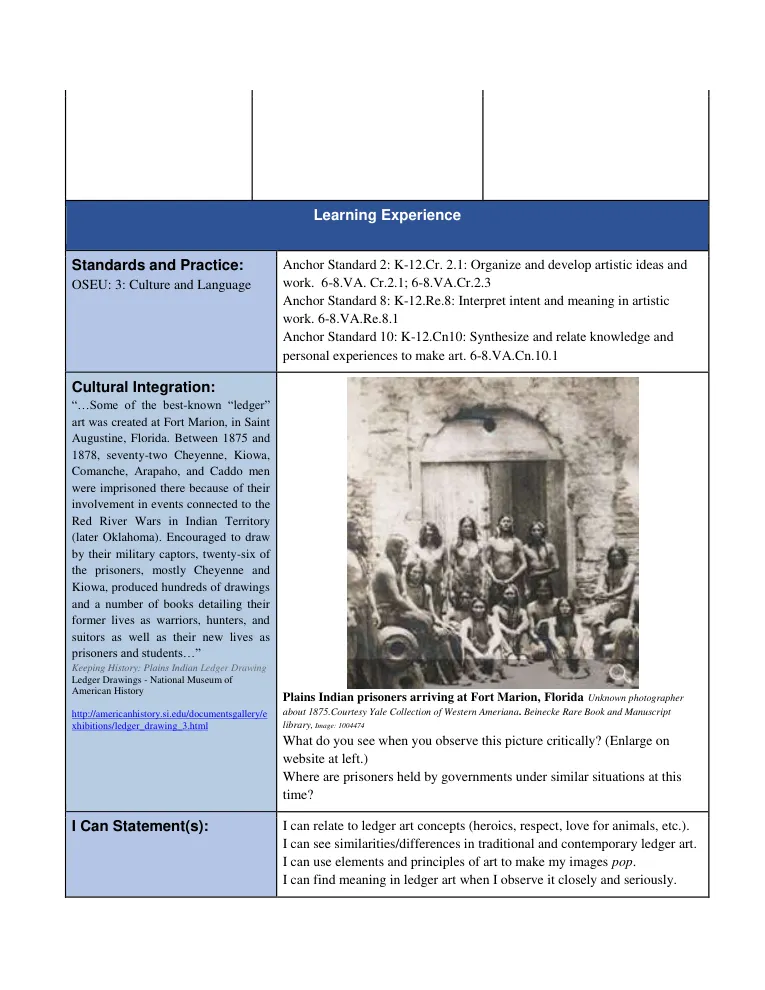
“Three Affiliated Women”
by Lauren Good Day Giago
Understanding the elements and principles of art and how to apply them
will be used as students observe, modify, and create their own ledger art.
Lakota people with their creative nature explored new ideas and adapted
them over time. In that way, ledger art is a progression and a life lesson to
show that it, like everything else, changes over time.
Knowledge about ledger art in daily life continues to be useful, as an
example of how to be resourceful. Lakota people used whatever they had
around them to meet their needs. This was especially true when it came to
creating
beauty.
Resourcefulness,
coupled
with
imagination
and
inventiveness, led the Lakota to problem-solve and express themselves by
creating useful objects of beauty. This was in the past—it is still true for
people today. We use diaries, journals, ledgers to continue recording events
and “spotlighting” people.
Evaluate: Summarizing
Strategie
Compare before, during, and after drawings to see progress.
Questioning Strategy: How does your personal artwork convey your
intended message?
Differentiation Strategies
Extension
Intervention
Language Development
See more about Artist Walter Bone
Shirt, on the Plains Indian Ledger Art
website. (Look at the work of other
artists to learn about Lakota history,
culture, and ledger art.)
See OSEU Lessons: Ledger Art Part1
Ledger Art Part 3.
Ask probing questions to help
students describe drawings and
better understand Lakota
concepts in the art work: What
kinds of things do you see?
What else do you see?
Assessment(s)
Formative
Self-Evaluation:
Summative
Final Project—Rubric or Rating Scale
1. What do you think is good and not so good
about your drawings?
2. Do you think you are doing a good or bad job?
Why?
3. Why do you think other people will want to see
your works of art?
4. What do you think other people will say about
your art pieces? Why do you think that?
5. What grade would you give yourself when your
work is completed? How will you arrive at it?
6. What will you do with this work?
7.
What do you think will be worth remembering
about your drawings?
Teacher and students will develop a rubric or rating
scale based on objective and standards—before
beginning the project. Sample questions:
•
How are knowledge and personal experiences
depicted in your ledger? Event? Subject?
•
How well does your intention, meaning show
through your art-making? What story does it tell?
•
What artistic ideas can be seen in your work?
(Elements of art, images, background, objects?)
•
How can an observer know your work is based on
Lakota ledger art concept? Your experience?
•
Would your art be classified as traditional,
contemporary art or both? Why?
Teacher Reflection: (Next steps?)
COMBINED ARCHIVE VERSION · pages 61–66
5 E’s Lesson Plan Template
Lesson: Ledger Art— Part 2
“The Old and the New”—My Journal
Objective:
To create a ledger art journal that reflects aspects of Lakota culture and personal experiences.
Ledger Art Part 1—“Rosebud School Album” sets the foundation for this lesson and for Lesson: Ledger Art Part
3—“A Dream Story”, although any of the three parts can be stand-alone lessons.
Essential Question(s):
How do people develop ideas and understandings of society, culture, and history through their interactions with
and analysis of art?
How can individual awareness developed through engagement with visual imagery lead to art appreciation, and
understanding of others?
Materials/Resources
Essential Vocabulary
Teacher:
Drawing media include a
variety of pencil grades and
sizes; colored pencils, pastels,
chalk, conte crayon, charcoal,
watercolors.
Plains Indian Ledger Art |
Home
https://plainsledgerart.org
Click on View Ledgers, click on Select
Tribe; Click on any of the six (6) Lakota
(Sioux) Tribes.
Elements and Principles of Art
(14:20 minutes well spent)
https://www.youtube.com/watch?v=qIOfb
ozTIY8
Student:
Ledger, journal, or composition
notebook
2 Different kinds of erasers
Line Pattern
Shape Rhythm
Form Ledger
Color, Value
Texture
Space
Learning Experience
Standards and Practice:
OSEU: 3: Culture and Language
Anchor Standard 2: K-12.Cr. 2.1: Organize and develop artistic ideas and
work. 6-8.VA. Cr.2.1; 6-8.VA.Cr.2.3
Anchor Standard 8: K-12.Re.8: Interpret intent and meaning in artistic
work. 6-8.VA.Re.8.1
Anchor Standard 10: K-12.Cn10: Synthesize and relate knowledge and
personal experiences to make art. 6-8.VA.Cn.10.1
Cultural Integration:
“…Some of the best-known “ledger”
art was created at Fort Marion, in Saint
Augustine, Florida. Between 1875 and
1878, seventy-two Cheyenne, Kiowa,
Comanche, Arapaho, and Caddo men
were imprisoned there because of their
involvement in events connected to the
Red River Wars in Indian Territory
(later Oklahoma). Encouraged to draw
by their military captors, twenty-six of
the prisoners, mostly Cheyenne and
Kiowa, produced hundreds of drawings
and a number of books detailing their
former lives as warriors, hunters, and
suitors as well as their new lives as
prisoners and students…”
Keeping History: Plains Indian Ledger Drawing
Ledger Drawings - National Museum of
American History
http://americanhistory.si.edu/documentsgallery/e
xhibitions/ledger_drawing_3.html
Plains Indian prisoners arriving at Fort Marion, Florida Unknown photographer
about 1875.Courtesy Yale Collection of Western Ameriana. Beinecke Rare Book and Manuscript
library, Image: 1004474
What do you see when you observe this picture critically? (Enlarge on
website at left.)
Where are prisoners held by governments under similar situations at this
time?
I Can Statement(s):
I can relate to ledger art concepts (heroics, respect, love for animals, etc.).
I can see similarities/differences in traditional and contemporary ledger art.
I can use elements and principles of art to make my images pop.
I can find meaning in ledger art when I observe it closely and seriously.
Engage: Activating
Strategy/Hook:
At left, Contemporary Artist Michele D. Burger
Why do you think Burger made this painting? Why do you think that?
Look at her painting for a moment. What observations can you make? What
purpose does the painting serve? What do you see that makes you say that?
Ancient Way of Travelling, Walter Bone Shirt Ledger, Lakota (Sioux) - Brulé
How is this drawing, above, like the one at left? What are important
differences?
What do these two paintings have in common?
What stories do the paintings tell?
Explore: Learning
Experiences
Big Idea—Traditional Ledger art
has transitioned to Contemporary
Art
It is only by drawing often, drawing
everything, drawing incessantly,
that one fine day you discover to
your surprise that you have
rendered something in its true
character.
--Cille Pissarro
Action Steps:
1. Go to the Tribal Index to find 13 Sioux ledgers on the American
Indian Ledger Art website. Choose five favorite drawings. Observe
each drawing closely for a minimum of 5 minutes. What aspects of
the drawings are most important? How can you describe one of the
drawings so someone could figure out what it looks and feels like
without seeing it for themselves? After 5 minutes of observing each
drawing, write down every detail you see. What patterns, shapes,
and textures do you see? What title would you give each of the 5
drawings?
2. Use your observations to generate a collection of ideas. How do the
observations reflect YOUR current interests and concerns that you
could make a part of YOUR ledger art-making?
3. Pre-Drawing: 1) Practice with pencils making marks such as
darkness, lightness, softness, hardness, smudgy, silvery. Make
notes about similarities and differences, noting the type of pencil
you used. 2) Draw a few interesting organic objects (from ledger
drawings that you are unfamiliar with) so that you MUST LOOK
closely at the objects as you draw. Save your practice pieces in your
journal, as a record of your drawing ability BEFORE you learned
and practiced more. Keep these pre-drawings in your journal.
4. Practice Pencil Drawings: 2) Start your ledger art drawings in your
journal, five of them, sketches to be revised. They should reflect
YOUR culture, interests, experiences, and in some way represent
Lakota culture. How will your observer know your work is based
on traditional and/or contemporary Lakota ledger art and its
concepts? How are you going to “describe” your ideas visually
using the elements: size, line, color, shape, space, texture, value
(lightness/darkness of a color), and rhythm? (Lakota artists showed
movement, a principle of art, in their drawings.)
5. If you replicate any of the drawings in some way, give credit to the
original artist by signing your name and adding “after... (Name of
the artist)”
Explain: Learning
Experiences
[Lakota] Warrior riding horse
holding gun and rope
Goodwyn Ledger
Explain movement seen in the drawing at left (Also, be observant of
movement in other ledger art you observe.) How can you explain Lakota
artists’ ability to use principles of art, without formal training, e. g., to
capture movement in their art? How did they know how to do that?
Which of your life experiences came to mind as you observed Lakota
practices in the ledger art?
How can you connect the subject matter, such as displaying power, to
situations that are common in your day and age?
How can thinking about what you see in the ledger art drawings make
meaning that relates to you and your experiences?
Who will you ask to observe and provide you with feedback for your
sketches? How will you use it to develop and complete your five ledger art
drawings for your journal?
Elaborate: Extending &
Defining
“Three Affiliated Women”
by Lauren Good Day Giago
Understanding the elements and principles of art and how to apply them
will be used as students observe, modify, and create their own ledger art.
Lakota people with their creative nature explored new ideas and adapted
them over time. In that way, ledger art is a progression and a life lesson to
show that it, like everything else, changes over time.
Knowledge about ledger art in daily life continues to be useful, as an
example of how to be resourceful. Lakota people used whatever they had
around them to meet their needs. This was especially true when it came to
creating
beauty.
Resourcefulness,
coupled
with
imagination
and
inventiveness, led the Lakota to problem-solve and express themselves by
creating useful objects of beauty. This was in the past—it is still true for
people today. We use diaries, journals, ledgers to continue recording events
and “spotlighting” people.
Evaluate: Summarizing
Strategie
Compare before, during, and after drawings to see progress.
Questioning Strategy: How does your personal artwork convey your
intended message?
Differentiation Strategies
Extension
Intervention
Language Development
See more about Artist Walter Bone
Shirt, on the Plains Indian Ledger Art
website. (Look at the work of other
artists to learn about Lakota history,
culture, and ledger art.)
See OSEU Lessons: Ledger Art Part1
Ledger Art Part 3.
Ask probing questions to help
students describe drawings and
better understand Lakota
concepts in the art work: What
kinds of things do you see?
What else do you see?
Assessment(s)
Formative
Self-Evaluation:
Summative
Final Project—Rubric or Rating Scale
1. What do you think is good and not so good
about your drawings?
2. Do you think you are doing a good or bad job?
Why?
3. Why do you think other people will want to see
your works of art?
4. What do you think other people will say about
your art pieces? Why do you think that?
5. What grade would you give yourself when your
work is completed? How will you arrive at it?
6. What will you do with this work?
7.
What do you think will be worth remembering
about your drawings?
Teacher and students will develop a rubric or rating
scale based on objective and standards—before
beginning the project. Sample questions:
How are knowledge and personal experiences
depicted in your ledger? Event? Subject?
How well does your intention, meaning show
through your art-making? What story does it tell?
What artistic ideas can be seen in your work?
(Elements of art, images, background, objects?)
How can an observer know your work is based on
Lakota ledger art concept? Your experience?
Would your art be classified as traditional,
contemporary art or both? Why?
Teacher Reflection: (Next steps?)
Source provenance: 09-Ledger-Art-Lesson-2.pdf · WoLakota Project archive. Reformatted for this collection.