The complete archived text is retained here, including details that may extend beyond the inquiry blueprint.
Read the full archived lesson text
5 E’s Lesson Plan Template
Lesson: Ledger Art—Part 1
The (Classroom Name ) Album
“Our Life in Pictures”
Student Objective: To express themselves as they discover Lakota Ledger Art and revisit elements of art to create
visual art.
This lesson sets the foundation for Part 2— “The Old and the New—My Journal” and Part 3—“A Dream Story”,
although any of the three may be used as stand-alone lessons.
Essential Question(s):
What is significant about Ledger Art?
How is Ledger Art like a narrative? How is it unlike a narrative?
Why were ledgers chosen rather than other art medium?
How has ledger art changed over the years?
Ledger Art, what’s in it for you?
Materials/Resources
Essential
Vocabulary
Teacher:
Short version. Ledger art - Wikipedia
https://en.wikipedia.org/wiki/Ledger_art
More information/explanation Ledger Art History
video https://plainsledgerart.org/history/ This source and
the one above provide background, themes, artists and
examples of the genre
The Rosebud School Album.
https://plainsledgerart.org/plates/view/485
Provide a review of basic art elements (Example:
Lines—drawing lines can be thick or thin; hard or
soft; light or dark; expressive or constructive; implied
or actual; choppy or smooth; barely there or strong
and sharp; fast or very slow.) Many tutorials on
YouTube or go to Elements and Principles of Art
(14:20 minutes well spent)
https://www.youtube.com/watch?v=qIOfbozTIY8
Student:
Pencils, ink fountain pens, crayons, and
watercolor paints
Narrative
Counter Narrative
Ledger
Genre
Medium
Learning Experience
Standards and Practice:
OSEU: 5: Oral tradition and story
Anchor Standard 10: K-12.Cn. 10: Synthesize and relate knowledge and
personal experiences to make art.
5.VA.Cn.10.1.a
6-8.VA.Cn.10.1
Cultural Integration:
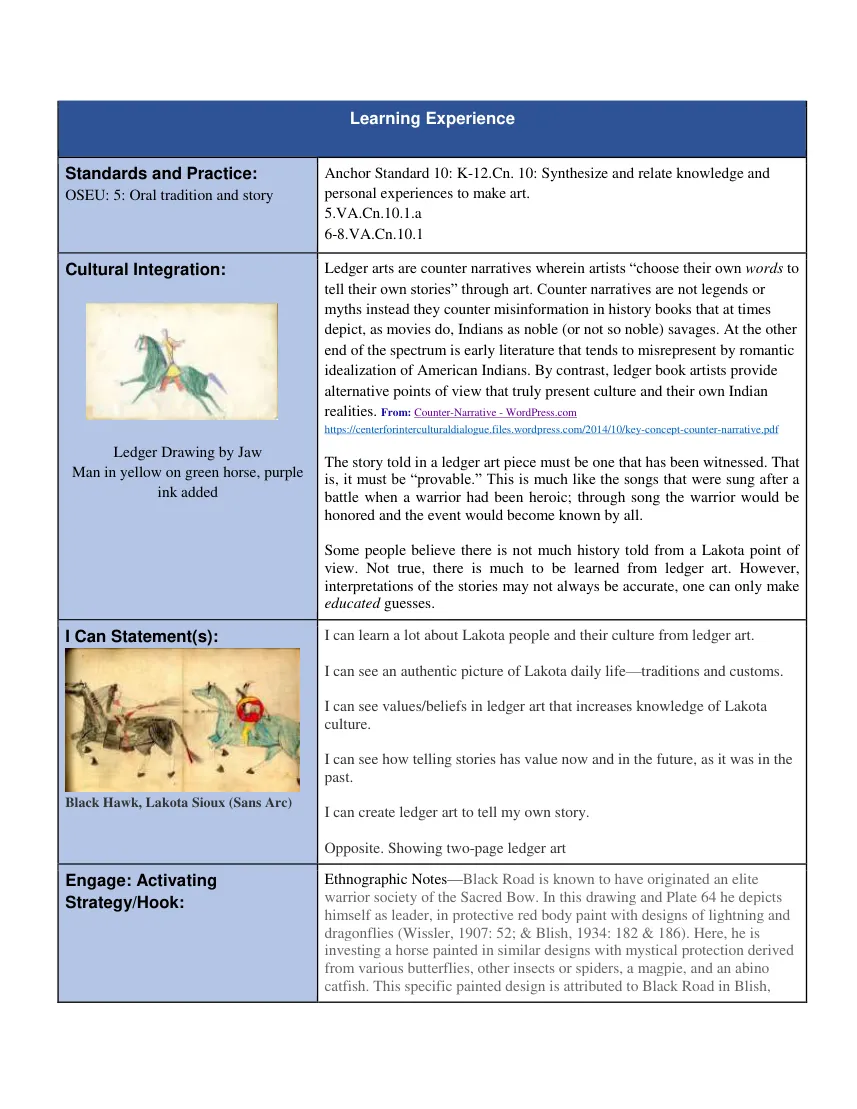
Ledger Drawing by Jaw
Man in yellow on green horse, purple
ink added
Ledger arts are counter narratives wherein artists “choose their own words to
tell their own stories” through art. Counter narratives are not legends or
myths instead they counter misinformation in history books that at times
depict, as movies do, Indians as noble (or not so noble) savages. At the other
end of the spectrum is early literature that tends to misrepresent by romantic
idealization of American Indians. By contrast, ledger book artists provide
alternative points of view that truly present culture and their own Indian
realities. From: Counter-Narrative - WordPress.com
https://centerforinterculturaldialogue.files.wordpress.com/2014/10/key-concept-counter-narrative.pdf
The story told in a ledger art piece must be one that has been witnessed. That
is, it must be “provable.” This is much like the songs that were sung after a
battle when a warrior had been heroic; through song the warrior would be
honored and the event would become known by all.
Some people believe there is not much history told from a Lakota point of
view. Not true, there is much to be learned from ledger art. However,
interpretations of the stories may not always be accurate, one can only make
educated guesses.
I Can Statement(s):
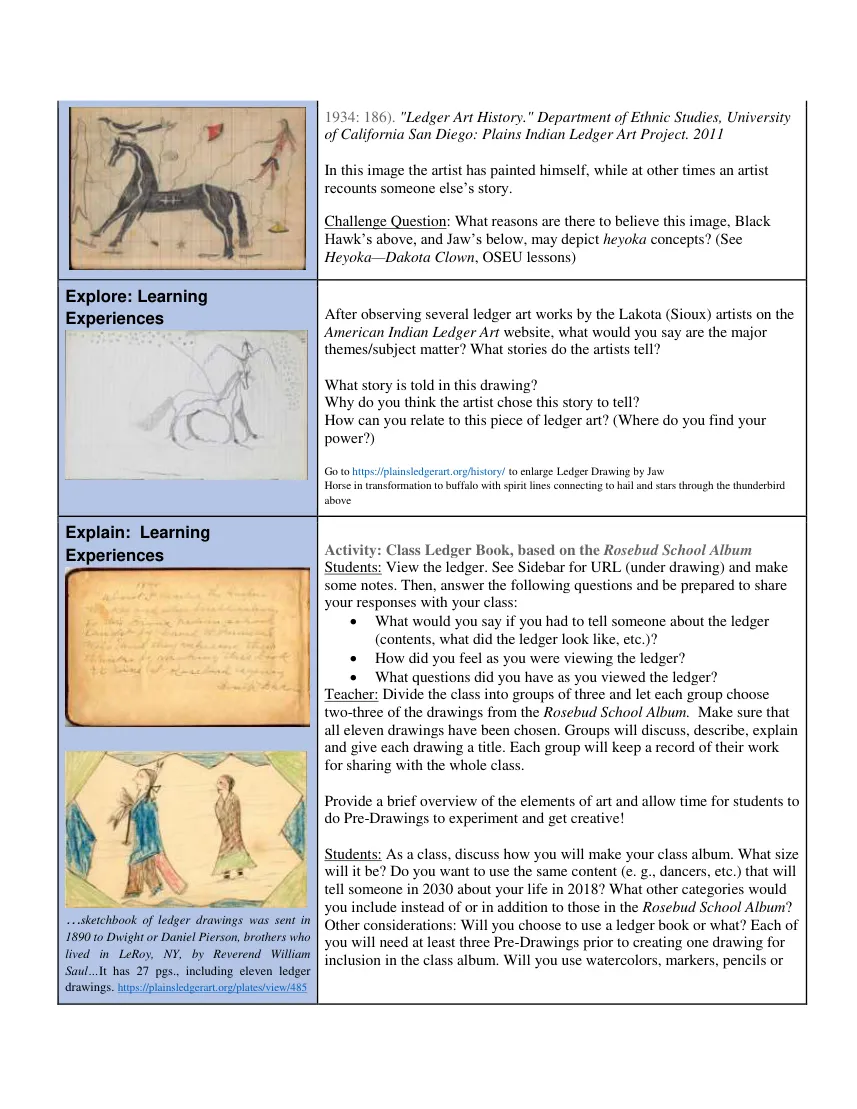
Black Hawk, Lakota Sioux (Sans Arc)
I can learn a lot about Lakota people and their culture from ledger art.
I can see an authentic picture of Lakota daily life—traditions and customs.
I can see values/beliefs in ledger art that increases knowledge of Lakota
culture.
I can see how telling stories has value now and in the future, as it was in the
past.
I can create ledger art to tell my own story.
Opposite. Showing two-page ledger art
Engage: Activating
Strategy/Hook:
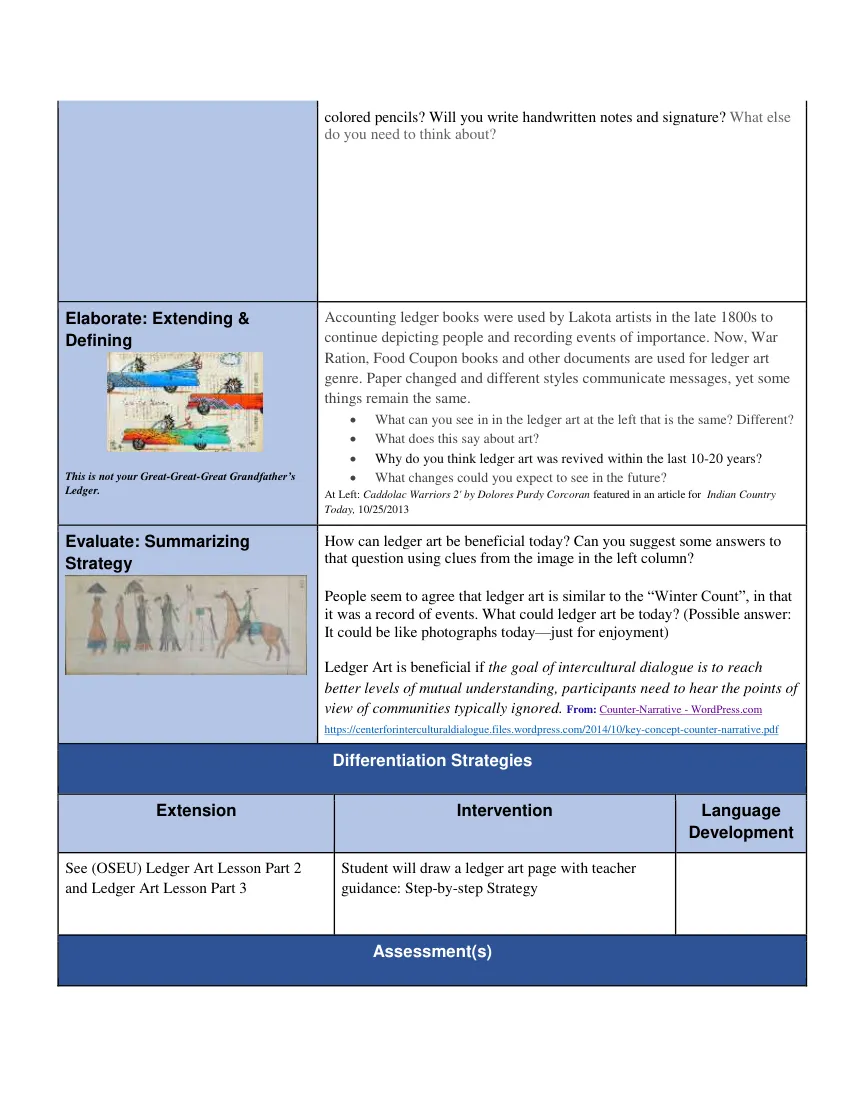
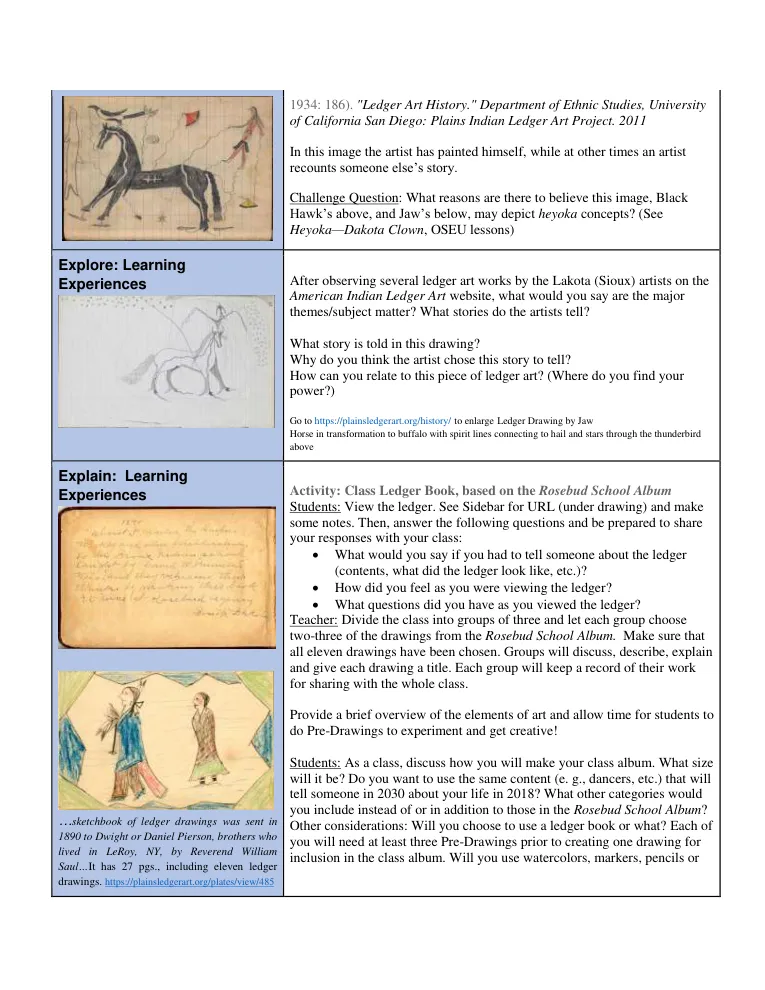
Ethnographic Notes—Black Road is known to have originated an elite
warrior society of the Sacred Bow. In this drawing and Plate 64 he depicts
himself as leader, in protective red body paint with designs of lightning and
dragonflies (Wissler, 1907: 52; & Blish, 1934: 182 & 186). Here, he is
investing a horse painted in similar designs with mystical protection derived
from various butterflies, other insects or spiders, a magpie, and an abino
catfish. This specific painted design is attributed to Black Road in Blish,
1934: 186). "Ledger Art History." Department of Ethnic Studies, University
of California San Diego: Plains Indian Ledger Art Project. 2011
In this image the artist has painted himself, while at other times an artist
recounts someone else’s story.
Challenge Question: What reasons are there to believe this image, Black
Hawk’s above, and Jaw’s below, may depict heyoka concepts? (See
Heyoka—Dakota Clown, OSEU lessons)
Explore: Learning
Experiences
After observing several ledger art works by the Lakota (Sioux) artists on the
American Indian Ledger Art website, what would you say are the major
themes/subject matter? What stories do the artists tell?
What story is told in this drawing?
Why do you think the artist chose this story to tell?
How can you relate to this piece of ledger art? (Where do you find your
power?)
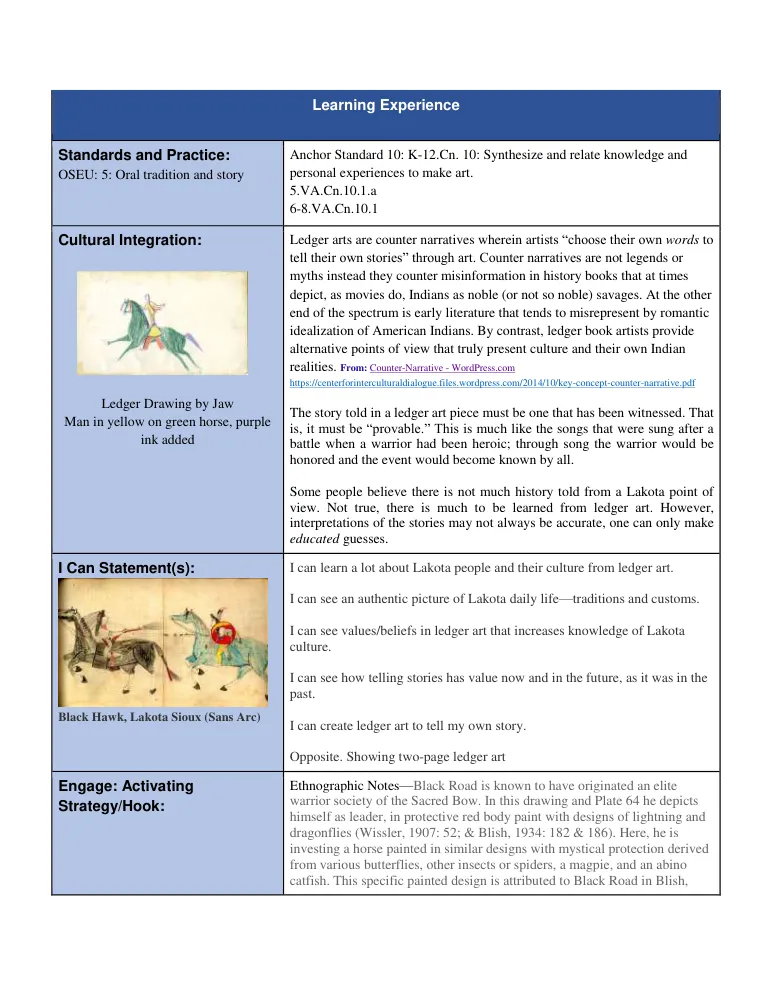
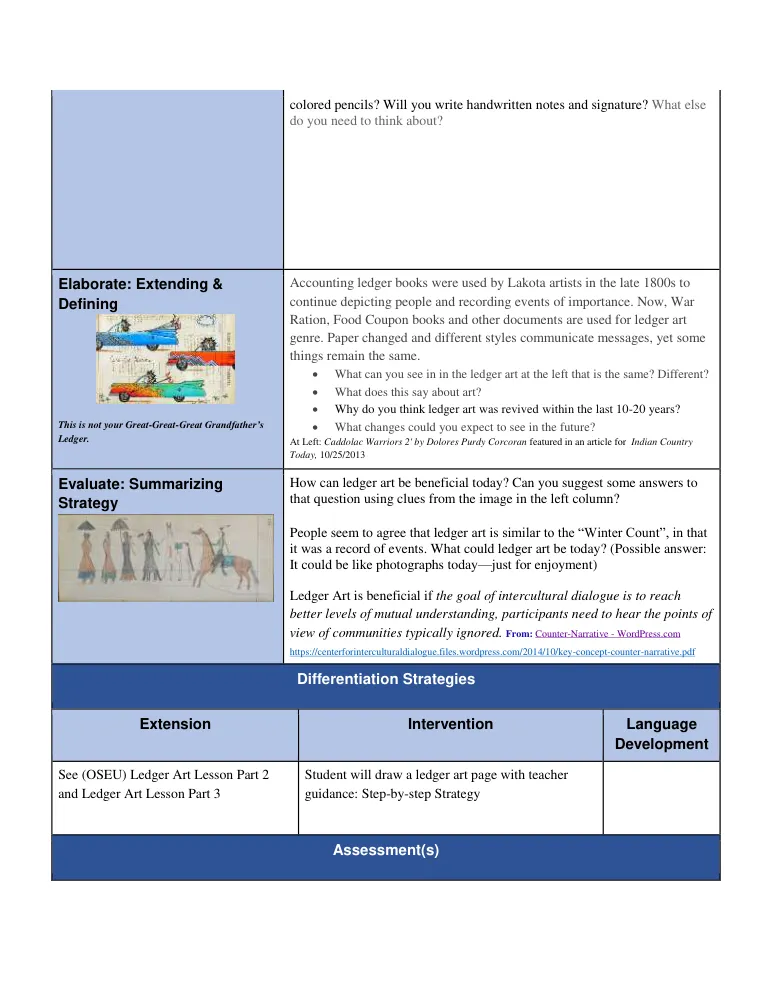
Go to https://plainsledgerart.org/history/ to enlarge Ledger Drawing by Jaw
Horse in transformation to buffalo with spirit lines connecting to hail and stars through the thunderbird
above
Explain: Learning
Experiences
…sketchbook of ledger drawings was sent in
1890 to Dwight or Daniel Pierson, brothers who
lived in LeRoy, NY, by Reverend William
Saul…It has 27 pgs., including eleven ledger
drawings. https://plainsledgerart.org/plates/view/485
Activity: Class Ledger Book, based on the Rosebud School Album
Students: View the ledger. See Sidebar for URL (under drawing) and make
some notes. Then, answer the following questions and be prepared to share
your responses with your class:
•
What would you say if you had to tell someone about the ledger
(contents, what did the ledger look like, etc.)?
•
How did you feel as you were viewing the ledger?
•
What questions did you have as you viewed the ledger?
Teacher: Divide the class into groups of three and let each group choose
two-three of the drawings from the Rosebud School Album. Make sure that
all eleven drawings have been chosen. Groups will discuss, describe, explain
and give each drawing a title. Each group will keep a record of their work
for sharing with the whole class.
Provide a brief overview of the elements of art and allow time for students to
do Pre-Drawings to experiment and get creative!
Students: As a class, discuss how you will make your class album. What size
will it be? Do you want to use the same content (e. g., dancers, etc.) that will
tell someone in 2030 about your life in 2018? What other categories would
you include instead of or in addition to those in the Rosebud School Album?
Other considerations: Will you choose to use a ledger book or what? Each of
you will need at least three Pre-Drawings prior to creating one drawing for
inclusion in the class album. Will you use watercolors, markers, pencils or
colored pencils? Will you write handwritten notes and signature? What else
do you need to think about?
Elaborate: Extending &
Defining
This is not your Great-Great-Great Grandfather’s
Ledger.
Accounting ledger books were used by Lakota artists in the late 1800s to
continue depicting people and recording events of importance. Now, War
Ration, Food Coupon books and other documents are used for ledger art
genre. Paper changed and different styles communicate messages, yet some
things remain the same.
•
What can you see in in the ledger art at the left that is the same? Different?
•
What does this say about art?
•
Why do you think ledger art was revived within the last 10-20 years?
•
What changes could you expect to see in the future?
At Left: Caddolac Warriors 2' by Dolores Purdy Corcoran featured in an article for Indian Country
Today, 10/25/2013
Evaluate: Summarizing
Strategy
How can ledger art be beneficial today? Can you suggest some answers to
that question using clues from the image in the left column?
People seem to agree that ledger art is similar to the “Winter Count”, in that
it was a record of events. What could ledger art be today? (Possible answer:
It could be like photographs today—just for enjoyment)
Ledger Art is beneficial if the goal of intercultural dialogue is to reach
better levels of mutual understanding, participants need to hear the points of
view of communities typically ignored. From: Counter-Narrative - WordPress.com
https://centerforinterculturaldialogue.files.wordpress.com/2014/10/key-concept-counter-narrative.pdf
Differentiation Strategies
Extension
Intervention
Language
Development
See (OSEU) Ledger Art Lesson Part 2
and Ledger Art Lesson Part 3
Student will draw a ledger art page with teacher
guidance: Step-by-step Strategy
Assessment(s)
Formative
Summative
The Three Minute Pause provides a chance for students to
stop and reflect on the concepts and ideas that have just
been introduced, make connections to prior knowledge or
experience, and seek clarification. Examples:
I felt…
I related to…
I became more aware of…
Performance Task
Teacher: Determine what specific set of skill and/or
abilities do you want to test? (See textbook for skills?)
Determine what students know and are capable of doing
from previous data or observations. Determine student
success using a checklist or rubric with a scoring guide.
Teacher Reflection: (Next steps?)
COMBINED ARCHIVE VERSION · pages 56–60
5 E’s Lesson Plan Template
Lesson: Ledger Art—Part 1
The (Classroom Name ) Album
“Our Life in Pictures”
Student Objective: To express themselves as they discover Lakota Ledger Art and revisit elements of art to create
visual art.
This lesson sets the foundation for Part 2— “The Old and the New—My Journal” and Part 3—“A Dream Story”,
although any of the three may be used as stand-alone lessons.
Essential Question(s):
What is significant about Ledger Art?
How is Ledger Art like a narrative? How is it unlike a narrative?
Why were ledgers chosen rather than other art medium?
How has ledger art changed over the years?
Ledger Art, what’s in it for you?
Materials/Resources
Essential
Vocabulary
Teacher:
Short version. Ledger art - Wikipedia
https://en.wikipedia.org/wiki/Ledger_art
More information/explanation Ledger Art History
video https://plainsledgerart.org/history/ This source and
the one above provide background, themes, artists and
examples of the genre
The Rosebud School Album.
https://plainsledgerart.org/plates/view/485
Provide a review of basic art elements (Example:
Lines—drawing lines can be thick or thin; hard or
soft; light or dark; expressive or constructive; implied
or actual; choppy or smooth; barely there or strong
and sharp; fast or very slow.) Many tutorials on
YouTube or go to Elements and Principles of Art
(14:20 minutes well spent)
https://www.youtube.com/watch?v=qIOfbozTIY8
Student:
Pencils, ink fountain pens, crayons, and
watercolor paints
Narrative
Counter Narrative
Ledger
Genre
Medium
Learning Experience
Standards and Practice:
OSEU: 5: Oral tradition and story
Anchor Standard 10: K-12.Cn. 10: Synthesize and relate knowledge and
personal experiences to make art.
5.VA.Cn.10.1.a
6-8.VA.Cn.10.1
Cultural Integration:
Ledger Drawing by Jaw
Man in yellow on green horse, purple
ink added
Ledger arts are counter narratives wherein artists “choose their own words to
tell their own stories” through art. Counter narratives are not legends or
myths instead they counter misinformation in history books that at times
depict, as movies do, Indians as noble (or not so noble) savages. At the other
end of the spectrum is early literature that tends to misrepresent by romantic
idealization of American Indians. By contrast, ledger book artists provide
alternative points of view that truly present culture and their own Indian
realities. From: Counter-Narrative - WordPress.com
https://centerforinterculturaldialogue.files.wordpress.com/2014/10/key-concept-counter-narrative.pdf
The story told in a ledger art piece must be one that has been witnessed. That
is, it must be “provable.” This is much like the songs that were sung after a
battle when a warrior had been heroic; through song the warrior would be
honored and the event would become known by all.
Some people believe there is not much history told from a Lakota point of
view. Not true, there is much to be learned from ledger art. However,
interpretations of the stories may not always be accurate, one can only make
educated guesses.
I Can Statement(s):
Black Hawk, Lakota Sioux (Sans Arc)
I can learn a lot about Lakota people and their culture from ledger art.
I can see an authentic picture of Lakota daily life—traditions and customs.
I can see values/beliefs in ledger art that increases knowledge of Lakota
culture.
I can see how telling stories has value now and in the future, as it was in the
past.
I can create ledger art to tell my own story.
Opposite. Showing two-page ledger art
Engage: Activating
Strategy/Hook:
Ethnographic Notes—Black Road is known to have originated an elite
warrior society of the Sacred Bow. In this drawing and Plate 64 he depicts
himself as leader, in protective red body paint with designs of lightning and
dragonflies (Wissler, 1907: 52; & Blish, 1934: 182 & 186). Here, he is
investing a horse painted in similar designs with mystical protection derived
from various butterflies, other insects or spiders, a magpie, and an abino
catfish. This specific painted design is attributed to Black Road in Blish,
1934: 186). "Ledger Art History." Department of Ethnic Studies, University
of California San Diego: Plains Indian Ledger Art Project. 2011
In this image the artist has painted himself, while at other times an artist
recounts someone else’s story.
Challenge Question: What reasons are there to believe this image, Black
Hawk’s above, and Jaw’s below, may depict heyoka concepts? (See
Heyoka—Dakota Clown, OSEU lessons)
Explore: Learning
Experiences
After observing several ledger art works by the Lakota (Sioux) artists on the
American Indian Ledger Art website, what would you say are the major
themes/subject matter? What stories do the artists tell?
What story is told in this drawing?
Why do you think the artist chose this story to tell?
How can you relate to this piece of ledger art? (Where do you find your
power?)
Go to https://plainsledgerart.org/history/ to enlarge Ledger Drawing by Jaw
Horse in transformation to buffalo with spirit lines connecting to hail and stars through the thunderbird
above
Explain: Learning
Experiences
…sketchbook of ledger drawings was sent in
1890 to Dwight or Daniel Pierson, brothers who
lived in LeRoy, NY, by Reverend William
Saul…It has 27 pgs., including eleven ledger
drawings. https://plainsledgerart.org/plates/view/485
Activity: Class Ledger Book, based on the Rosebud School Album
Students: View the ledger. See Sidebar for URL (under drawing) and make
some notes. Then, answer the following questions and be prepared to share
your responses with your class:
What would you say if you had to tell someone about the ledger
(contents, what did the ledger look like, etc.)?
How did you feel as you were viewing the ledger?
What questions did you have as you viewed the ledger?
Teacher: Divide the class into groups of three and let each group choose
two-three of the drawings from the Rosebud School Album. Make sure that
all eleven drawings have been chosen. Groups will discuss, describe, explain
and give each drawing a title. Each group will keep a record of their work
for sharing with the whole class.
Provide a brief overview of the elements of art and allow time for students to
do Pre-Drawings to experiment and get creative!
Students: As a class, discuss how you will make your class album. What size
will it be? Do you want to use the same content (e. g., dancers, etc.) that will
tell someone in 2030 about your life in 2018? What other categories would
you include instead of or in addition to those in the Rosebud School Album?
Other considerations: Will you choose to use a ledger book or what? Each of
you will need at least three Pre-Drawings prior to creating one drawing for
inclusion in the class album. Will you use watercolors, markers, pencils or
colored pencils? Will you write handwritten notes and signature? What else
do you need to think about?
Elaborate: Extending &
Defining
This is not your Great-Great-Great Grandfather’s
Ledger.
Accounting ledger books were used by Lakota artists in the late 1800s to
continue depicting people and recording events of importance. Now, War
Ration, Food Coupon books and other documents are used for ledger art
genre. Paper changed and different styles communicate messages, yet some
things remain the same.
What can you see in in the ledger art at the left that is the same? Different?
What does this say about art?
Why do you think ledger art was revived within the last 10-20 years?
What changes could you expect to see in the future?
At Left: Caddolac Warriors 2' by Dolores Purdy Corcoran featured in an article for Indian Country
Today, 10/25/2013
Evaluate: Summarizing
Strategy
How can ledger art be beneficial today? Can you suggest some answers to
that question using clues from the image in the left column?
People seem to agree that ledger art is similar to the “Winter Count”, in that
it was a record of events. What could ledger art be today? (Possible answer:
It could be like photographs today—just for enjoyment)
Ledger Art is beneficial if the goal of intercultural dialogue is to reach
better levels of mutual understanding, participants need to hear the points of
view of communities typically ignored. From: Counter-Narrative - WordPress.com
https://centerforinterculturaldialogue.files.wordpress.com/2014/10/key-concept-counter-narrative.pdf
Differentiation Strategies
Extension
Intervention
Language
Development
See (OSEU) Ledger Art Lesson Part 2
and Ledger Art Lesson Part 3
Student will draw a ledger art page with teacher
guidance: Step-by-step Strategy
Assessment(s)
Formative
Summative
The Three Minute Pause provides a chance for students to
stop and reflect on the concepts and ideas that have just
been introduced, make connections to prior knowledge or
experience, and seek clarification. Examples:
I felt…
I related to…
I became more aware of…
Performance Task
Teacher: Determine what specific set of skill and/or
abilities do you want to test? (See textbook for skills?)
Determine what students know and are capable of doing
from previous data or observations. Determine student
success using a checklist or rubric with a scoring guide.
Teacher Reflection: (Next steps?)
Source provenance: 08-Ledger-Art-Lesson-1.pdf · WoLakota Project archive. Reformatted for this collection.