The complete archived text is retained here, including details that may extend beyond the inquiry blueprint.
Read the full archived lesson text
5 E’s Lesson Plan Template
Lesson: Ledger Art Part 3
“A Dream Story”
Black Hawk, Chief Medicine Man of the Sioux, circa 1880-1881
Objective: To examine works of art that add to what we know about Lakota people and what they valued.
To learn more about ourselves through art experience.
Ledger Art Part 1—“Rosebud School Album” sets the foundation for this lesson and for Lesson: Ledger Art Part
2—“The Old and the New, My Journal”, although any of the three parts can be stand-alone lessons.
Essential Question(s):
How does art preserve aspects of life?
How does art help us understand the lives of people of different times, places, and cultures?
How does life imitate art or does art imitate life?
How is art used to impact our views of modern day society?
Materials/Resources
Essential Vocabulary
Teacher:
Native American Artists, the
Material Is the Message
https://www.smithsonianmag.
com/smithsonian-institution/these-native-
american-artists-material-message-
180958567/
“Girl with a Pearl Earring”,
Movie Trailer
https://www.youtube.com/watch?v=8awfl
TA4QYE
Student:
Letter: Black Hawk Ledger
Plates: 5, 6, and 22
https://plainsledgerart.org/plates/index/4
Participation Rubric, Attachment
Ledger Art
Performance Art
Learning Experience
Standards and Practice:
OSEU 5: Oral Traditions and Story
Anchor Standard 11.2: K-12. Cn.11.2: Relate artistic ideas and works with
societal, historical, cultural, and personal context to deepen understanding.
HSp.TH.Cn.11.2.1
Cultural Integration:
The term “ledger art” has come to
be interchangeable with “narrative
art,”
https://www.smithsonianmag.com/smithsonian-
institution/these-native-american-artists-material-
message-180958567/#hOsdrOSAH8oRXY5i.99
Nineteenth-century Plains Indian drawings have often been called
“ledger” drawings because they were made with pencil, ink, and
watercolor on pages of old ledger or account books. From Keeping History: Plains
Indian Ledger Drawings
“The stories that they are telling are either war deeds, horse-raiding scenes,
ceremonial scenes, or courting,” says Emil Her Many Horses (Oglala
Lakota)…Plains artists began using ledger paper from surplus government
accounting notebook or ledger books which became widely available during
the reservation era (1870–1920). As the U.S. government imposed
policies aimed at assimilating Native Americans into the mainstream
culture, and in many cases imprisoning the Plains Indians, the crafting of
“ledger art” became a way for the warrior-artists to hold on to their heritage
and document their experiences.” From Keeping History: Plains Indian Ledger Drawings |
NMAHuseum and “For These Native American Artists, the Material Is the Message” By Alex Palmer
SMITHSONIAN.COM
How can I hold on to my heritage and document my experiences?
How can ledger art relate to me and my cultural background?
I Can Statement(s):
•
I can understand how art tells a story.
•
I can express my ideas, thoughts, feelings, and experiences through
performance arts.
Engage: Activating
Strategy/Hook:
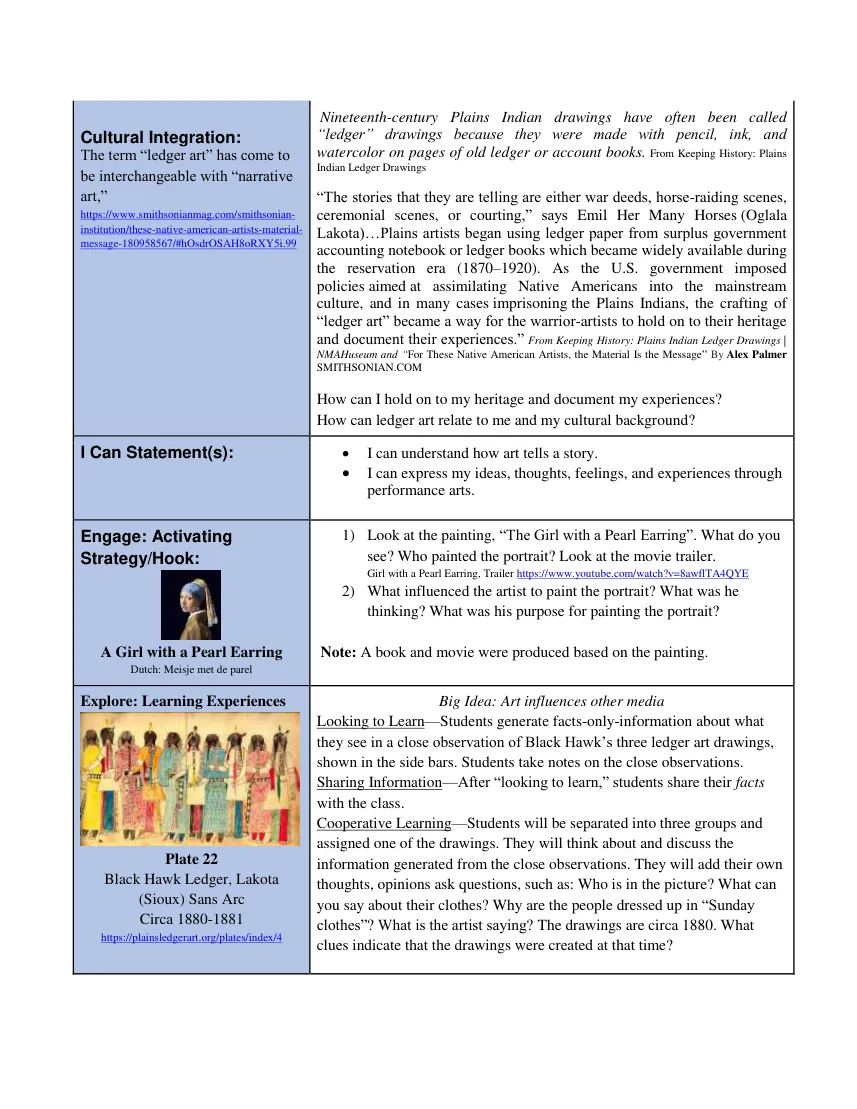
A Girl with a Pearl Earring
Dutch: Meisje met de parel
1) Look at the painting, “The Girl with a Pearl Earring”. What do you
see? Who painted the portrait? Look at the movie trailer.
Girl with a Pearl Earring, Trailer https://www.youtube.com/watch?v=8awflTA4QYE
2) What influenced the artist to paint the portrait? What was he
thinking? What was his purpose for painting the portrait?
Note: A book and movie were produced based on the painting.
Explore: Learning Experiences
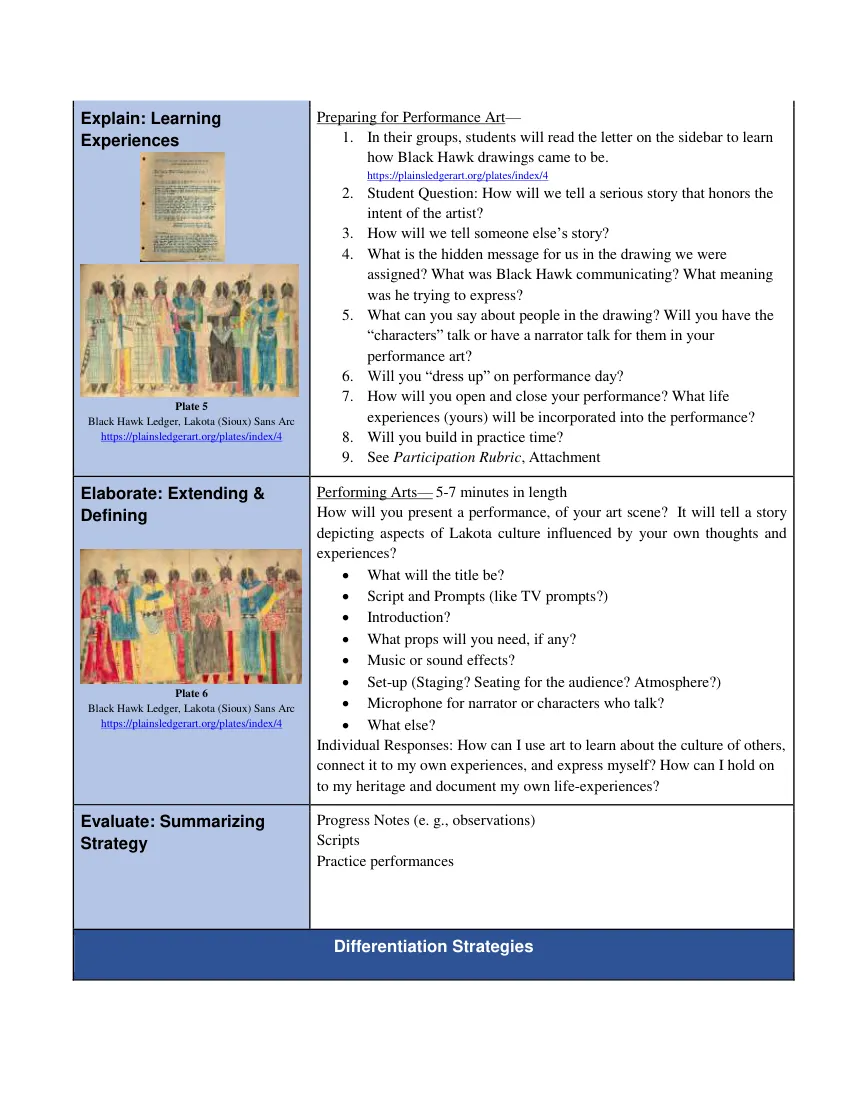
Plate 22
Black Hawk Ledger, Lakota
(Sioux) Sans Arc
Circa 1880-1881
https://plainsledgerart.org/plates/index/4
Big Idea: Art influences other media
Looking to Learn—Students generate facts-only-information about what
they see in a close observation of Black Hawk’s three ledger art drawings,
shown in the side bars. Students take notes on the close observations.
Sharing Information—After “looking to learn,” students share their facts
with the class.
Cooperative Learning—Students will be separated into three groups and
assigned one of the drawings. They will think about and discuss the
information generated from the close observations. They will add their own
thoughts, opinions ask questions, such as: Who is in the picture? What can
you say about their clothes? Why are the people dressed up in “Sunday
clothes”? What is the artist saying? The drawings are circa 1880. What
clues indicate that the drawings were created at that time?
Explain: Learning
Experiences
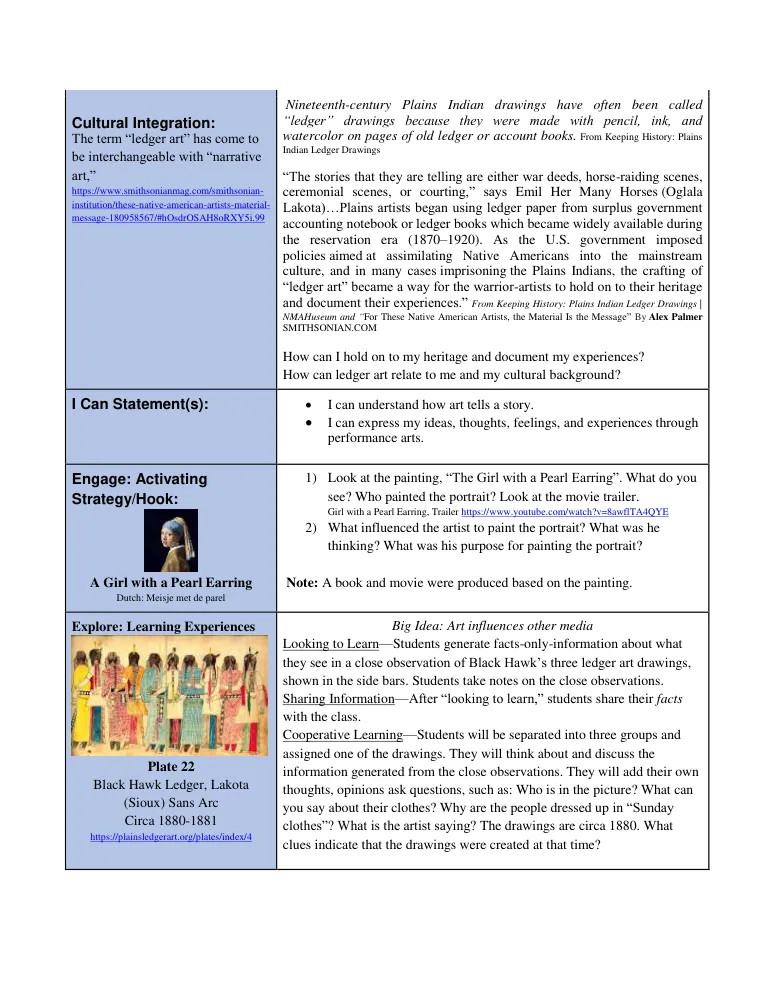
Plate 5
Black Hawk Ledger, Lakota (Sioux) Sans Arc
https://plainsledgerart.org/plates/index/4
Preparing for Performance Art—
1. In their groups, students will read the letter on the sidebar to learn
how Black Hawk drawings came to be.
https://plainsledgerart.org/plates/index/4
2. Student Question: How will we tell a serious story that honors the
intent of the artist?
3. How will we tell someone else’s story?
4. What is the hidden message for us in the drawing we were
assigned? What was Black Hawk communicating? What meaning
was he trying to express?
5. What can you say about people in the drawing? Will you have the
“characters” talk or have a narrator talk for them in your
performance art?
6. Will you “dress up” on performance day?
7. How will you open and close your performance? What life
experiences (yours) will be incorporated into the performance?
8. Will you build in practice time?
9. See Participation Rubric, Attachment
Elaborate: Extending &
Defining
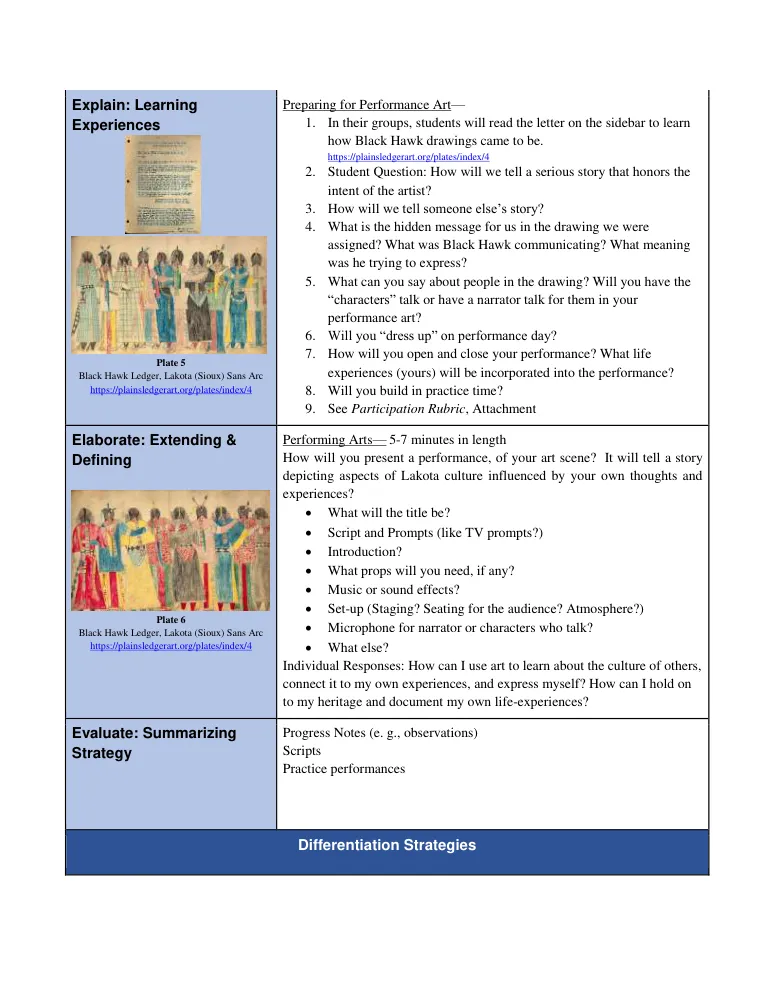
Plate 6
Black Hawk Ledger, Lakota (Sioux) Sans Arc
https://plainsledgerart.org/plates/index/4
Performing Arts— 5-7 minutes in length
How will you present a performance, of your art scene? It will tell a story
depicting aspects of Lakota culture influenced by your own thoughts and
experiences?
•
What will the title be?
•
Script and Prompts (like TV prompts?)
•
Introduction?
•
What props will you need, if any?
•
Music or sound effects?
•
Set-up (Staging? Seating for the audience? Atmosphere?)
•
Microphone for narrator or characters who talk?
•
What else?
Individual Responses: How can I use art to learn about the culture of others,
connect it to my own experiences, and express myself? How can I hold on
to my heritage and document my own life-experiences?
Evaluate: Summarizing
Strategy
Progress Notes (e. g., observations)
Scripts
Practice performances
Differentiation Strategies
Extension
Intervention
Language Development
Ledger Art Lesson 1
Ledger At Lesson 2
Research to learn more about Black
Hawk and his ledger art.
Ask additional probing
questions: What are the people
in the drawing looking at?
Ask: What would you like to
know about the drawings,
Lakota life, etc.?
Assessment(s)
Formative
Summative
Conga Line—to share ideas with different partners; two
lines of students face each other, one line moves with same
question or a new one. Any questions in the Elaborate:
Extending & Defining or Explain: Learning Experiences
sections of this lesson may be used for sharing ideas.
Observation Grid— Use a grid that contains all the names
of the students in your class. As you observe different
students, jot down information in their box on the grid. The
grid allows you to see, at a glance, the names of the students
who need assistance and you can see which students have not
been observed. These students can then become the focus of
your attention during the next class. You can also determine
whether the class has a pattern of behaviors you observed so
you can address them.
See Rubric Attachment
Teacher Reflection: (Next steps?)
Attachment
Class Participation/Preparation Rubric:
Consistent participation, preparation and a positive attitude are a vital part of learning. (Teacher: Adjust rubric as necessary.)
Category
Excellent A+/A
(20-19)
Good B+/B
(18.5-17.5)
Satisfactory C+
(17-16)
Needs Improvement
C (15 and below)
Contributions
Routinely provides useful
ideas when participating. A
definite leader who
contributes a lot of effort
and who makes class and
group discussions better.
Usually provides
useful ideas when
participating in
discussions. A strong
student who tries hard.
Sometimes provides
useful ideas when
participating in
discussions. A
satisfactory effort, does
what is required.
Needs to increase
participation by adding
more ideas to the
discussions and by
participating
consistently.
Attitude
Student is always respectful
of self, others, and teacher.
Has a positive attitude and
does not criticize anyone
else’s ideas or work.
Students feel safe
participating in his/her
presence.
Rarely is critical of
ideas or work of
others. Often has a
positive attitude about
the task(s). Usually
treats others and self
with respect.
Often or occasionally
has a positive attitude
about the task(s) and
behaves in a respectful
manner.
Can be critical of the
work or ideas of others.
Can improve working
in a more respectful
manner.
Preparedness &
Focus
Follows all project
instructions and
procedures, brings needed
materials and is ready to
work. Consistently stays
focused on what needs to
be done. Self-directed and
highly motivated.
Almost always brings
needed material to
class, almost always
follows project
instructions and
procedures, and is
ready to work. Focuses
on what needs to be
done most of the time.
Often brings materials
but sometimes needs to
borrow. Usually
follows procedures and
ready to work. Focuses
on the task and what
needs to be done some
of the time. Often must
be reminded by the
teacher about what
needs to get done.
Needs to ask for
classroom materials
when he/she has none.
To improve,
concentrate and focus
more on working, tasks
and procedures.
Quality of Work
Provides work of the
highest quality that reflects
the student’s best efforts.
Provides quality work
that reflects effort from
the student.
Provides work that
meets the requirements,
but more effort or time
could have been given.
Needed to provide
complete work that
demonstrates effort.
Behavior
Student engaged in class on
a daily basis. Student
shows no disruptive
behavior.
Student is engaged in
class nearly every day,
minimal distractions.
Student is working
most of the time but
has been distracting at
times.
Student can be
disengaged which adds
to class disruption.
COMBINED ARCHIVE VERSION · pages 67–71
5 E’s Lesson Plan Template
Lesson: Ledger Art Part 3
“A Dream Story”
Black Hawk, Chief Medicine Man of the Sioux, circa 1880-1881
Objective: To examine works of art that add to what we know about Lakota people and what they valued.
To learn more about ourselves through art experience.
Ledger Art Part 1—“Rosebud School Album” sets the foundation for this lesson and for Lesson: Ledger Art Part
2—“The Old and the New, My Journal”, although any of the three parts can be stand-alone lessons.
Essential Question(s):
How does art preserve aspects of life?
How does art help us understand the lives of people of different times, places, and cultures?
How does life imitate art or does art imitate life?
How is art used to impact our views of modern day society?
Materials/Resources
Essential Vocabulary
Teacher:
Native American Artists, the
Material Is the Message
https://www.smithsonianmag.
com/smithsonian-institution/these-native-
american-artists-material-message-
180958567/
“Girl with a Pearl Earring”,
Movie Trailer
https://www.youtube.com/watch?v=8awfl
TA4QYE
Student:
Letter: Black Hawk Ledger
Plates: 5, 6, and 22
https://plainsledgerart.org/plates/index/4
Participation Rubric, Attachment
Ledger Art
Performance Art
Learning Experience
Standards and Practice:
OSEU 5: Oral Traditions and Story
Anchor Standard 11.2: K-12. Cn.11.2: Relate artistic ideas and works with
societal, historical, cultural, and personal context to deepen understanding.
HSp.TH.Cn.11.2.1
Cultural Integration:
The term “ledger art” has come to
be interchangeable with “narrative
art,”
https://www.smithsonianmag.com/smithsonian-
institution/these-native-american-artists-material-
message-180958567/#hOsdrOSAH8oRXY5i.99
Nineteenth-century Plains Indian drawings have often been called
“ledger” drawings because they were made with pencil, ink, and
watercolor on pages of old ledger or account books. From Keeping History: Plains
Indian Ledger Drawings
“The stories that they are telling are either war deeds, horse-raiding scenes,
ceremonial scenes, or courting,” says Emil Her Many Horses (Oglala
Lakota)…Plains artists began using ledger paper from surplus government
accounting notebook or ledger books which became widely available during
the reservation era (1870–1920). As the U.S. government imposed
policies aimed at assimilating Native Americans into the mainstream
culture, and in many cases imprisoning the Plains Indians, the crafting of
“ledger art” became a way for the warrior-artists to hold on to their heritage
and document their experiences.” From Keeping History: Plains Indian Ledger Drawings |
NMAHuseum and “For These Native American Artists, the Material Is the Message” By Alex Palmer
SMITHSONIAN.COM
How can I hold on to my heritage and document my experiences?
How can ledger art relate to me and my cultural background?
I Can Statement(s):
I can understand how art tells a story.
I can express my ideas, thoughts, feelings, and experiences through
performance arts.
Engage: Activating
Strategy/Hook:
A Girl with a Pearl Earring
Dutch: Meisje met de parel
1) Look at the painting, “The Girl with a Pearl Earring”. What do you
see? Who painted the portrait? Look at the movie trailer.
Girl with a Pearl Earring, Trailer https://www.youtube.com/watch?v=8awflTA4QYE
2) What influenced the artist to paint the portrait? What was he
thinking? What was his purpose for painting the portrait?
Note: A book and movie were produced based on the painting.
Explore: Learning Experiences
Plate 22
Black Hawk Ledger, Lakota
(Sioux) Sans Arc
Circa 1880-1881
https://plainsledgerart.org/plates/index/4
Big Idea: Art influences other media
Looking to Learn—Students generate facts-only-information about what
they see in a close observation of Black Hawk’s three ledger art drawings,
shown in the side bars. Students take notes on the close observations.
Sharing Information—After “looking to learn,” students share their facts
with the class.
Cooperative Learning—Students will be separated into three groups and
assigned one of the drawings. They will think about and discuss the
information generated from the close observations. They will add their own
thoughts, opinions ask questions, such as: Who is in the picture? What can
you say about their clothes? Why are the people dressed up in “Sunday
clothes”? What is the artist saying? The drawings are circa 1880. What
clues indicate that the drawings were created at that time?
Explain: Learning
Experiences
Plate 5
Black Hawk Ledger, Lakota (Sioux) Sans Arc
https://plainsledgerart.org/plates/index/4
Preparing for Performance Art—
1. In their groups, students will read the letter on the sidebar to learn
how Black Hawk drawings came to be.
https://plainsledgerart.org/plates/index/4
2. Student Question: How will we tell a serious story that honors the
intent of the artist?
3. How will we tell someone else’s story?
4. What is the hidden message for us in the drawing we were
assigned? What was Black Hawk communicating? What meaning
was he trying to express?
5. What can you say about people in the drawing? Will you have the
“characters” talk or have a narrator talk for them in your
performance art?
6. Will you “dress up” on performance day?
7. How will you open and close your performance? What life
experiences (yours) will be incorporated into the performance?
8. Will you build in practice time?
9. See Participation Rubric, Attachment
Elaborate: Extending &
Defining
Plate 6
Black Hawk Ledger, Lakota (Sioux) Sans Arc
https://plainsledgerart.org/plates/index/4
Performing Arts— 5-7 minutes in length
How will you present a performance, of your art scene? It will tell a story
depicting aspects of Lakota culture influenced by your own thoughts and
experiences?
What will the title be?
Script and Prompts (like TV prompts?)
Introduction?
What props will you need, if any?
Music or sound effects?
Set-up (Staging? Seating for the audience? Atmosphere?)
Microphone for narrator or characters who talk?
What else?
Individual Responses: How can I use art to learn about the culture of others,
connect it to my own experiences, and express myself? How can I hold on
to my heritage and document my own life-experiences?
Evaluate: Summarizing
Strategy
Progress Notes (e. g., observations)
Scripts
Practice performances
Differentiation Strategies
Extension
Intervention
Language Development
Ledger Art Lesson 1
Ledger At Lesson 2
Research to learn more about Black
Hawk and his ledger art.
Ask additional probing
questions: What are the people
in the drawing looking at?
Ask: What would you like to
know about the drawings,
Lakota life, etc.?
Assessment(s)
Formative
Summative
Conga Line—to share ideas with different partners; two
lines of students face each other, one line moves with same
question or a new one. Any questions in the Elaborate:
Extending & Defining or Explain: Learning Experiences
sections of this lesson may be used for sharing ideas.
Observation Grid— Use a grid that contains all the names
of the students in your class. As you observe different
students, jot down information in their box on the grid. The
grid allows you to see, at a glance, the names of the students
who need assistance and you can see which students have not
been observed. These students can then become the focus of
your attention during the next class. You can also determine
whether the class has a pattern of behaviors you observed so
you can address them.
See Rubric Attachment
Teacher Reflection: (Next steps?)
Attachment
Class Participation/Preparation Rubric:
Consistent participation, preparation and a positive attitude are a vital part of learning. (Teacher: Adjust rubric as necessary.)
Category
Excellent A+/A
(20-19)
Good B+/B
(18.5-17.5)
Satisfactory C+
(17-16)
Needs Improvement
C (15 and below)
Contributions
Routinely provides useful
ideas when participating. A
definite leader who
contributes a lot of effort
and who makes class and
group discussions better.
Usually provides
useful ideas when
participating in
discussions. A strong
student who tries hard.
Sometimes provides
useful ideas when
participating in
discussions. A
satisfactory effort, does
what is required.
Needs to increase
participation by adding
more ideas to the
discussions and by
participating
consistently.
Attitude
Student is always respectful
of self, others, and teacher.
Has a positive attitude and
does not criticize anyone
else’s ideas or work.
Students feel safe
participating in his/her
presence.
Rarely is critical of
ideas or work of
others. Often has a
positive attitude about
the task(s). Usually
treats others and self
with respect.
Often or occasionally
has a positive attitude
about the task(s) and
behaves in a respectful
manner.
Can be critical of the
work or ideas of others.
Can improve working
in a more respectful
manner.
Preparedness &
Focus
Follows all project
instructions and
procedures, brings needed
materials and is ready to
work. Consistently stays
focused on what needs to
be done. Self-directed and
highly motivated.
Almost always brings
needed material to
class, almost always
follows project
instructions and
procedures, and is
ready to work. Focuses
on what needs to be
done most of the time.
Often brings materials
but sometimes needs to
borrow. Usually
follows procedures and
ready to work. Focuses
on the task and what
needs to be done some
of the time. Often must
be reminded by the
teacher about what
needs to get done.
Needs to ask for
classroom materials
when he/she has none.
To improve,
concentrate and focus
more on working, tasks
and procedures.
Quality of Work
Provides work of the
highest quality that reflects
the student’s best efforts.
Provides quality work
that reflects effort from
the student.
Provides work that
meets the requirements,
but more effort or time
could have been given.
Needed to provide
complete work that
demonstrates effort.
Behavior
Student engaged in class on
a daily basis. Student
shows no disruptive
behavior.
Student is engaged in
class nearly every day,
minimal distractions.
Student is working
most of the time but
has been distracting at
times.
Student can be
disengaged which adds
to class disruption.
Source provenance: 10-Ledger-Art-Lesson-3.pdf · WoLakota Project archive. Reformatted for this collection.