Archived standards are preserved as originally published and may differ from current standards.
IDM adaptation of an archived lesson originally written in another format. Questions and activity summaries have been adapted for IDM; the complete original wording and materials are retained below. Fields absent from the source are identified.
Compelling question
How can we care for resources and energy in our community?
Introduce Ancient Pockets of Sunlight and the Elder sources.
Supporting inquiries
Supporting question 1
How can we care for resources and energy in our community?
Formative performance task
Explore energy, ecosystems, and stewardship. Complete A World of Solutions in groups, identifying immediate community actions and longer-term solutions.
Featured sources
Use the complete source text, illustrations, worksheets, and matched Elder sources reproduced below. Named readings and external media are identified in the original text.
Summative performance task · Argument
Use the original lesson’s assessment criteria and culminating activity reproduced in the source text. A separate IDM argument prompt was not stated.
Extension
See the complete archived lesson for its original extensions, where provided.
Taking informed action
A separate informed-action task was not stated in the archived lesson.
Elder sources included in this lesson
No specific Elder video could be matched to the archived lesson’s source references.
Also named in the source: Gladys Hawk. A specific video was not identified for these references.
Original text & supporting materials
The complete archived text is retained here, including details that may extend beyond the inquiry blueprint.
Read the full archived lesson text
9-12 Physical Science Lesson Plan
“Ancient Pockets of Sunlight”
SD High School Science Standards
9-12.L.3.1. Students are able to identify factors that can cause changes in stability of
populations, communities, and ecosystems.
9-12.E.1.3. Students are able to assess how human activity has changed the land, ocean, and
atmosphere of Earth.
Examples: forest cover, chemical usage, farming, urban sprawl, grazing
9-12.S.2.1. Students are able to describe immediate and long-term consequences of potential
solutions for technological issues.
9-12.S.2.3. Students are able to analyze and describe the benefits, limitations, cost, and
consequences involved in using, conserving, or recycling resources.
Common Core
Speaking and Listening:
SL.9.1 Initiate and participate effectively in a range of collaborative discussions (one-on-one, in
groups, and teacher-led) with diverse partners on grades 9–10 topics, texts, and issues, building
on others’ ideas and expressing their own clearly and persuasively.
OSEU
ESSENTIAL UNDERSTANDING 1: The original land base and natural resources of the Oceti
Sakowin were under communal stewardship prior to immigrant settlement. The Oceti Sakowin
tribes have a distinct and unique interrelationship with the environment that contributes to
South Dakota.
Lesson:
•
Create 2 circles of students: one small circle in the center (4 to 5 students) and one large circle
around them with the rest of the students (ideally 18- 25 students). Have 2 bags of small candy
prepared, both with about 20 pieces. Give the first bag to one person in the center circle without
telling them what’s inside, giving this instruction: “Take what you need and then pass the bag on to
the next person.” Observe the activity of the smaller circle. Now give the second bag to the first
person in the large circle saying: “Don’t worry! We didn’t forget about you guys… take what you
need and then pass the bag on to the next person.” Observe the activity of the large circle. Return
everyone to the large circle to begin the discussion.
o Questions for discussion
What happens when there is a limited amount of candy?
Who gets the most?
What happens when someone decide they need more?
What happens when you have the same amount of candy, but MORE people in the
circle?
What is necessary for everyone to get something?
How do we define “what I need”?
•
View clip from The 11th Hour (clip: http://youtu.be/sguPheFzFBo full video: http://vimeo.com/107108296)
o Questions for discussion
How did the Industrial Age change our view of the environment?
What might be the danger in aiming for “limitless growth”?
From what we can gather from our history, how many people could a year’s worth
of sunlight naturally sustain on this planet?
Why does he call deposits of coal and oil “ancient pockets of sunlight”?
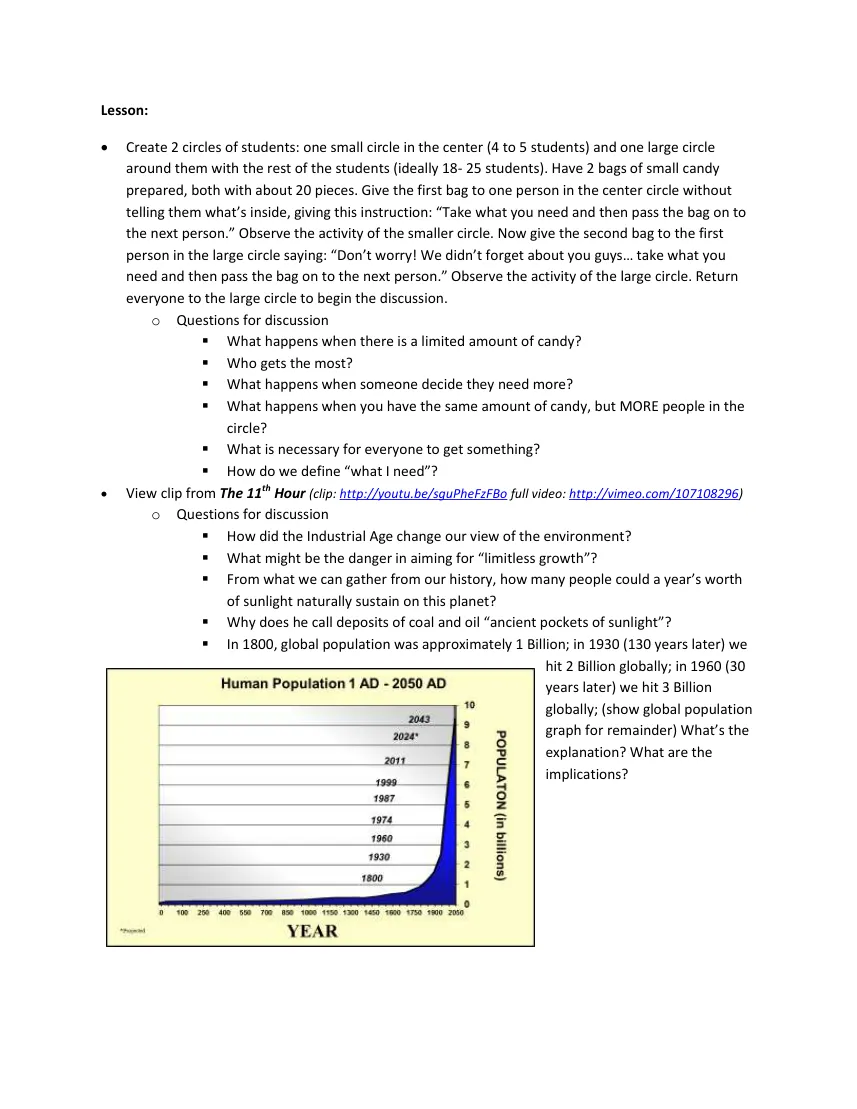
In 1800, global population was approximately 1 Billion; in 1930 (130 years later) we
hit 2 Billion globally; in 1960 (30
years later) we hit 3 Billion
globally; (show global population
graph for remainder) What’s the
explanation? What are the
implications?
•
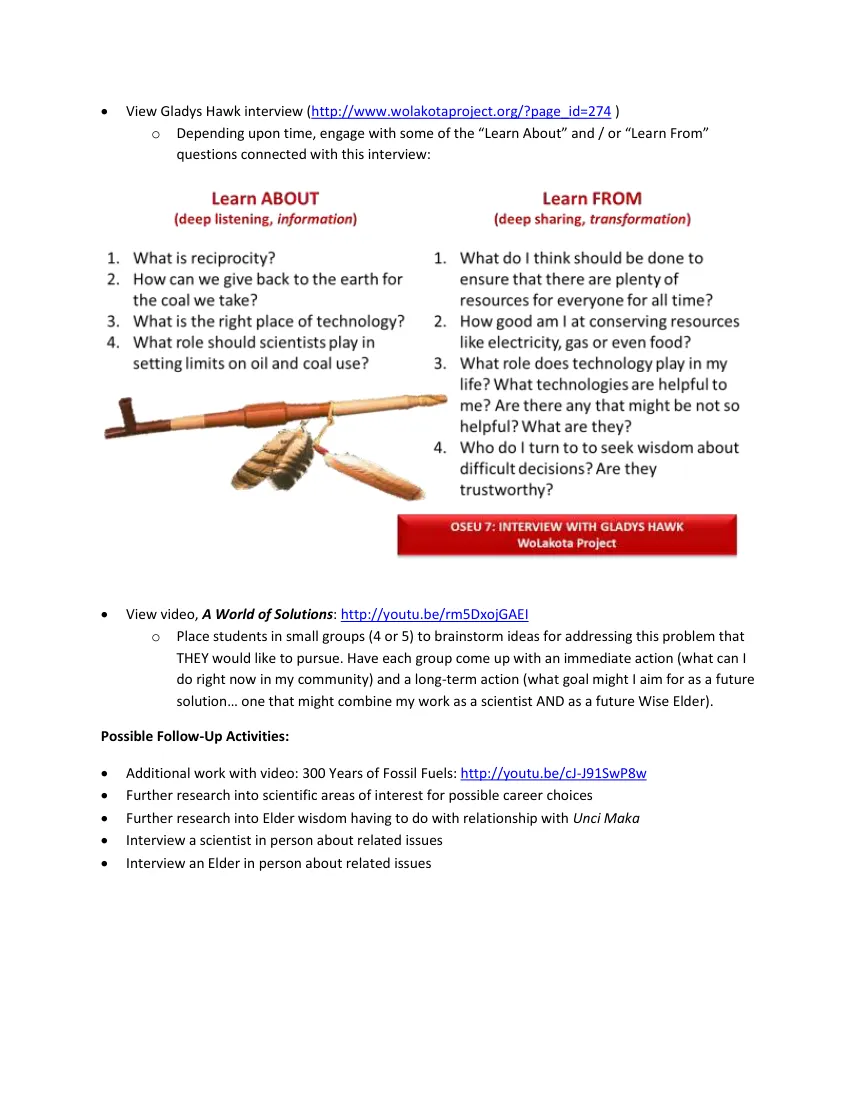
View Gladys Hawk interview (http://www.wolakotaproject.org/?page_id=274 )
o Depending upon time, engage with some of the “Learn About” and / or “Learn From”
questions connected with this interview:
•
View video, A World of Solutions: http://youtu.be/rm5DxojGAEI
o Place students in small groups (4 or 5) to brainstorm ideas for addressing this problem that
THEY would like to pursue. Have each group come up with an immediate action (what can I
do right now in my community) and a long-term action (what goal might I aim for as a future
solution… one that might combine my work as a scientist AND as a future Wise Elder).
Possible Follow-Up Activities:
•
Additional work with video: 300 Years of Fossil Fuels: http://youtu.be/cJ-J91SwP8w
•
Further research into scientific areas of interest for possible career choices
•
Further research into Elder wisdom having to do with relationship with Unci Maka
•
Interview a scientist in person about related issues
•
Interview an Elder in person about related issues
A World of Solutions
Students in my group:
What I (we) can do right now in our community to help solve the problem of environmental
destruction and over consumption:
Long-term goals that I (we) have for solving this problem through science, education, Elder
wisdom or some other related means:
Original page 1 · illustrations and source materialsOriginal page 2 · illustrations and source materialsOriginal page 3 · illustrations and source materialsOriginal page 4 · illustrations and source materials