Archived standards are preserved as originally published and may differ from current standards.
IDM adaptation of an archived lesson originally written in another format. Questions and activity summaries have been adapted for IDM; the complete original wording and materials are retained below. Fields absent from the source are identified.
Compelling question
How can different sources help us understand boarding school experiences?
Standards & practices
7.RL.2
RI.7.7
SL.7.1
OSEU 2.1
Staging the question
Examine the archived photographs, text, and Elder accounts.
Supporting inquiries
Supporting question 1
How can different sources help us understand boarding school experiences?
Formative performance task
Identify themes and compare the different media. Record reflections and personal connections on the source chart.
Featured sources
Use the complete source text, illustrations, worksheets, and matched Elder sources reproduced below. Named readings and external media are identified in the original text.
Summative performance task · Argument
Use the original lesson’s assessment criteria and culminating activity reproduced in the source text. A separate IDM argument prompt was not stated.
Extension
See the complete archived lesson for its original extensions, where provided.
Taking informed action
A separate informed-action task was not stated in the archived lesson.
Elder sources included in this lesson
No specific Elder video could be matched to the archived lesson’s source references.
Original text & supporting materials
The complete archived text is retained here, including details that may extend beyond the inquiry blueprint.
Read the full archived lesson text
McLaughlin Modeling for 7th Grade Reading
“Reflections on Boarding Schools”
Common Core State Standards:
7.RL.2 Determine a theme or central idea of a text and analyze its
development over the course of the text; provide an objective summary
of the text.
RI.7.7 - Compare and contrast a text to an audio, video, or multimedia
version of the text, analyzing each medium’s
portrayal of the subject (e.g., how the delivery of a speech
affects the impact of the words).
SL.7.1 - Engage effectively in a range of collaborative discussions (one-on-one, in groups, and teacher-led) with diverse
partners on grade 7 topics, texts, and issues, building on others’ ideas and expressing their own clearly.
OSEU:
ESSENTIAL UNDERSTANDING 2: There is variety and resiliency among individual Tribal people as identity is developed,
defined and redefined by entities, organization and people. A continuum of tribal identity, unique to each individual,
ranges from assimilated to traditional lifestyle. There is no “generic American Indian”.
OSEU2.1.9-12: Students are able to personalize topics on assimilation; examples are boarding schools, relocation,
religion, etc.
Opening:
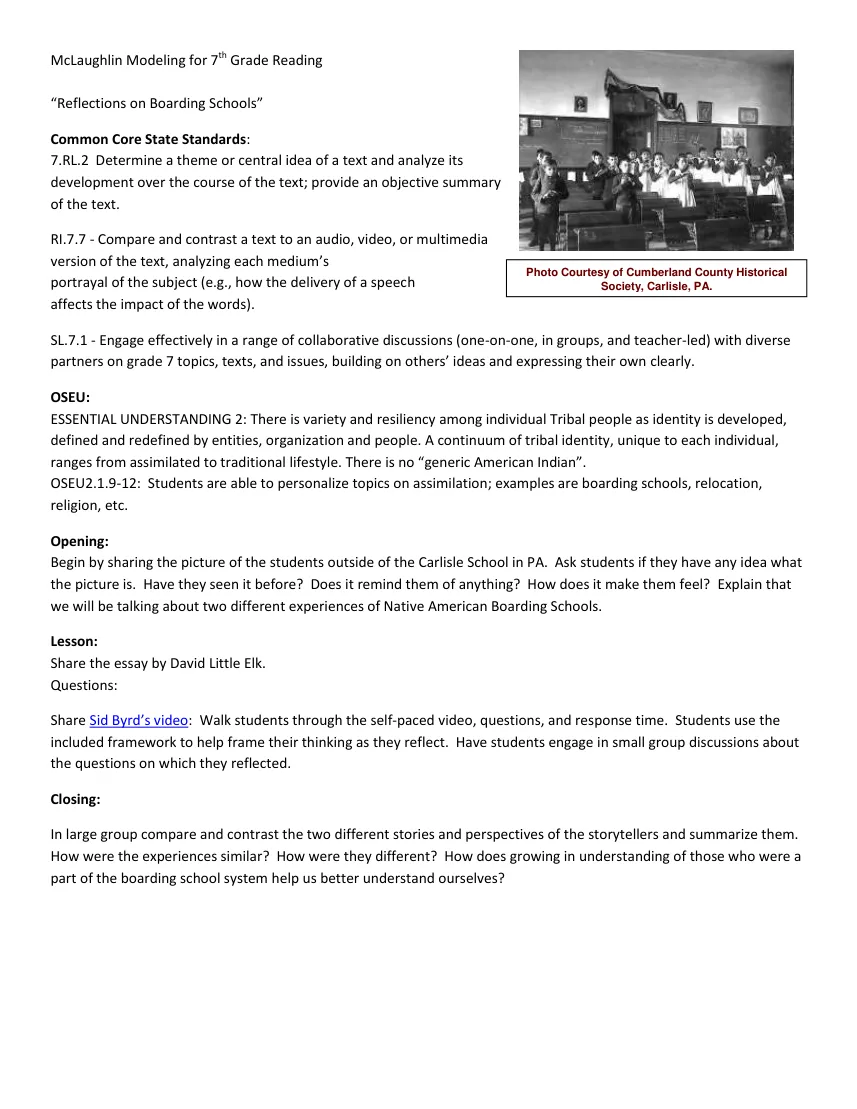
Begin by sharing the picture of the students outside of the Carlisle School in PA. Ask students if they have any idea what
the picture is. Have they seen it before? Does it remind them of anything? How does it make them feel? Explain that
we will be talking about two different experiences of Native American Boarding Schools.
Lesson:
Share the essay by David Little Elk.
Questions:
Share Sid Byrd’s video: Walk students through the self-paced video, questions, and response time. Students use the
included framework to help frame their thinking as they reflect. Have students engage in small group discussions about
the questions on which they reflected.
Closing:
In large group compare and contrast the two different stories and perspectives of the storytellers and summarize them.
How were the experiences similar? How were they different? How does growing in understanding of those who were a
part of the boarding school system help us better understand ourselves?
Photo Courtesy of Cumberland County Historical
Society, Carlisle, PA.
LOOKING THROUGH LAKOTA EYES
Excerpts from an Essay by David Little Elk
To speak the Lakota Language, one needs to be aware of the Lakota perspective so that the correct
words will be used. This is achieved by either growing up among Lakota People whose first language
is Lakota and who live in their homelands. Or it can be introduced by a Lakota who has lived that
perspective all of his life. Because of the experience of Natives with western civilization, meanings of
some words were altered by those from the dominant society to attempt to change and control the
Natives. They did this hoping it would tame us.
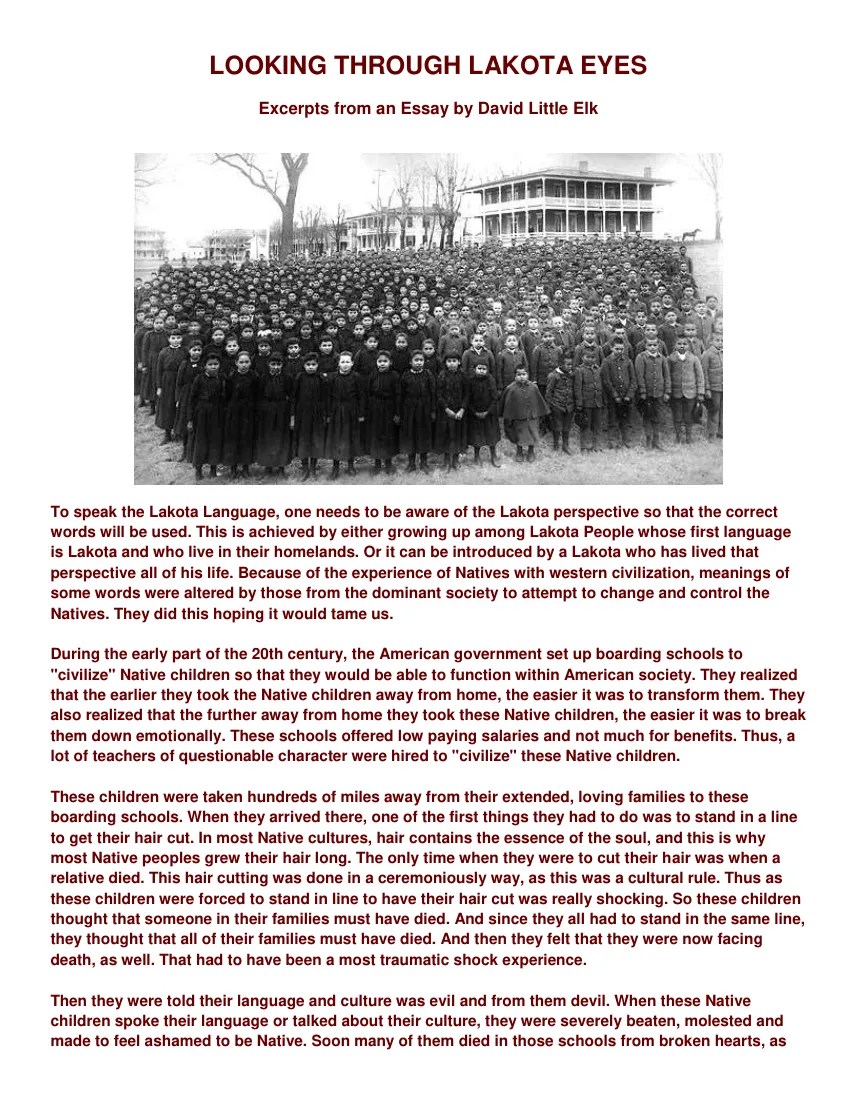
During the early part of the 20th century, the American government set up boarding schools to
"civilize" Native children so that they would be able to function within American society. They realized
that the earlier they took the Native children away from home, the easier it was to transform them. They
also realized that the further away from home they took these Native children, the easier it was to break
them down emotionally. These schools offered low paying salaries and not much for benefits. Thus, a
lot of teachers of questionable character were hired to "civilize" these Native children.
These children were taken hundreds of miles away from their extended, loving families to these
boarding schools. When they arrived there, one of the first things they had to do was to stand in a line
to get their hair cut. In most Native cultures, hair contains the essence of the soul, and this is why
most Native peoples grew their hair long. The only time when they were to cut their hair was when a
relative died. This hair cutting was done in a ceremoniously way, as this was a cultural rule. Thus as
these children were forced to stand in line to have their hair cut was really shocking. So these children
thought that someone in their families must have died. And since they all had to stand in the same line,
they thought that all of their families must have died. And then they felt that they were now facing
death, as well. That had to have been a most traumatic shock experience.
Then they were told their language and culture was evil and from them devil. When these Native
children spoke their language or talked about their culture, they were severely beaten, molested and
made to feel ashamed to be Native. Soon many of them died in those schools from broken hearts, as
well as the physical, spiritual and emotional abuse. And some adopted the abusive ways of the
teachers, priests and other authority figures in these schools, as the older students began to abuse
those they considered weaker than themselves. Thus, these children grew up away from their
extended families that normally would have helped them to learn to process their emotions and
thoughts, as they grew to become adults. And instead they grew up facing constant abuse and with no
emotionally healthy adult role models to emulate.
Reflections on Boarding Schools
Ideas shared in video or text
My personal connection
Original page 1 · illustrations and source materialsOriginal page 2 · illustrations and source materials